5 Signs Your Anxiety Needs More Than Self-Help Books

You've read the books. You've tried the breathing exercises, the journaling prompts, the affirmations. You've downloaded meditation apps, practiced gratitude, and attempted to "reframe your thoughts."
And you're still anxious.
Maybe the techniques help for a moment, then the anxiety comes roaring back. Maybe you understand what you should do, but you can't actually do it. Maybe you've been trying for months, or years, and you're no better than when you started.
Here's what you need to hear: This doesn't mean you're doing it wrong. It means you need more support than a book can provide.
Self-help books are valuable. They're a great starting point. They can teach you concepts, offer strategies, and help you understand what you're experiencing. But they have limits, and for some people, those limits mean anxiety doesn't improve no matter how many books they read.
If you've been trying to manage your anxiety on your own and it's not working, you're not failing. You're dealing with something that needs professional support.
Let's talk about the signs that your anxiety needs more than self-help and why asking for help is the strongest thing you can do.
Why Self-Help Works for Some People (But Not Everyone)
Before we talk about when self-help isn't enough, let's acknowledge: self-help can be incredibly valuable.
For some people, learning anxiety management techniques through books, apps, or online resources is enough. They implement the strategies, see improvement, and build sustainable coping skills.
Self-help works best when:
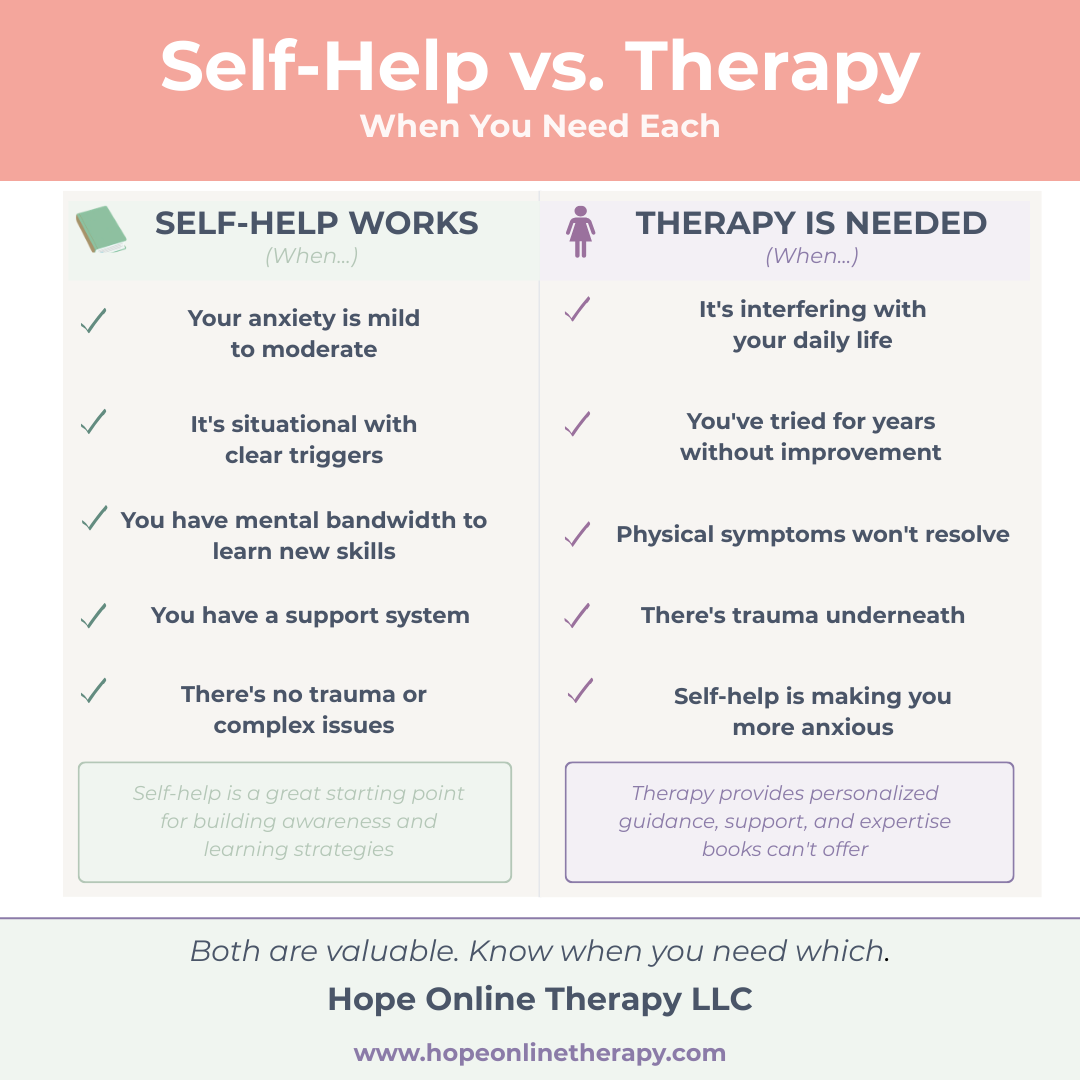
Your anxiety is mild to moderate
It's situational (specific triggers, not constant)
You have the mental bandwidth to learn and practice new skills
You have a support system
There's no underlying trauma or complex mental health issues
You're already in a relatively stable place
But self-help has limits:
Books can't provide personalized guidance for your specific situation
You can't ask a book questions or get feedback
Books assume you have the capacity to implement strategies (which anxiety often undermines)
Books can't address complex trauma, severe symptoms, or co-occurring conditions
Self-help puts all the responsibility on you, which can be overwhelming when you're already struggling
If your anxiety isn't improving with self-help, it doesn't mean the information is wrong. It means you need someone trained to help you apply it to your specific situation.
5 Signs Your Anxiety Needs Professional Support
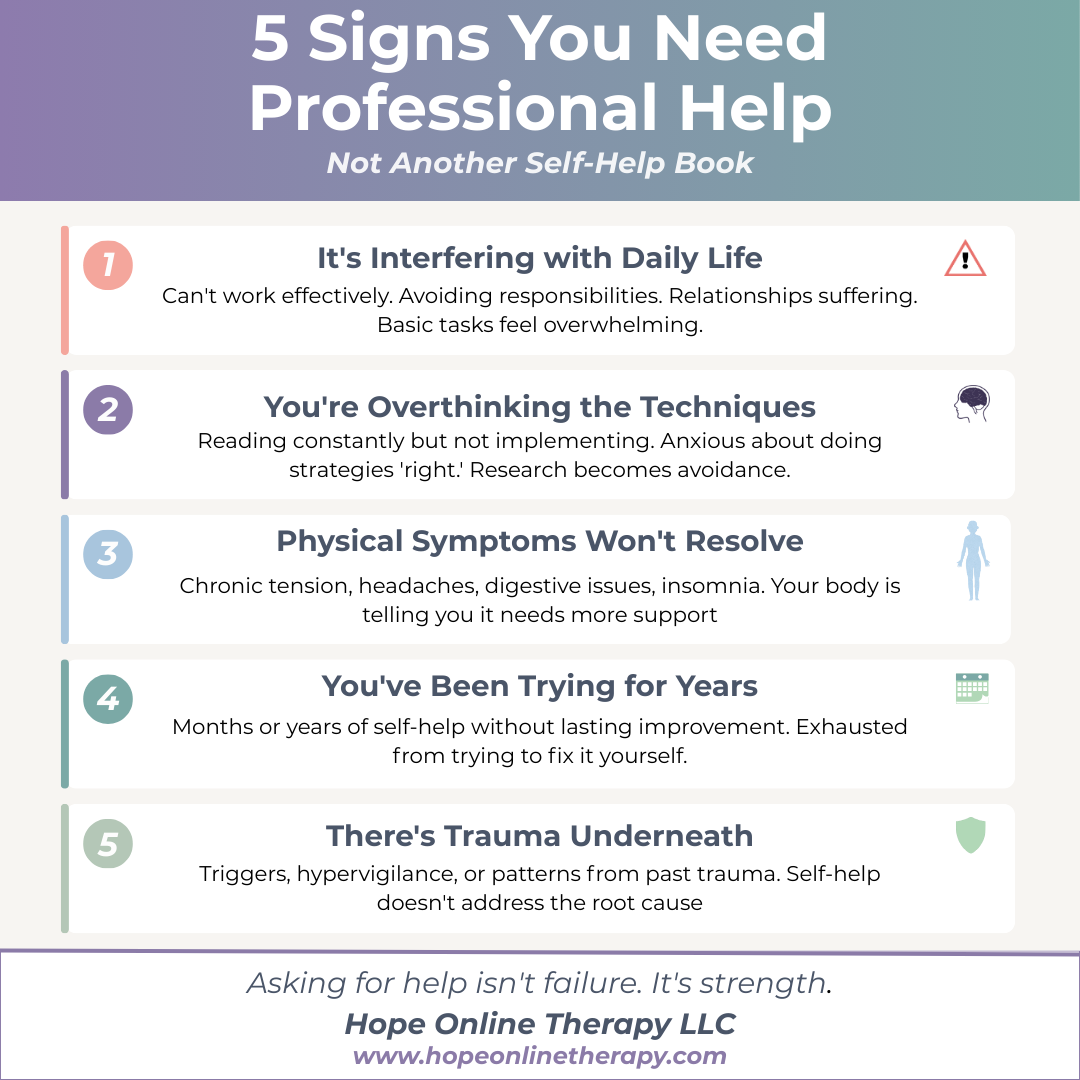
1. Your Anxiety Is Interfering with Daily Functioning
You can't do your job effectively. Your relationships are suffering. You're avoiding important responsibilities. Basic tasks feel overwhelming.
What this looks like:
Calling out of work frequently or struggling to perform
Canceling plans repeatedly because anxiety is too high
Avoiding necessary activities (doctor appointments, grocery shopping, social obligations)
Relationships deteriorating because you're withdrawn, irritable, or need constant reassurance
Can't sleep, can't eat, can't focus
Making decisions based on anxiety rather than what you actually want or need
Why self-help isn't enough: When anxiety is this pervasive, you need more than strategies, you need someone to help you understand why your anxiety is this high and address the root causes. A therapist can help you gradually build capacity while supporting you through the process.
If your anxiety is affecting your relationships, our post on how anxiety shows up in relationships explores this dynamic further.
What therapy offers:
Personalized treatment plan based on your specific symptoms
Support in identifying and addressing underlying causes
Gradual exposure to feared situations with professional guidance
Skills tailored to your life, not generic advice
2. You're Overthinking the Self-Help Techniques
You've read so many books that you're now anxious about doing anxiety management "correctly." You second-guess every technique. You analyze whether you're breathing right, journaling right, meditating right.
What this looks like:
Collecting strategies but not implementing them (or trying too many at once)
Feeling like you're failing if a technique doesn't work perfectly
Spending more time researching anxiety than actually living your life
Using self-help as a form of avoidance ("I just need to read one more book before I...")
Intellectualizing your anxiety without actually feeling better
Why self-help isn't enough: If you're someone with an analytical mind (check out our post on why smart people struggle with anxiety), you can get stuck in the learning phase without moving to the doing phase. Or worse, the self-help becomes another source of anxiety.
What therapy offers:
A therapist who guides you through implementation, not just information
Accountability and support in actually practicing skills
Permission to stop researching and start healing
Feedback on what's working and what's not for you specifically
3. You're Experiencing Physical Symptoms That Won't Resolve
Your anxiety isn't just mental; it's in your body. And no amount of reading about the mind-body connection is making it better.
What this looks like:
Chronic tension headaches or migraines
Persistent digestive issues (IBS, nausea, stomach pain)
Chest tightness, rapid heartbeat, or shortness of breath
Insomnia or disrupted sleep despite "sleep hygiene"
Muscle tension, jaw clenching, teeth grinding
Frequent illness (weakened immune system from chronic stress)
Panic attacks that feel uncontrollable
Why self-help isn't enough: Physical symptoms indicate your nervous system is chronically dysregulated. Books can explain this, but they can't help you regulate your nervous system the way therapy can, especially somatic or trauma-informed approaches.
What therapy offers:
Nervous system regulation techniques practiced with support
Understanding of how trauma might be stored in your body
Somatic experiencing or EMDR for trauma-related physical symptoms
Collaboration with medical providers if needed
Validation that this is real, not "all in your head"
4. You've Been Trying for Years Without Improvement
You've been working on your anxiety for months or years. You've tried multiple books, apps, techniques, and approaches. And you're still struggling, or you're actually worse.
What this looks like:
"I've been trying to manage my anxiety for 5 years and nothing works"
Brief periods of improvement followed by relapse
Feeling hopeless about ever getting better
Wondering if this is just how life will always be
Exhaustion from constantly trying to fix yourself
Why self-help isn't enough: If years of self-directed work hasn't created lasting change, there's likely something deeper that needs to be addressed, trauma, learned patterns from childhood, avoidance strategies that seem helpful but keep you stuck, or an underlying condition that needs treatment.
What therapy offers:
Fresh perspective from someone trained to see patterns you can't see
Identification of what's actually keeping you stuck (often not what you think)
Evidence-based treatments proven to work for persistent anxiety
Hope that change is possible, because a professional believes it and can show you the path
5. There's Trauma Underlying Your Anxiety
Your anxiety isn't random; it's connected to past experiences. You have triggers, flashbacks, or patterns that trace back to trauma. And self-help books on anxiety management don't address the root cause.
What this looks like:
Specific triggers that activate intense anxiety
Hypervigilance (constantly scanning for threats)
Difficulty trusting people or feeling safe
Anxiety that seems disproportionate to the current situation
Patterns that started after a traumatic event
Self-help advice feels impossible to implement because your nervous system won't calm down
Why self-help isn't enough: Trauma-related anxiety requires trauma-informed treatment. General anxiety strategies can help manage symptoms, but they won't resolve the underlying trauma. And trying to "fix" trauma symptoms without addressing the trauma can actually make things worse.
For more on recognizing and working with trauma triggers, see our post on how to identify triggers without reliving trauma.
What therapy offers:
Trauma-specific treatments like EMDR, trauma-focused CBT, or somatic experiencing
Safe space to process traumatic memories
Nervous system regulation techniques designed for trauma
Understanding of how trauma affects the brain and body
Validation that this isn't just anxiety, it's a response to something real that happened
"But I Should Be Able to Handle This Myself"
If you're reading this and thinking, "I should be able to manage my anxiety on my own," let's address that.
Why we resist asking for help:
"I should be strong enough to handle this." Needing help isn't weakness. Mental health struggles aren't a character flaw. You wouldn't expect yourself to self-treat a broken leg with a book, why expect that with anxiety?
"Other people have it worse." Someone else's suffering doesn't diminish yours. You don't have to hit rock bottom to deserve support.
"Therapy is expensive/hard to find/stigmatized." These are real barriers. But suffering indefinitely because you won't seek help is a higher cost, to your health, relationships, career, and quality of life.
"I've learned so much, I should be able to do this." Understanding anxiety intellectually and being able to manage it are two different things. You can know what to do and still need help doing it.
"What if therapy doesn't work either?" What if it does? You've already tried self-help alone. Isn't it worth trying with professional support?
What Therapy Offers That Books Don't
Personalization. A therapist tailors treatment to your specific anxiety, your history, your life, your barriers. Books are one-size-fits-all.
Feedback. You can ask questions, get clarity, and adjust strategies based on what's working. Books can't respond to your unique situation.
Accountability. Someone supporting you in actually implementing strategies, not just reading about them.
Expertise. Therapists are trained to see patterns, identify underlying issues, and know when to adjust the approach. Books assume you can do this yourself.
Relationship. Healing happens in connection. The therapeutic relationship itself is part of what helps, and you can't get that from a book.
Safety. A trained professional can help you work through difficult material without retraumatizing yourself. Books can't ensure your safety as you do this work.
When to Seek Help (Immediately)
Some situations require immediate professional support, not self-help:
Seek help right away if:
You're having thoughts of self-harm or suicide
You're using substances to cope with anxiety
You're experiencing panic attacks that feel uncontrollable
Your anxiety is causing you to make dangerous decisions
You're dissociating or losing touch with reality
Your physical symptoms are severe or worsening
Crisis resources:
988 Suicide & Crisis Lifeline (call or text)
Crisis Text Line: Text HOME to 741741
SAMHSA National Helpline: 1-800-662-4357
If you're in crisis, put down the self-help book and call for support. You deserve immediate help.
You Don't Have to Do This Alone
Here's the truth: Trying to manage severe anxiety alone is like trying to perform surgery on yourself. You might know the theory, but that doesn't mean you can do it without help.
Self-help books are a great starting point. They build awareness, teach concepts, and offer strategies. But they're not a replacement for professional support when anxiety is interfering with your life.
You've already shown incredible strength by trying to help yourself. Reading books, researching techniques, implementing strategies—that takes effort and commitment.
Now it's time to show strength in a different way: by asking for help.
Therapy isn't admitting defeat. It's recognizing that you deserve support. It's understanding that some things are too hard to do alone. It's choosing your wellbeing over the myth that you should be able to handle everything yourself.
You've tried self-help. You've done your part. Now let someone trained help you do the rest.
What to Expect from Therapy for Anxiety
If you're considering therapy but feel uncertain, here's what to expect:
Initial sessions: You'll talk about your history, your current symptoms, and your goals. Your therapist will develop a treatment plan specific to you.
Evidence-based approaches: For anxiety, this often includes Cognitive Behavioral Therapy (CBT), exposure therapy, EMDR (for trauma), or acceptance-based approaches. Your therapist will explain what they recommend and why.
Active participation: Therapy isn't passive. You'll learn skills, practice them between sessions, and get feedback. It's collaborative work.
Gradual improvement: Therapy isn't a quick fix, but most people see improvement within weeks to months. Progress isn't always linear, and that's normal.
Homework: You'll likely have between-session work—practicing skills, tracking symptoms, or challenging thoughts. This is where self-help strategies become useful with professional guidance.

Ready to Get Professional Support?
If you recognize yourself in these signs, if self-help hasn't been enough, if your anxiety is interfering with your life, if you're exhausted from trying to fix this alone, therapy can help.
I work with adults in Texas and Idaho who are ready to move beyond self-help and get personalized support for anxiety. We'll work together to understand your specific anxiety, address underlying causes, and build sustainable coping skills.
Virtual therapy means you can access support from home, on your schedule.
Schedule a Free Consultation – Let's talk about how therapy can help you finally get relief from anxiety.
You've been working hard on your own. You don't have to keep doing it alone.