How Your Anxiety Is Affecting Your Relationship (Even If You Think You're Hiding It)
You think you're managing it well.
You don't talk about the racing thoughts. You don't mention the panic you feel before social events. You push through the physical symptoms, the tight chest, the shallow breathing, the knot in your stomach. You show up. You smile. You participate.
From the outside, you look fine. Maybe even great.
But the people closest to you? They notice.
They notice when you snap over small things. When you withdraw and go quiet. When you need constant reassurance. When you avoid making plans. When you overthink every conversation. When you seem exhausted for no apparent reason.
You think you're hiding your anxiety. But anxiety doesn't hide as well as you think it does, and it's affecting your relationships in ways you might not realize.
The good news? Once you understand how anxiety shows up in your relationships, you can start addressing it. And that awareness, that willingness to see the pattern, is the first step toward healthier connections.
The Ways Anxiety Shows Up in Relationships
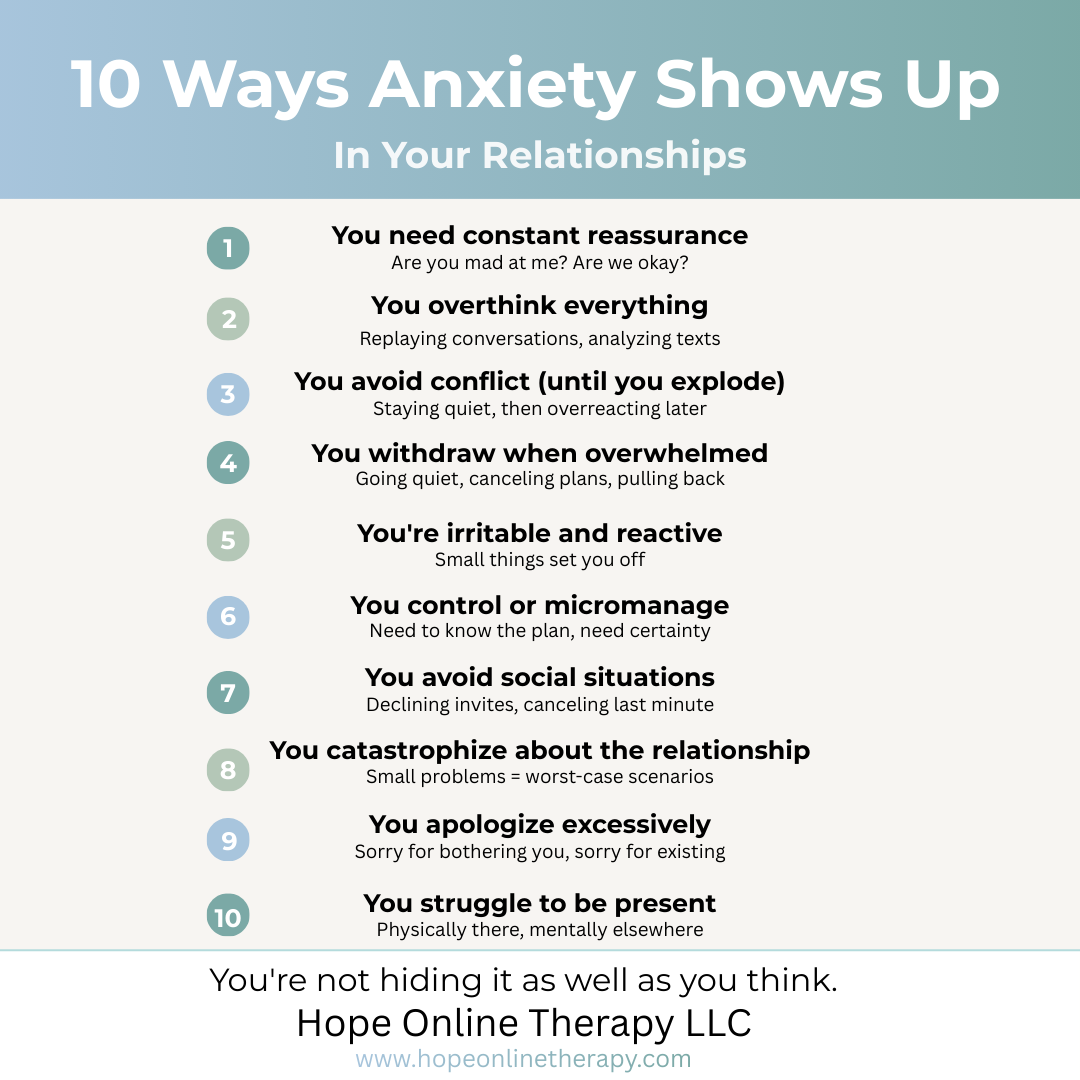
Anxiety isn't just an internal experience. It changes how you interact with the people around you, often in subtle ways that accumulate over time.
You Need Constant Reassurance
"Are you mad at me?" "Are we okay?" "Do you still love me?" "Did I do something wrong?"
You ask these questions a lot. Maybe after every disagreement, or when someone seems quiet, or when plans change, or seemingly out of nowhere.
The reassurance helps, temporarily. But the relief doesn't last. The anxiety returns, and you need to ask again.
What's happening: Anxiety creates doubt and catastrophic thinking. Your brain interprets neutral situations as threatening. A delayed text becomes "they're pulling away." A quiet mood becomes "they're angry with me." A change in routine becomes "something's wrong."
Seeking reassurance is a way to quiet that fear. But reassurance doesn't address the underlying anxiety, it just temporarily soothes it. And over time, the constant need for reassurance can exhaust the people around you.
You Overthink Everything
You replay conversations in your head. You analyze text messages for hidden meanings. You worry about what you said, how you said it, what they meant, and what they didn't say.
Did that comment have a tone? Did they seem distant? Why did they word it that way? What does that silence mean?
What's happening: Anxiety makes you hypervigilant to perceived threats. Your brain is looking for danger—and in relationships, that often means looking for signs of rejection, disapproval, or conflict.
The overthinking feels productive, like you're problem-solving. But you're not solving a real problem, you're creating anxiety about hypothetical ones.
And while you're stuck in your head analyzing the interaction, you're missing the actual connection happening in front of you.
You Avoid Conflict (Until You Explode)
You hate confrontation. You'd rather stay quiet, let things go, keep the peace. So you do keep quiet, for weeks, or maybe months.
But resentment builds. Small frustrations accumulate. And then something minor happens, they forget to text back, they make an offhand comment, or they're five minutes late, and suddenly you're furious.
The explosion seems disproportionate to the trigger. Because it's not really about the trigger, it's about everything you've been holding in.
What's happening: Anxiety often makes conflict feel unbearable. Your nervous system perceives disagreement as dangerous. So you avoid it, suppress your needs, and minimize your feelings.
But avoidance doesn't resolve the issue. It just delays it. And when you finally do express yourself, it comes out sideways, as irritability, passive-aggression, or a disproportionate reaction to something small.
The people around you are confused. They don't understand why you're so upset about something minor. But they don't see the weeks of unexpressed frustration underneath.
You Withdraw When You're Overwhelmed
When anxiety spikes, you pull back. You go quiet. You cancel plans. You need space. You stop responding as much.
You're not trying to be distant, you are just overwhelmed. You need time to regulate, to recharge, to get your nervous system back to baseline.
What's happening: Withdrawal is a form of self-protection. When your nervous system is activated, social interaction feels like too much. You need to retreat to feel safe again.
But the people in your life don't always understand that. They interpret your withdrawal as rejection, disinterest, or anger. They wonder what they did wrong. They feel shut out.
And if you don't communicate what's happening, "I'm feeling overwhelmed and need some quiet time," they are left to guess. And anxiety often makes them guess wrong.
You're Irritable and Reactive
Small things set you off. Someone chews too loudly. A question feels invasive. A minor inconvenience feels catastrophic.
You snap. You get defensive. You overreact. And then you feel guilty about it later.
What's happening: Anxiety keeps your nervous system in a heightened state. You're already running close to your threshold—so it doesn't take much to push you over.
It's like a cup that's already 90% full. One more drop and it overflows. But from the outside, it looks like you're overreacting to something small. People don't see the 90% that was already there.
Chronic anxiety is exhausting. It drains your patience, your capacity for frustration tolerance, your ability to regulate your emotions. You're not being dramatic, you are dysregulated.
You Control or Micromanage
You need to know the plan. You need details. You need certainty. When things feel unpredictable or out of your control, your anxiety spikes.
So you try to control what you can: schedules, plans, decisions, how things are done. You might micromanage, insist on certain routines, or struggle when things don't go as expected.
What's happening: Anxiety thrives on uncertainty. Your brain interprets the unknown as dangerous. Controlling your environment is a way to reduce that perceived threat.
But relationships require flexibility, spontaneity, and compromise. When you rigidly need things done a certain way, it can feel controlling or inflexible to others, even if your intention is just to manage your own anxiety.
You Avoid Social Situations (and It Affects Shared Experiences)
Parties, gatherings, dinners with friends, family events, these situations make your anxiety spike. So you avoid them. Or you go but feel miserable the whole time. Or you agree to go and cancel at the last minute.
What's happening (especially with social anxiety): Social situations feel threatening. You worry about being judged, saying something wrong, not fitting in, or being the center of attention. The anticipatory anxiety can be so intense that avoidance feels like the only option.
But if your partner, friends, or family want to attend these events, your avoidance creates tension. They might go alone and feel like you're not part of their life. Or they stay home with you and feel resentful. Or they feel caught between supporting you and living their own life.
You Catastrophize About the Relationship
A small disagreement becomes "they're going to leave me." A quiet evening becomes "something's wrong." A change in their behavior becomes "they're losing interest."
Your brain jumps to the worst-case scenario. The relationship isn't just having a rough patch, it's ending. They're not just tired, they're done with you.
What's happening: Anxiety doesn't do nuance. It sees minor problems and predicts catastrophe. This catastrophic thinking creates unnecessary panic and can lead you to preemptively protect yourself by withdrawing, picking fights, or creating distance.
You might even push people away before they can leave you, because that feels safer than being blindsided.
You Apologize Excessively
"I'm sorry." "Sorry for bothering you." "Sorry for being like this." "Sorry I'm so anxious."
You apologize constantly, for having needs, for expressing feelings, for taking up space, for existing in a way that might inconvenience others.
What's happening: Anxiety often comes with shame. You believe you're too much, too needy, too difficult. Apologizing is a way to preemptively manage others' potential frustration with you.
But excessive apologizing can be exhausting for the people around you. They're not frustrated with you, but the constant apologies make them wonder if they're doing something to make you feel like you need to apologize. It creates a dynamic where they feel like they have to constantly reassure you that you're not a burden.
You Struggle to Be Present
You're physically there, but mentally elsewhere. You're worrying about tomorrow, replaying yesterday, planning for contingencies, running through scenarios.
Your partner is talking to you, but you're not fully listening. Your friend is telling you something important, but you're distracted by your own thoughts. You're at the event, but you're not really there.
What's happening: Anxiety pulls you out of the present moment. It's hard to be fully engaged when your brain is constantly scanning for threats, solving hypothetical problems, or managing worry.
The people around you can feel it. They sense that you're not fully present. It creates distance, even when you're right next to each other.
The Impact You Might Not See
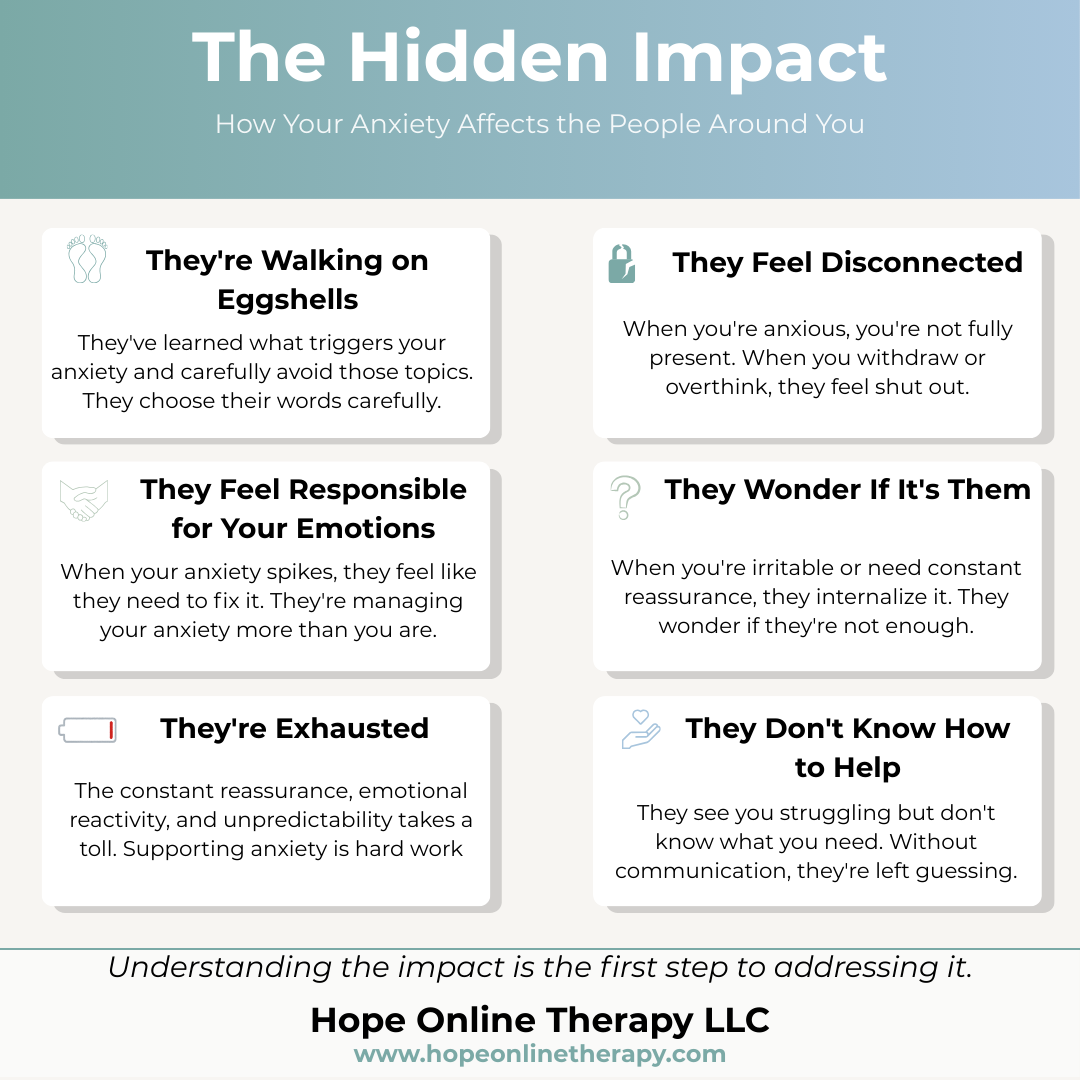
You're aware that you have anxiety. You might even be working on it. But you might not realize how it's affecting the people you care about.
They're walking on eggshells. They've learned what triggers your anxiety, and they're careful around those topics. They choose their words carefully. They avoid bringing up certain subjects. They adjust their behavior to prevent your anxiety from spiking.
They feel responsible for your emotions. When your anxiety is high, they feel like they need to fix it. They try to reassure you, calm you down, solve the problem. Over time, they might feel like they're managing your anxiety more than you are.
They're exhausted. Supporting someone with anxiety is hard work, especially when they don't recognize or address it. The constant reassurance, the emotional reactivity, the unpredictability, it takes a toll.
They feel disconnected. When you're anxious, you're not fully present. And when you withdraw, avoid, or overthink, they feel shut out. They might want to connect with you, but anxiety is in the way.
They wonder if it's them. When you're irritable, distant, or need constant reassurance, they might internalize it. They wonder if they're doing something wrong. If they're not enough. If you're unhappy with them.
They don't know how to help. They can see you're struggling, but they don't know what you need. And if you're not communicating what's happening, they're left to guess, and they often guess wrong.
This isn't about blame. You're not intentionally causing these effects. Anxiety is hard, and it's especially hard to manage in relationships.
But understanding the impact is important. Because once you see it, you can start addressing it.
It's Not Just Romantic Relationships
Anxiety doesn't only affect romantic partnerships, it shows up in all your relationships.
With friends: You cancel plans frequently. You need excessive reassurance that they still like you. You overthink text conversations. You avoid group settings. You withdraw when overwhelmed.
With family: You're more irritable with them than anyone else. You avoid family gatherings. You feel judged or criticized even when they're being neutral. You struggle with boundaries or feel responsible for their emotions.
At work: You avoid speaking up in meetings. You overwork to manage anxiety about performance. You need excessive validation from your boss. You struggle with criticism, even when it's constructive. You overthink your interactions with coworkers.
All relationships require presence, communication, and emotional regulation. When anxiety interferes with those, it creates distance—no matter what type of relationship it is.
You're Not Broken. You're Managing Something Hard.
If you're reading this and recognizing yourself, you might feel guilty. You might feel like you're the problem. You might worry that your anxiety makes you unlovable or too difficult to be around.
That's not true.
Having anxiety doesn't make you a bad partner, friend, family member, or colleague. It doesn't make you unworthy of connection. It doesn't mean you're broken.
It means you're dealing with something hard, something that affects how you experience the world and how you show up in relationships.
The people who care about you don't need you to be anxiety-free. They need you to be aware of how anxiety shows up, willing to communicate about it, and actively working on managing it.
You don't have to be perfect. You just have to be honest.
What Helps: Managing Anxiety in Relationships

You can't eliminate anxiety entirely. But you can learn to manage it in ways that protect your relationships instead of straining them.
1. Recognize When Anxiety Is Driving Your Behavior
The first step is awareness. Start noticing when anxiety is influencing how you're showing up.
Are you asking for reassurance because something's actually wrong, or because anxiety is creating doubt?
Are you withdrawing because you need space, or because anxiety is telling you to protect yourself?
Are you irritable because someone did something wrong, or because your nervous system is overwhelmed?
You don't have to stop the behavior immediately. Just start noticing the pattern.
2. Communicate What's Happening
Instead of hiding your anxiety or expecting people to read your mind, tell them what's going on.
"I'm feeling really anxious right now, and I need some reassurance. Can you tell me we're okay?"
"I'm overwhelmed and need to withdraw for a bit. It's not about you, I just need to recharge."
"I'm feeling anxious about [situation], and I know I'm being more irritable than usual. I'm working on it."
When you name what's happening, people don't have to guess. They can support you more effectively, and they are less likely to take your anxiety-driven behavior personally.
3. Develop Self-Soothing Skills
You can't rely on others to constantly regulate your anxiety for you. You need tools to calm your own nervous system.
This might include:
Deep breathing or grounding techniques
Physical movement (walking, stretching, exercise)
Sensory regulation (cold water, weighted blanket, soothing music)
Mindfulness or meditation practices
Journaling or talking it out with a therapist
The more you can self-regulate, the less your anxiety will leak into your relationships.
4. Challenge Your Anxious Thoughts
Anxiety tells you stories. "They're mad at me." "This relationship is doomed." "I said something wrong." "They're going to leave."
Start questioning those stories.
What's the evidence for this thought? What's the evidence against it?
Is there another explanation that's equally or more likely?
Am I responding to what's actually happening, or what anxiety is predicting might happen?
You don't have to eliminate the anxious thought. Just create some distance from it. "I'm having the thought that they're mad at me" is different from "They're definitely mad at me."
5. Be Willing to Sit with Discomfort
A lot of anxiety-driven behavior is about avoiding discomfort. You seek reassurance to avoid uncertainty. You withdraw to avoid overwhelm. You control to avoid unpredictability.
But avoidance reinforces anxiety. It tells your brain that the discomfort was dangerous, and that you need to avoid it next time too.
Healing from anxiety means gradually building tolerance for discomfort. Sitting with uncertainty. Allowing uncomfortable emotions. Not immediately seeking reassurance or escape.
It's hard. But it's necessary.
6. Address the Anxiety Itself
If anxiety is significantly affecting your relationships, and your life, it's worth addressing directly.
This might mean:
Therapy (especially CBT or exposure therapy for anxiety)
Medication (if appropriate and with medical guidance)
Lifestyle changes (sleep, exercise, nutrition, stress management)
Learning anxiety management skills
Addressing underlying trauma or attachment issues
You can work on relationship skills all you want, but if the underlying anxiety isn't addressed, the patterns will keep showing up.
7. Repair When You Miss the Mark
You're going to mess up. You're going to snap at someone when you're dysregulated. You're going to withdraw without explaining. You're going to let anxiety drive your behavior.
That's okay. What matters is what you do next.
Apologize. Take responsibility. Explain what happened without making excuses. Commit to doing better.
"I'm sorry I snapped at you earlier. I was feeling really anxious and didn't regulate well. That's not your fault, and I'm working on handling it differently."
Repair builds trust. It shows that you're aware, accountable, and trying, even when you fall short.
For the People Who Love Someone with Anxiety
If you're reading this because someone you care about has anxiety, here's what you should know.
Their anxiety isn't about you. When they need reassurance, withdraw, or get irritable, it's not because you're doing something wrong. It's because their nervous system is responding to perceived threat, and that response isn't always rational.
You can't fix it. You can support, reassure, and be patient, but you can't eliminate their anxiety. That's their work to do, ideally with professional support.
It's okay to have limits. Supporting someone with anxiety can be draining. You're allowed to have boundaries. You're allowed to say "I can't be your only source of reassurance" or "I need you to work on this with a therapist."
Communication helps. Ask them what they need. Don't assume. And encourage them to tell you when anxiety is driving their behavior, it helps you not take it personally.
Encourage professional support. If their anxiety is significantly affecting the relationship, gently encourage them to seek therapy. Not as an ultimatum, but as a loving suggestion: "I think talking to someone might really help."
Take care of yourself too. You can't pour from an empty cup. Make sure you're also getting support, whether that's through your own therapy, talking to friends, or taking time for yourself.
You don't have to be perfect. But you also don't have to carry their anxiety for them.
Anxiety and Relationships Can Coexist—With Work
Anxiety doesn't have to ruin your relationships. Plenty of people with anxiety have healthy, connected, fulfilling relationships.
But it requires:
Awareness of how anxiety shows up
Willingness to communicate about it
Active management of symptoms
Taking responsibility for your patterns
Seeking help when needed
You're not too much. You're not unlovable. You're not broken.
You're managing something hard, and with the right tools and support, you can manage it in a way that brings you closer to people instead of pushing them away.
The relationships in your life can handle your anxiety. What they can't handle is your anxiety going unaddressed, unspoken, and unmanaged.
You deserve connection. And the people who care about you deserve to understand what you're going through, and how they can support you.
That starts with being honest. With them, and with yourself.
Learn more about anxiety.
Need Support Managing Anxiety in Your Relationships?
If anxiety is affecting your relationships, romantic, family, friendships, or work, therapy can help.
I work with adults in Texas and Idaho who are ready to understand their anxiety patterns, develop healthier coping strategies, and build stronger, more connected relationships.
Virtual therapy means you can get support from home, on a schedule that works for you.
Schedule a Free Consultation – Let's talk about how therapy can help you manage anxiety and improve your relationships.
You don't have to keep struggling alone. Support is available.