Why Smart People Struggle with Anxiety (And What That Says About Your Brain)
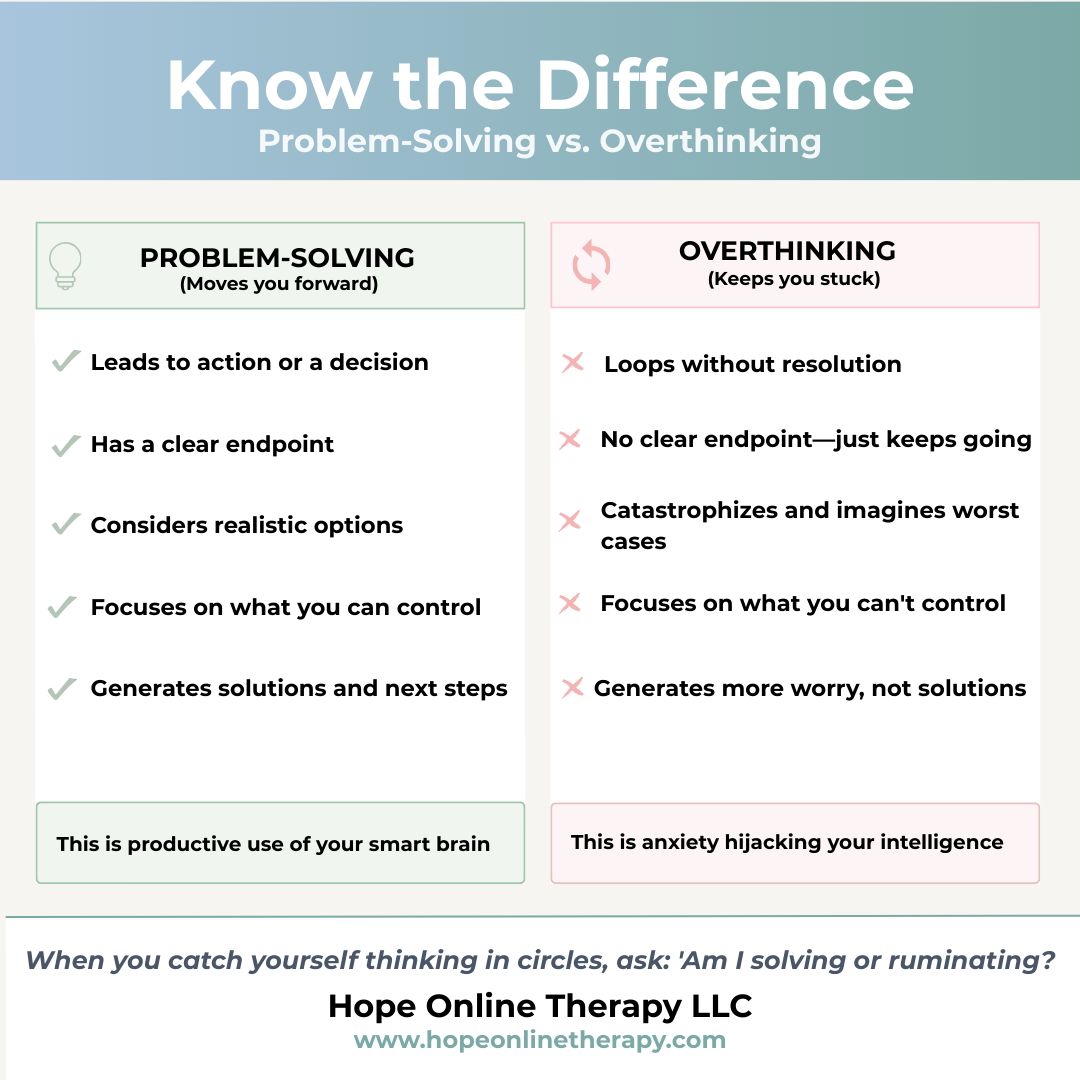
Your smart brain is thinking. But is it productive thinking or destructive thinking?
You can analyze a problem from every angle. You see patterns others miss. You think three steps ahead. You consider all the possibilities, all the outcomes, all the ways things could go wrong.
People call you smart. Thoughtful. Detail-oriented. A problem-solver.
But here's what they don't see: the constant mental chatter. The inability to turn your brain off. The replaying of conversations. The planning for disasters that will probably never happen. The paralysis that comes from seeing too many options.
You're smart. And you're anxious.
And if you've ever wondered why those two things seem to go together—why intelligent, capable people often struggle with anxiety—you're not alone.
Here's the truth: Your anxiety isn't a flaw in your intelligence. It's a feature of how your brain works.
The same brain that helps you solve complex problems, anticipate obstacles, and think critically is also the brain that won't stop analyzing, catastrophizing, and searching for threats.
Your smart brain is working exactly as designed. It's just working overtime.
Let's talk about why intelligent people are prone to anxiety, what that reveals about how your brain functions, and what you can actually do about it.
The Connection Between Intelligence and Anxiety
First, let's be clear: not all smart people have anxiety, and not all anxious people are smart. Anxiety doesn't discriminate. It affects people across all intelligence levels, backgrounds, and circumstances.
But research does suggest a connection between certain types of intelligence and anxiety, particularly verbal intelligence, pattern recognition, and analytical thinking.
Why? Because the traits that make you intelligent are the same traits that fuel anxiety.
High intelligence often includes:
Advanced pattern recognition (seeing connections and possibilities)
Strong verbal reasoning (analyzing and overthinking)
Enhanced future-oriented thinking (planning and predicting)
Heightened awareness (noticing details others miss)
Complex problem-solving (considering multiple variables)
Anxiety involves:
Overactive pattern recognition (seeing threats everywhere)
Rumination (analyzing the same thoughts repeatedly)
Catastrophizing (predicting worst-case futures)
Hypervigilance (constantly scanning for danger)
Overthinking (too many variables, too many what-ifs)
See the overlap? The skills that make you smart are the same skills anxiety hijacks.
Your brain is incredibly good at analyzing, predicting, and planning. That's an asset, until it isn't.
Why Smart Brains Are Prone to Overthinking

If you're smart and anxious, overthinking is probably your default mode.
Overthinking looks like:
Replaying conversations over and over, analyzing what you said and what they meant
Creating mental flowcharts of all possible outcomes before making a decision
Researching excessively before taking action
Getting stuck in "what if" loops that spiral into worst-case scenarios
Analyzing your own thoughts and feelings instead of just experiencing them
Why smart people overthink:
1. You have a high-capacity working memory. Your brain can hold and manipulate multiple pieces of information at once. That's great for problem-solving. But it also means you can hold multiple worries, scenarios, and "what-ifs" simultaneously, and your brain will keep processing them.
2. You're wired to see patterns. Pattern recognition is a hallmark of intelligence. You connect dots quickly. You see how X could lead to Y, which might result in Z. That's brilliant for analysis, but it also means you see potential problems everywhere. Your brain is constantly running simulations of what could go wrong.
3. You value thoroughness and accuracy. Smart people often have high standards. You want to make the "right" decision. You want to understand things fully before acting. So you analyze. And analyze. And analyze. But there's rarely a "perfect" answer, so you keep thinking.
4. Your brain treats thoughts like problems to solve. When an anxious thought appears, your smart brain immediately tries to solve it. "What if I fail?" becomes a problem that needs solving. So you analyze the likelihood, create backup plans, research outcomes. But anxious thoughts aren't actually solvable problems, they're fears. And trying to "solve" them just keeps you stuck in the loop.
The result: You're thinking when you should be acting. You're analyzing when you should be experiencing. You're in your head when you should be in your life. Your overthinking affects your relationships too.
The Perfectionism Trap
If you're smart, there's a good chance you're also a perfectionist. And perfectionism and anxiety are best friends.
Perfectionism shows up as:
Setting impossibly high standards for yourself
Feeling like anything less than perfect is failure
Procrastinating because you're afraid you can't do it perfectly
Overworking to avoid mistakes
Beating yourself up over small errors
Struggling to start or finish projects because they're never "good enough"
Why smart people become perfectionists:
1. You've been rewarded for being right. Smart people often receive praise for getting things correct, for having the answer, for being "the smart one." Over time, you internalize the belief that your value comes from being right. Mistakes feel like personal failures, not just learning opportunities.
2. You can envision the ideal outcome. Your intelligence allows you to imagine exactly how something should be. You can see the perfect version in your mind. And when reality doesn't match that vision, it feels like you've failed, even if what you've produced is objectively good.
3. Your brain focuses on what's wrong. Smart brains are excellent at critical thinking, spotting flaws, identifying problems, and seeing gaps. That's valuable in many contexts. But when you turn that critical lens on yourself, it becomes a constant stream of "not good enough."
4. You equate your performance with your worth. When you've been praised for being smart your whole life, it's easy to tie your identity to your achievements. If you're not performing at a high level, who are you? This creates enormous pressure to be perfect, and enormous anxiety when you're not.
The perfectionism-anxiety cycle:
You set an impossibly high standard
You work obsessively to meet it (or procrastinate because it feels impossible)
You fall short (because the standard was unrealistic)
You criticize yourself harshly
Your anxiety increases
You set an even higher standard to "prove yourself"
Repeat
The irony: Perfectionism doesn't lead to better outcomes. It leads to paralysis, burnout, and chronic anxiety.
What Your Anxiety Actually Reveals About Your Brain
Here's the reframe that changes everything: Your anxiety isn't a sign that something's wrong with your brain. It's a sign of how your brain works.
Anxiety in intelligent people often means:
Your brain is highly active and engaged. You're not coasting through life on autopilot. You're thinking, analyzing, considering. That mental activity is part of what makes you intelligent, but it also means your brain doesn't easily "shut off."
You have strong future-oriented thinking. Anxiety is essentially your brain's attempt to prepare for the future. You're running simulations, planning for contingencies, trying to prevent problems. That forward-thinking ability is valuable, but when it's turned up too high, it becomes worry and catastrophizing.
You're attuned to nuance and complexity. You notice subtleties. You see the gray areas. You understand that situations are complicated and that outcomes are uncertain. That's sophisticated thinking, but it also means you're aware of all the things that could go wrong.
You have high standards and care deeply about outcomes. Anxiety often comes from caring. You wouldn't be anxious about a presentation if you didn't care about doing well. You wouldn't overthink a conversation if the relationship didn't matter to you. Your anxiety is connected to your values, and that's not a bad thing.
Your brain is sensitive to stimulation. Some research suggests that intelligent people have more active neural pathways and may process information more deeply. This can make you more sensitive to stress, more aware of potential problems, and more prone to overstimulation, all of which contribute to anxiety.
None of this makes you broken. It makes you wired differently, in ways that come with both gifts and challenges.
The Dark Side of Intelligence: When Your Gifts Become Burdens
Intelligence is an asset. But when paired with anxiety, it can become exhausting.
The downsides of a smart, anxious brain:
Decision paralysis. You see all the options, all the pros and cons, all the potential outcomes. You can argue for and against every choice. So you get stuck. The ability to see multiple perspectives, usually a strength, becomes a barrier to action.
Chronic self-doubt. The smarter you are, the more you're aware of what you don't know. You see the complexity of situations. You recognize your limitations. This intellectual humility is valuable, but it can also fuel imposter syndrome and constant second-guessing.
Isolation. When your brain is constantly analyzing, it's hard to be present with others. You're in your head during conversations, replaying what you just said, predicting how they'll respond. Or you hide your anxiety because you think you "should" have it figured out. Either way, connection becomes harder.
Exhaustion. Thinking constantly is tiring. Overthinking is even more exhausting. When your brain is running scenarios, analyzing possibilities, and criticizing yourself nonstop, you end up mentally drained, even when you haven't "done" anything.
Missed experiences. While you're busy thinking about life, analyzing it, and planning for it, you're not actually living it. You miss moments because you're too busy worrying about what comes next or replaying what just happened.
The tragedy of the smart, anxious brain: You have all this capacity for insight, creativity, and problem-solving, and you spend most of your mental energy stuck in worry loops.
Your Brain Isn't Broken—It's Just Untrained
Here's the good news: You don't need a different brain. You need to train the one you have.
Your smart brain is like a powerful engine. Right now, it's revving in neutral, lots of activity, not much forward movement. What you need isn't to slow down the engine. You need to direct that energy productively.
The goal isn't to stop thinking. It's to think differently.
This is where Cognitive Behavioral Therapy (CBT) becomes especially useful for smart, anxious people. Because CBT works with the way your brain already operates—it just redirects it.
(If you haven't already, read our full post on cognitive distortions and CBT to understand how your thought patterns keep you stuck and how to challenge them.)
Why CBT works for intelligent, anxious people:
It appeals to your logical brain. CBT isn't about "just relax" or "think positive." It's structured, evidence-based, and logical. You learn to identify thinking patterns, examine evidence, and challenge distortions. Your analytical brain can work with this.
It gives you something to do with your overthinking. Instead of endlessly ruminating, you learn to examine your thoughts systematically. "Is this thought accurate? What's the evidence? What are alternative explanations?" You're still using your analytical skills, but now you're analyzing your anxiety instead of being controlled by it.
It addresses perfectionism directly. CBT helps you identify the all-or-nothing thinking and unrealistic standards that fuel perfectionism. It teaches you to recognize when "perfect" is actually "impossible" and to create more balanced expectations.
It's practical and actionable. Smart people often get frustrated with vague advice. CBT gives you specific tools, techniques, and exercises. You can see progress, measure change, and understand how it's working.
What Smart, Anxious People Can Do Right Now
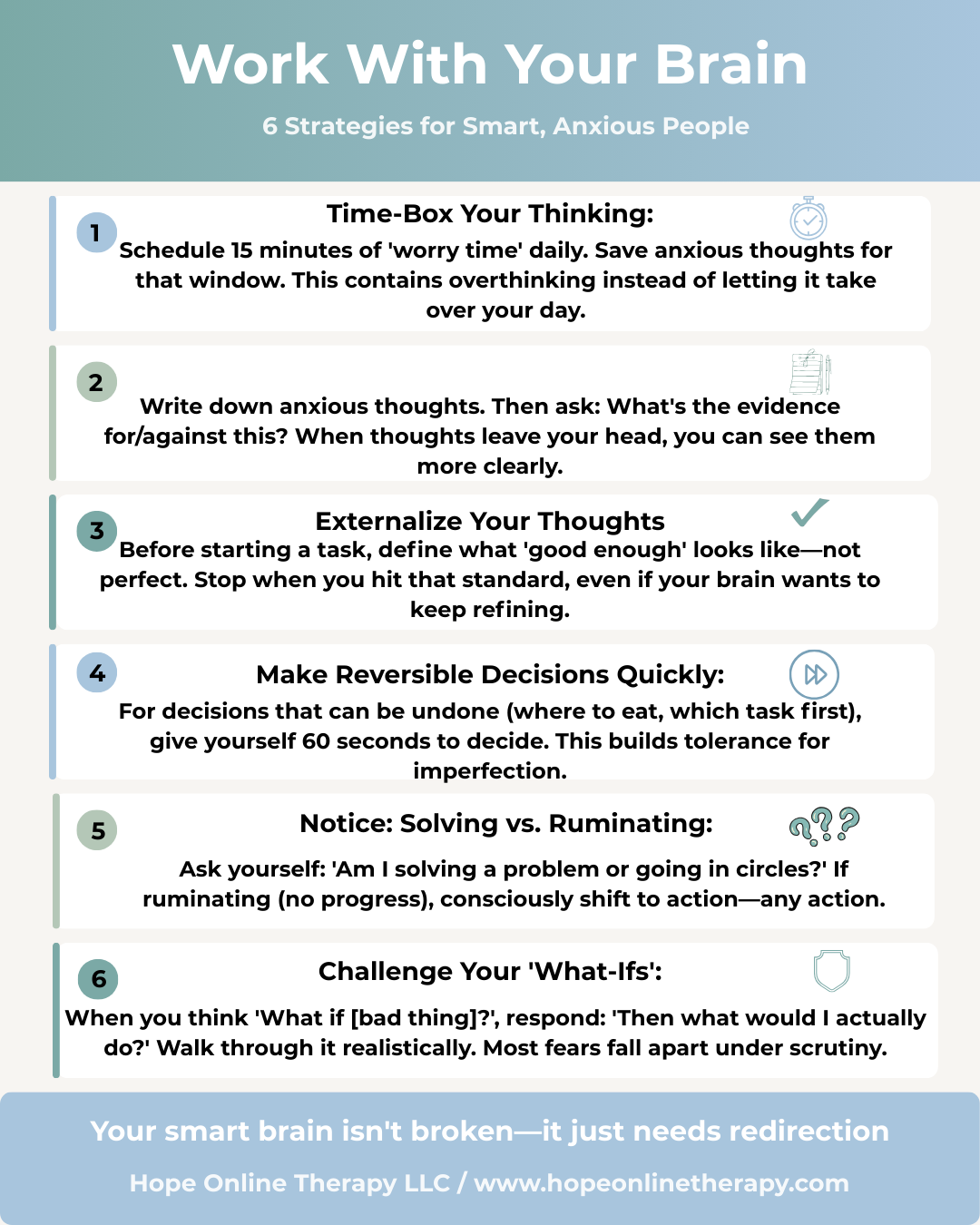
Save this: 6 strategies for smart, anxious brains 👆
You don't have to wait for therapy to start working with your brain differently. Here are strategies specifically helpful for intelligent people with anxiety:
1. Time-Box Your Thinking
Your brain wants to think things through. Let it, but set limits.
Try this: Schedule "worry time." Give yourself 15 minutes a day to overthink, analyze, and worry about whatever you want. When anxious thoughts come up outside that time, write them down and save them for your scheduled session.
Why it works: You're not trying to stop thinking (which doesn't work for smart brains). You're containing it. This satisfies your brain's need to process while preventing overthinking from taking over your entire day.
2. Externalize Your Thoughts
When thoughts stay in your head, they spiral. When you get them out, you can see them more clearly.
Try this: Write down the anxious thought. Then write: "What's the evidence for this? What's the evidence against it? What would I tell a friend who had this thought?"
Why it works: You're using your analytical abilities on your anxiety instead of being trapped in it. Seeing thoughts on paper makes them less overwhelming and easier to challenge.
3. Set "Good Enough" Standards
Perfectionism keeps you stuck. "Good enough" gets you moving.
Try this: Before starting a task, define what "good enough" looks like. Not perfect, good enough. Then stop when you hit that standard, even if your brain wants to keep refining.
Why it works: It retrains your brain to recognize that "good enough" is actually functional and acceptable. You'll discover that most things don't need to be perfect to be valuable.
4. Practice Making "Reversible Decisions" Quickly
Not every decision needs extensive analysis.
Try this: Identify decisions that are reversible (where to eat, which route to take, which task to do first). Give yourself 60 seconds to decide. Then commit.
Why it works: It builds your tolerance for uncertainty and imperfection. It teaches your brain that not every decision requires deep analysis, and that you can handle less-than-perfect outcomes.
5. Notice When You're Solving vs. Ruminating
Problem-solving moves you forward. Rumination keeps you stuck.
Try this: When you catch yourself thinking in circles, ask: "Am I solving a problem or am I ruminating?" If you're ruminating (going over the same thoughts without resolution), consciously shift to an action, any action.
Why it works: Your brain thinks it's problem-solving when it's actually just worrying. Recognizing the difference helps you redirect your mental energy.
6. Challenge Your "What-Ifs"
Your brain generates worst-case scenarios automatically. Challenge them.
Try this: When you think "What if [bad thing happens]?" respond with: "Then what? What would I actually do?" Walk through the scenario realistically, not catastrophically.
Why it works: Most "what-ifs" fall apart under scrutiny. When you realize you'd actually handle the situation (even if it's unpleasant), the anxiety loses power.
When Your Smart Brain Needs Professional Support
Sometimes self-help strategies aren't enough. And that's okay.
Consider therapy if:
Your overthinking is interfering with your work, relationships, or daily functioning
Perfectionism is keeping you from starting or finishing important projects
You're exhausted from constant mental activity and can't shut your brain off
Anxiety is preventing you from taking risks or pursuing opportunities
You're stuck in analysis paralysis and can't make decisions
Your high standards are fueling chronic stress or burnout
Therapy for smart, anxious people often focuses on:
Learning to recognize and challenge cognitive distortions
Developing tolerance for uncertainty and imperfection
Building skills to manage overthinking and rumination
Addressing the underlying perfectionism driving your anxiety
Creating strategies that work with your analytical brain, not against it
A good therapist won't tell you to "stop thinking so much." They'll help you redirect that thinking productively and build a healthier relationship with your very active mind.
Your Intelligence Is an Asset—Even When It Feels Like a Burden
If you're smart and anxious, you might sometimes wish you could just turn your brain off. You might envy people who seem to coast through life without analyzing every detail.
But here's what you need to remember: Your brain's ability to think deeply, see patterns, and consider possibilities is a gift.
Yes, it makes you prone to overthinking. Yes, it contributes to anxiety. But it also enables you to:
Solve complex problems
Understand nuance and complexity
Plan effectively and think ahead
Create innovative solutions
See connections others miss
Care deeply about outcomes and quality
You don't need a different brain. You need to work with the brain you have.
That means:
Learning to recognize when your thinking is productive and when it's destructive
Setting boundaries on your overthinking
Challenging perfectionist standards
Building tolerance for "good enough"
Using your analytical skills to challenge anxiety instead of feeding it
Your smart, anxious brain isn't broken. It's powerful, and it just needs some redirection.
You're Not Alone in This

If you're reading this and recognizing yourself—if you're nodding along to the overthinking, the perfectionism, the constant mental chatter—know that you're not alone.
Millions of intelligent, capable people struggle with anxiety. It doesn't mean you're weak or that you're not as smart as you think. It means your brain is wired for depth, analysis, and complexity, and that comes with challenges as well as gifts.
You deserve support that respects your intelligence while helping you manage the anxiety that comes with it.
You deserve strategies that work with your analytical mind, not against it.
You deserve to use your mental capacity for creativity, problem-solving, and connection, not just worry.
Your smart brain is an asset. Let's help it work for you, not against you.
Need Support for Anxiety and Overthinking?
If anxiety, overthinking, and perfectionism are interfering with your life, therapy can help.
I work with adults in Texas and Idaho who have smart, active minds that won't shut off. helping you redirect that mental energy, challenge perfectionist standards, and manage anxiety using evidence-based approaches like CBT.
Virtual therapy means you can do this work from the comfort of home, on your schedule.
Schedule a Free Consultation – Let's talk about how therapy can help you work with your brain instead of fighting against it.
You don't have to keep struggling with overthinking and anxiety. Let's help your smart brain work for you.