Anxiety Isn't Just Worry: 7 Unexpected Ways It Shows Up in High-Achievers
You're successful. You get things done. You hit deadlines, exceed expectations, and consistently perform at a high level.
People see you as driven, ambitious, and capable. You probably see yourself that way too.
But here's what they don't see: The 2 AM work sessions because you couldn't stop thinking about a project. The constant feeling that you're one mistake away from being exposed as a fraud. The inability to celebrate achievements because you're already focused on what's next. The perfectionism that makes every task take three times longer than it should.
You don't think you have anxiety. You think you're just a high achiever.
But what if those aren't two separate things? What if the very behaviors you've labeled as "driven" or "perfectionistic" or "committed to excellence" are actually anxiety wearing a professional mask?
Anxiety in high-achievers doesn't always look like panic attacks or constant worry. It looks like overworking. Perfectionism. Inability to delegate. Procrastination dressed up as "waiting for the right time." Burnout you power through because "that's just how success works."
If you're a high-achiever who's exhausted, stressed, or running on fumes but tells yourself "I don't have anxiety, I'm just busy," this post is for you.
Let's talk about the unexpected ways anxiety shows up in high-performing people and why recognizing it matters more than your next achievement.
Why High-Achievers Don't Recognize Their Anxiety
Before we get into how anxiety manifests, let's talk about why you might not have recognized it yet.
1. Your anxiety is functional. You're not paralyzed by it. You're productive with it. You channel anxious energy into work output. So, it doesn't feel like a problem, it feels like drive.
2. You've reframed it as personality traits. "I'm just a perfectionist." "I'm detail-oriented." "I have high standards." These sound like strengths, not symptoms. So you never question them.
3. Success validates the behavior. When perfectionism leads to promotions, overworking leads to accolades, and people-pleasing leads to being well-liked, why would you change? The external validation tells you it's working.
4. You compare yourself to people who are "really" struggling. You think: "I don't have panic attacks. I'm not crying in the bathroom. I'm managing. So I don't have anxiety." But anxiety exists on a spectrum. Yours is just quieter.
5. You've been conditioned to see these behaviors as virtues. Hustle culture, toxic productivity, and the glorification of burnout have taught you that overworking equals success. So you wear your exhaustion like a badge of honor instead of recognizing it as a red flag.
The truth: Your anxiety might be functional, but that doesn't mean it's sustainable. And just because it's working now doesn't mean it's not costing you.
7 Unexpected Ways Anxiety Shows Up in High-Achievers
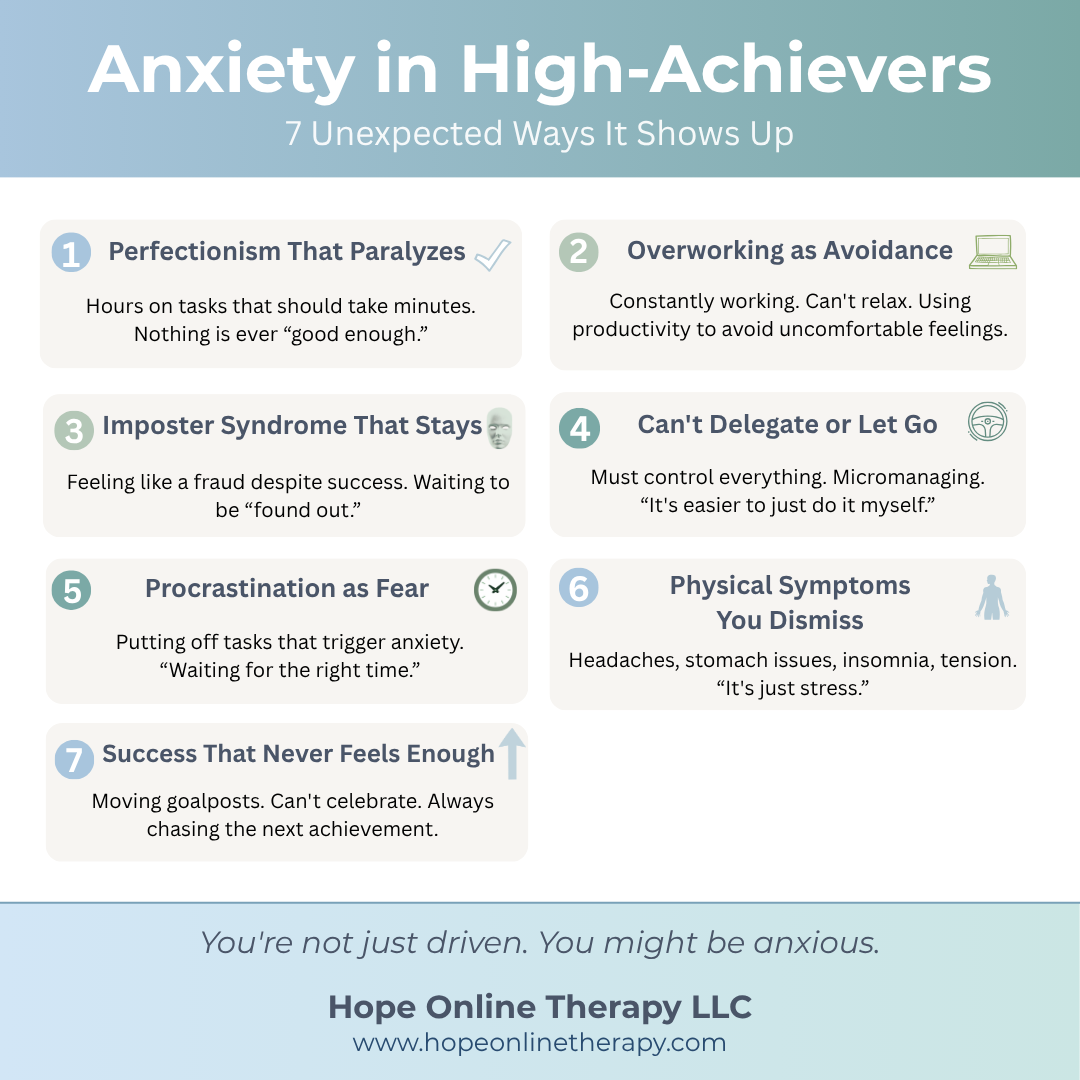
1. Perfectionism That Paralyzes Your Progress
You have impossibly high standards, not just for important projects, but for everything. An email needs to be perfectly worded. A presentation needs to be flawless. A report needs to cover every possible angle.
What it looks like:
Spending hours on tasks that should take minutes
Redoing work multiple times because it's "not quite right"
Struggling to finish projects because they're never "good enough"
Feeling physical anxiety when you can't control every detail
Obsessing over minor mistakes long after they happen
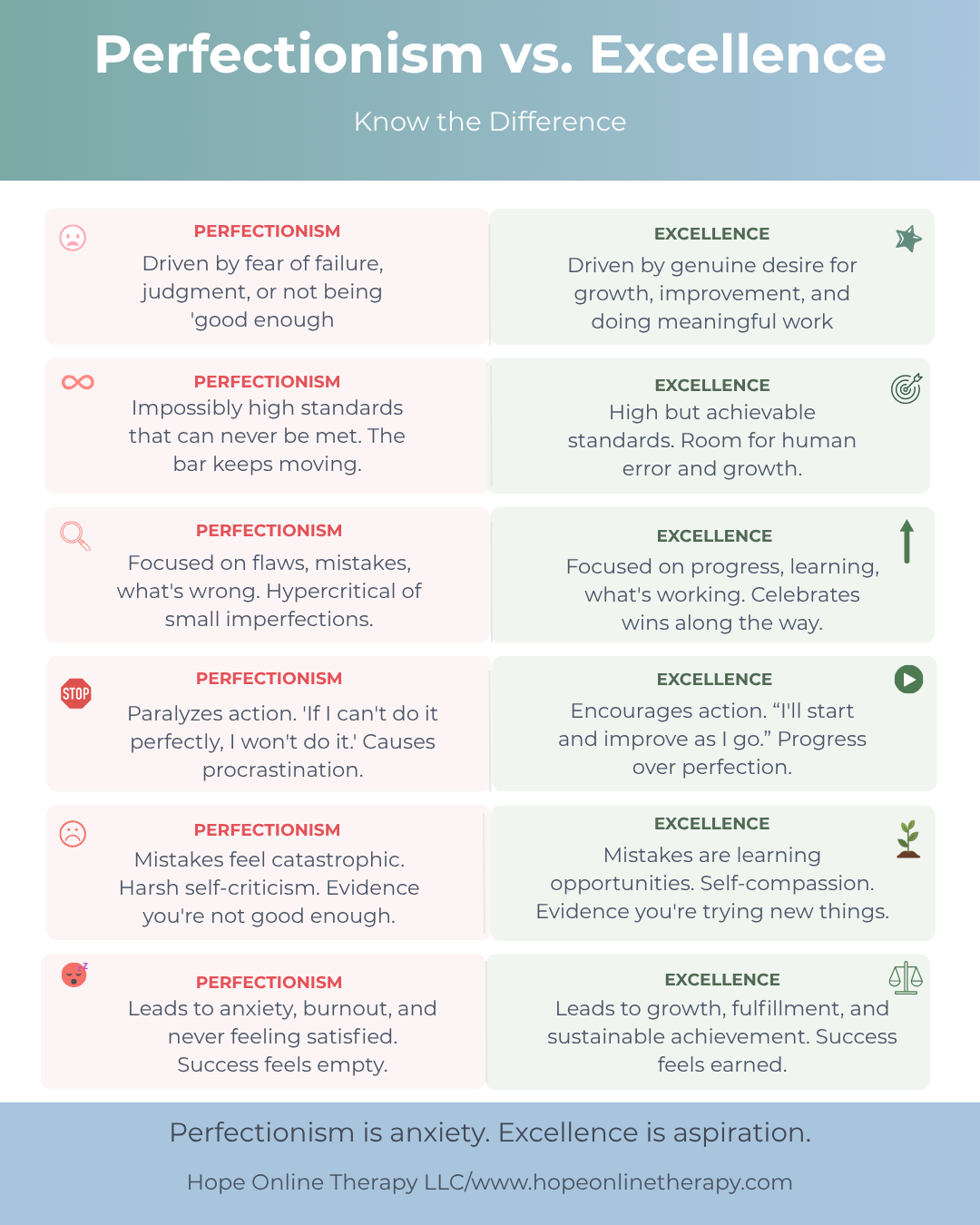
Why it's anxiety: Perfectionism is often driven by fear, fear of judgment, fear of failure, and fear of being exposed as inadequate. The impossibly high standards aren't about excellence; they are about avoiding the anxiety that comes with being less than perfect.
What it costs you: Time, energy, and the ability to actually complete things. Perfectionism doesn't produce better work, it produces slower work, more stress, and often worse outcomes because you're too focused on details that don't matter.
If you're someone who overthinks and sets impossible standards, check out our post on why smart people struggle with anxiety to understand the connection between analytical thinking and perfectionism.
2. Overworking as Emotional Avoidance
You work constantly. Evenings, weekends, vacations, there's always something to do. You tell yourself this is necessary, that this is what success requires.
What it looks like:
Checking email at all hours
Feeling guilty or anxious when you're not working
Using work to avoid uncomfortable feelings
Unable to relax because your brain is always in "work mode"
Sacrificing sleep, relationships, and health for work
Why it's anxiety: Overworking is often a way to avoid anxiety, not address it. When you're working, you're focused and productive. When you stop, the anxiety floods in. So you keep working to keep the anxiety at bay.
What it costs you: Burnout. Health problems. Damaged relationships. The irony? Overworking eventually destroys your ability to perform, but by then, you're so deep in the pattern you feel stuck.
If your overworking is affecting your relationships, our post on how anxiety affects relationships explores this dynamic in depth.
3. Imposter Syndrome That Never Goes Away

No matter how much you achieve, you feel like a fraud. You're waiting for someone to figure out you're not as competent as they think. Every success feels like luck, not skill.
What it looks like:
Attributing success to luck, timing, or other people
Feeling like you "fooled" people into thinking you're capable
Constant fear of being "found out"
Downplaying your accomplishments
Overworking to "prove" you deserve your position
Why it's anxiety: Imposter syndrome is anxiety about being judged and found inadequate. It's your brain catastrophizing: "What if they realize I'm not good enough?" It's the fear that your worth is contingent on performance, and that one mistake will reveal the "truth."
What it costs you: You can never enjoy your achievements. You're always chasing external validation but dismissing it when you receive it. You live in constant fear instead of confidence, no matter how successful you become.
4. Inability to Delegate or Let Go of Control
You have to do everything yourself. Not because others aren't capable, but because you don’t trust that it will be done "right" unless you do it.
What it looks like:
Micromanaging projects or people
Redoing others' work because it's not "your way"
Taking on too much because "it's easier to just do it myself"
Feeling anxious when you're not in control
Bottlenecking progress because everything has to go through you
Doing everything for your kids
Why it's anxiety: Control is an anxiety management strategy. When everything is under your control, you feel safer. When you delegate, you lose control, and then your anxiety spikes. So, you hold onto everything, even when it's unsustainable.
What it costs you: You become the bottleneck. You limit your capacity for growth. You exhaust yourself doing work others could do—and you prevent them from developing their own skills. You can't scale, and you can't rest.
5. Procrastination Masquerading as Perfectionism
You put things off, not because you're lazy, but because the task feels overwhelming. You're waiting for the "right time" or the "right mood" or until you "have enough time to do it right."
What it looks like:
Starting projects at the last minute despite having time
Avoiding tasks that make you anxious (pitches, difficult conversations, high-stakes projects)
Telling yourself you "work better under pressure"
Chronic deadline stress followed by relief (which reinforces the pattern)
Why it's anxiety: Procrastination is often anxiety avoidance. The task triggers anxiety (what if it's not good enough? what if I fail?), so you avoid it. The deadline eventually forces you to act, and the adrenaline overrides the anxiety temporarily.
What it costs you: Chronic stress, which is not healthy. Rushed, lower-quality work. A reputation for being last-minute. And the mental exhaustion of carrying unfinished tasks in your head for weeks.
For more on how anxiety-driven thought patterns keep you stuck in these cycles, see our post on cognitive distortions and CBT.
6. Physical Symptoms You Dismiss as "Just Stress"
Your body is screaming at you, but you're not listening. Headaches, stomach issues, muscle tension, exhaustion, you chalk it up to being busy and keep going.
What it looks like:
Chronic tension headaches or migraines
Digestive issues (IBS, nausea, stomach pain)
Jaw clenching or teeth grinding
Insomnia or poor sleep quality
Getting sick frequently
Muscle tension, especially neck and shoulders
Why it's anxiety: Anxiety doesn't just live in your mind, it lives in your body. When your nervous system is chronically activated (which it is when you're in constant high-achievement mode), your body pays the price.
What it costs you: Long-term health consequences. Chronic pain. Increased risk of serious health issues. And the cognitive load of constantly feeling physically bad while trying to perform at a high level.
7. Success That Never Feels Like Enough
You hit your goal and then immediately set the next one. You get a promotion and start worrying about the next level. You achieve something you've been working toward and feel... nothing. Or worse, you feel anxiety about maintaining it.
What it looks like:
Moving the goalposts every time you achieve something
Inability to celebrate wins
Feeling like you're "behind" no matter how much you accomplish
Always comparing yourself to people further ahead
Exhaustion from constantly chasing the next thing
Why it's anxiety: Achievement becomes a way to manage your anxiety about not being enough. If you can just achieve this, then you'll feel secure, worthy, and successful. But the anxiety doesn't go away with achievement, it just finds a new target.
What it costs you: You never feel fulfilled. Your worth is always contingent on your next achievement. And you miss the present moment, including joy, connection, and the life you've already built, because you're always focused on what's next.
The Real Cost of High-Achievement Anxiety
Let's be honest about what this is costing you.
Your health. Chronic stress wreaks havoc on your body—heart disease, autoimmune issues, digestive problems, sleep disorders. Your body isn't built to run in overdrive indefinitely.
Your relationships. When you're always working, always stressed, always thinking about the next thing, you're not fully present with the people you care about.
Your mental health. High-functioning anxiety often leads to burnout, depression, or breakdown. You can only run on stress hormones for so long before your system crashes.
Your actual performance. Ironically, anxiety-driven behaviors often undermine the very success you're chasing. Perfectionism slows you down. Overworking leads to mistakes. Inability to delegate limits growth. Procrastination creates stress.
Your sense of self. When your identity is entirely wrapped up in achievement, you lose touch with who you are outside of what you produce. Your worth becomes contingent on performance, which is a terrifying way to live.
What to Do If You Recognize Yourself
If you're reading this and thinking "Oh. That's me," here's what to do next.
1. Name it. Stop calling it drive, ambition, or high standards. Call it what it is: anxiety. You can't address what you won't acknowledge.
2. Notice the cost. What is this costing you? Your health? Your relationships? Your peace? Get honest about the price you're paying.
3. Question the beliefs. What do you believe about success, worth, and achievement? Where did those beliefs come from? Are they actually true? Or are they anxiety talking?
CBT (Cognitive Behavioral Therapy) is particularly effective for challenging these beliefs.
4. Set real boundaries. Not working after 7 PM. Taking actual weekends. Delegating tasks even when it's uncomfortable. Saying no to projects that will push you past capacity.
5. Practice "good enough." Not everything needs to be perfect. Most things can be 80% and still be completely fine. Practice finishing instead of perfecting.
6. Address the root cause. High-achievement anxiety doesn't exist in a vacuum. Where did you learn that your worth = your output? What are you trying to prove, or avoid, or achieve? These are questions best explored with a therapist.
When Professional Help Is Essential
You've built a successful career on anxiety-driven behaviors. Changing them isn't just about willpower, it requires understanding and rewiring deep patterns.
Consider therapy if:
You're burned out but can't stop working
Physical symptoms are affecting your health
Your relationships are suffering
You're successful but miserable
You can see the cost but can't change the pattern
You've tried to slow down and felt overwhelming anxiety
Therapy can help you:
Understand where these patterns originated
Separate your worth from your achievement
Learn to manage anxiety without overworking
Set boundaries without guilt
Find fulfillment that doesn't require constant striving
Build a sustainable relationship with work and success
You Can Be Successful Without Being Anxious

Here's what you need to hear: You don't have to choose between success and peace.
The anxiety-driven behaviors that got you here aren't the only path to achievement. In fact, they're often what's holding you back from the next level, because they're unsustainable, they limit your capacity, and they prevent you from actually enjoying what you've built.
You can:
Be ambitious without being anxious
Have high standards without perfectionism
Work hard without overworking
Achieve goals without sacrificing your health
Be successful without constantly feeling like you're not enough
But it requires recognizing that what you've been calling "drive" might actually be anxiety. And that recognition, uncomfortable as it is, is the first step toward building success that doesn't cost you everything.
Need Support Managing High-Achievement Anxiety?
If you're a high-achiever struggling with perfectionism, overworking, imposter syndrome, or burnout, therapy can help.
I work with professionals and high achievers in Texas and Idaho who are ready to build sustainable success, learning to manage anxiety, set boundaries, challenge perfectionistic thinking, and separate worth from achievement.
Virtual therapy means you can fit this important work into your already, full schedule.
Schedule a Free Consultation– Let's talk about how therapy can help you achieve without sacrificing your wellbeing.
You've worked hard to get where you are. You deserve to enjoy it, not just survive it.