Mindfulness for People Who Think They're Bad at Meditation
You downloaded a meditation app. You sat down. You closed your eyes. You tried to "clear your mind."
And immediately, your brain exploded with thoughts.
Did I send that email? What's for dinner? Why is my leg itchy? This is so boring. Am I doing this right? How much longer? I'm terrible at this.
You opened your eyes after three minutes, frustrated and convinced: "I'm just bad at meditation."
Here's the truth: You're not bad at meditation. You just don't understand what meditation actually is.
And here's the even better news: You don't need meditation. You need mindfulness. And mindfulness doesn't require you to sit still, clear your mind, or do anything that feels impossible.
If you're someone who's tried meditation and felt like a failure, if you're skeptical that this "mindfulness thing" could ever work for your particular brain, if you can't imagine sitting still for even five minutes—this post is for you.
Let's talk about what mindfulness actually is, why traditional meditation doesn't work for everyone, and how you can practice mindfulness in ways that feel natural and doable.
The Myth You've Been Sold About Meditation
Most people think meditation means:
Sitting cross-legged in complete silence
Clearing your mind of all thoughts
Achieving some zen state of total calm
Doing it for 20+ minutes at a time
That's not meditation. That's one very specific style of meditation. And it's not the only way—or even the best way—for most people.
Here's what you probably experienced when you tried:
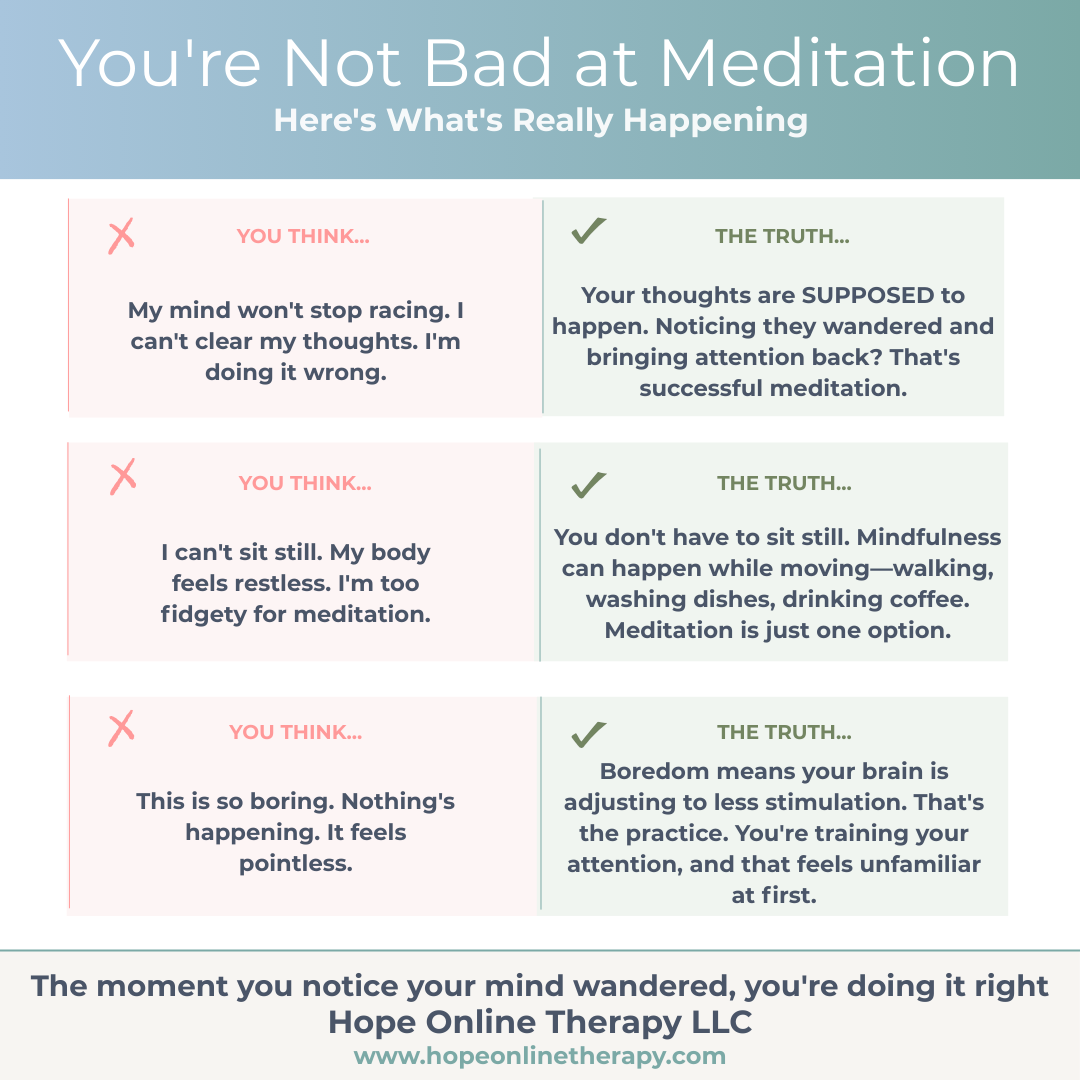
"My mind won't stop thinking." You sat down, closed your eyes, and immediately your brain started chattering. You tried to stop the thoughts. They got louder. You felt like you were failing.
"I can't sit still." Your body felt restless. Your leg itched. Your back hurt. Sitting felt impossible. You wondered how anyone does this.
"It's so boring." Nothing was happening. You were just… sitting there. Your mind wandered. You checked the timer. Only two minutes had passed. This felt pointless.
You concluded: "I'm bad at meditation. This isn't for me."
But here's what actually happened: You were told meditation was one thing, and it's actually something else entirely.
What Meditation Actually Is (And Why Your Thoughts Are Supposed to Happen)
Meditation is not about stopping your thoughts. It's about noticing your thoughts without getting pulled into them.
Think of your mind like a river. Thoughts are the water flowing by. Most of the time, you're in the river, being swept along by every thought. Meditation is learning to sit on the bank and watch the river flow.
When you meditate, thoughts will come. That's not failure. That's the whole point.
The practice isn't stopping thoughts. The practice is:
Noticing when your mind has wandered
Gently bringing your attention back
Repeating this over and over
Every time you notice your mind wandered and bring it back? That's a successful meditation. Not a failed one.
You're not bad at meditation because your mind wanders. You're doing meditation correctly when you notice it wandered and return your focus.
The Real Problem: You're Trying the Wrong Approach
Sitting meditation is like strength training for your attention. It's valuable. But it's not the only way to build that muscle.
If sitting meditation feels impossible, it might mean:
Your nervous system is too activated (you're anxious, stressed, or hypervigilant)
Your body needs to move before it can settle
You're someone who processes better while moving
You haven't found the right style yet
None of this means you can't benefit from mindfulness. It means traditional meditation isn't your entry point.
Mindfulness vs. Meditation: The Difference That Changes Everything
Here's the key distinction:
Meditation is a formal practice, sitting (or lying down) with the specific intention to train your attention.
Mindfulness is a way of being, paying attention to the present moment, on purpose, without judgment. You can be mindful anytime, anywhere, doing anything.
Meditation is one way to practice mindfulness. But it's not the only way.
You can practice mindfulness while:
Washing dishes
Walking
Eating
Brushing your teeth
Waiting in line
Petting your dog
Drinking coffee
Mindfulness doesn't require sitting still. It doesn't require silence. It doesn't require a cushion or an app or 20 free minutes.
It just requires your attention, right here, right now.
Why Mindfulness Matters (Especially If You're Anxious)
If you struggle with anxiety, overthinking, or racing thoughts (see our post on why smart people struggle with anxiety), mindfulness is one of the most effective tools available.
Here's why:
Anxiety lives in the future. Your mind is running simulations of what could go wrong, planning for disasters that haven't happened, worrying about outcomes you can't control.
Depression lives in the past. Your mind is replaying what went wrong, analyzing old conversations, dwelling on regrets.
Mindfulness brings you to the present. Right now, in this moment, you're usually okay. The disaster isn't happening right now. The past isn't happening right now. Right now, you're just here—breathing, existing, safe.
Mindfulness trains your brain to notice when you've left the present and return to it. Over time, this reduces anxiety, breaks rumination cycles, and helps you feel more grounded.
It's not magic. It's practice. And it works.
Everyday Mindfulness: No Meditation Required
The best part about mindfulness? You can start right now, exactly where you are, doing what you're already doing.
Here are simple ways to practice mindfulness throughout your day, no sitting required.
Mindful Morning Coffee (or Tea)
Instead of scrolling your phone while you drink your morning coffee, just drink your coffee.
How to practice:

Notice the warmth of the cup in your hands
Smell the coffee before you drink it
Taste it, really taste it
Feel the warmth as you swallow
Notice when your mind wanders to your to-do list, and bring it back to the coffee
That's it. That's mindfulness.
You're not trying to stop thoughts about your day. You're just practicing returning your attention to the sensory experience of drinking coffee.
Mindful Walking
You walk every day. You can turn any walk into a mindfulness practice.
How to practice:
Feel your feet touching the ground with each step
Notice the rhythm of your walking
Feel the air on your skin
Hear the sounds around you (don't label them as "good" or "bad," just notice them)
When your mind wanders to thoughts, gently bring it back to the physical sensation of walking
You don't need a special walking meditation. Just walk, and pay attention to walking.
This works whether you're walking to your car, around your neighborhood, or through the grocery store.
Mindful Eating (Even Just One Bite)
Most of us eat on autopilot—scrolling, working, watching TV. We finish a meal and barely remember eating it.
How to practice:
Take one bite and actually pay attention to it
Notice the texture, temperature, flavor
Chew slowly
Put your fork down between bites
Notice when you're full (not when your plate is empty)
You don't have to eat every meal this way. Start with one bite. One meal. One snack.
Mindful Breathing (10 Seconds at a Time)
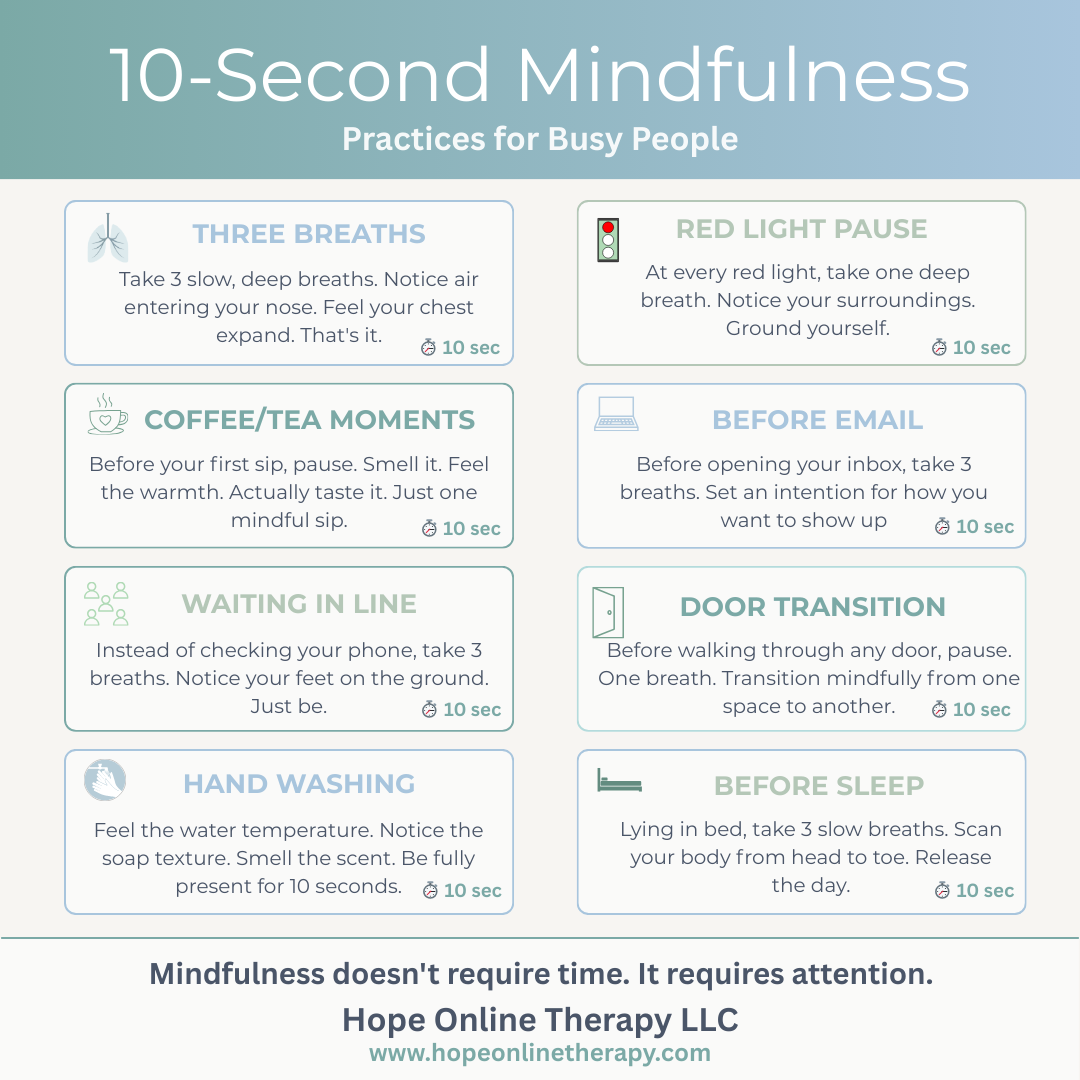
You don't need to sit for 20 minutes. You can practice mindful breathing for 10 seconds.
How to practice:
Wherever you are, take three slow, deep breaths
Notice the sensation of air entering your nose
Feel your chest or belly expand
Notice the exhale
That's it
Do this while:
Waiting at a red light
Before a meeting
In line at the store
Before responding to a stressful text
When you notice you're feeling anxious
Ten seconds. Three breaths. That's a mindfulness practice.
Mindful Transition Moments
The moments between activities are perfect for micro-mindfulness.
How to practice:
Before you get out of your car, pause for five seconds. Notice your breath.
Before you open your laptop, take three breaths.
Before you pick up your phone, pause and ask: "What am I about to do?"
When you close a browser tab, take one breath before opening the next.
These tiny pauses create space. They interrupt autopilot. They bring you back to awareness.
Mindful Observation
Pick one thing and really look at it.
How to practice:
Look at a tree, a flower, a piece of art, your pet, the sky
Really look—notice details you usually miss
When your mind starts narrating or judging, bring it back to just seeing
This works with any sense:
Really listen to music (not as background, as the main event)
Really feel the water in the shower
Really smell your food before eating
You're not trying to have a profound experience. You're just practicing paying attention.
What to Do About the Three Big Obstacles
Obstacle 1: "My Mind Won't Stop Racing"
The truth: Your mind is supposed to race. That's what minds do.
What helps:
Stop trying to stop your thoughts (that's a losing battle)
Instead, practice noticing: "Oh, I'm thinking about work." Then gently return your attention to whatever you're doing.
Think of thoughts like clouds passing through the sky. You don't have to grab them or push them away. Just let them pass.
Start with shorter practices (10 seconds, not 10 minutes)
Racing thoughts don't disqualify you from mindfulness. They're exactly why you need it.
If your mind races often, check out our post on cognitive distortions and overthinking to understand why—and how to work with it.
Obstacle 2: "I Can't Sit Still"
The truth: You don't have to.
What helps:
Practice mindful movement instead—walking, yoga, stretching, even fidgeting mindfully
Try shorter sitting periods (start with 60 seconds)
Let yourself move, scratching an itch or shifting position isn't failure
Consider that your body might need to discharge energy before it can settle (try movement first, then stillness)

Restlessness often means your nervous system is activated. Movement helps.
Obstacle 3: "It Feels Boring and Pointless"
The truth: Boredom is actually a great mindfulness teacher.
What helps:
Get curious about the boredom itself: "What does boredom feel like in my body?"
Start with activities you enjoy (mindful eating of something delicious, mindful listening to music you love)
Reframe: boredom means your brain is used to constant stimulation. This is practice in being okay with less stimulation.
Make it shorter, if it's boring, do less of it
Boredom doesn't mean it's not working. It means your brain is adjusting to a different pace.
You Don't Need to Be "Good" at This
Here's the secret about mindfulness: There's no such thing as being good or bad at it.
You can't fail at noticing. You can't do it wrong. The moment you become aware that your mind has wandered, you're being mindful.
Mindfulness isn't about achieving a state. It's about practicing a skill.
And like any skill, it gets easier with practice. Not because your mind stops wandering (it won't), but because you get faster at noticing when it wanders and bringing it back.
You're not trying to become a zen master. You're just practicing paying attention.
That's it. That's the whole thing.
How to Start (Even If You're Skeptical)
If you've made it this far and you're thinking, "Okay, maybe I could try this," here's how to start:
1. Pick one everyday activity. Just one. Coffee, walking, brushing your teeth—something you already do.
2. For one week, do that activity mindfully. Not perfectly. Not every time. Just when you remember.
3. Don't judge yourself. You'll forget. You'll get distracted. Your mind will wander. That's normal. Just start again.
4. Notice how you feel. After a week, check in: Do you feel any different? Even slightly?
That's your experiment. No pressure. No performance. Just curiosity.
When Professional Support Helps
Mindfulness is a powerful tool, but it's not a replacement for therapy, especially if you're dealing with anxiety, trauma, or depression.
Consider therapy if:
Mindfulness feels impossible because your anxiety is too high
You need help with the underlying issues driving your racing thoughts
You want to learn mindfulness in a structured, supported way
Your mind won't settle even with gentle practices
A therapist can help you understand why your mind works the way it does and give you tools, including mindfulness, that are tailored to your specific needs.
You're Not Bad at This. You're Just Starting.
If you've tried meditation and felt like you failed, you didn't fail. You just tried one approach that didn't fit.
Mindfulness isn't one-size-fits-all. What works for someone else might not work for you. And that's okay.
You don't need to sit in silence for 20 minutes. You don't need to clear your mind. You don't need a special cushion or app or perfect environment.
You just need to pay attention, to anything, for any amount of time.
That coffee you're drinking. That walk you're taking. That breath you're breathing right now.
That's mindfulness.
And you're already doing it.
Need Support Building Mindfulness Skills?
If anxiety, overthinking, or racing thoughts are making mindfulness feel impossible, therapy can help.
I work with adults in Texas and Idaho who want to learn practical tools to manage anxiety and stress—including mindfulness practices tailored to how your brain actually works.
Virtual therapy means you can learn these skills from the comfort of home, on your schedule.
Schedule a Free Consultation – Let's talk about how therapy can help you build mindfulness practices that actually fit your life.
You don't need to be "good" at meditation. You just need tools that work for you.