How to Communicate When You're Triggered (Without Making Things Worse)

You're in the middle of a normal conversation, and then it happens. Something is said, a word, a tone, a look, and suddenly you're not responding to the actual conversation anymore. You're reacting to something bigger.
Your heart rate spikes. Your thoughts race or go completely blank. You feel the urge to defend yourself, shut down, or say something you'll regret.
In that moment, anything you say is coming from your activated nervous system, not your clearest thinking. And that's exactly when communication tends to go sideways, not because you don't care about the relationship, but because you're temporarily not operating from your most thoughtful self.
Here's the good news: you don't have to choose between saying nothing and saying something you'll regret. There's a middle path, ways to communicate honestly while triggered that don't torch the conversation or the relationship.
Let's talk about what's actually happening in your brain and body when you're triggered, and how to communicate through it without making things worse.
What "Triggered" Actually Means
"Triggered" gets used casually, but the experience is physiological, not just emotional. When you're triggered, your nervous system has moved into a stress response, often fight, flight, or freeze, based on something in the present moment that resembles a past hurt, whether or not you're consciously aware of the connection.
In this state:
Your access to calm, rational thinking is genuinely reduced (this isn't a character flaw, it's biology)
Your body is preparing to defend or protect you, even if there's no real threat
Your interpretation of what's happening is colored by whatever got activated, not just the facts in front of you
This is why arguments that start over something small can spiral fast. You're not just responding to what was said, you're responding to what it represents to your nervous system.
If you want to understand this pattern more deeply, especially if certain situations reliably set you off, our post on how to identify your triggers without reliving the trauma is a good next read.
Why "Just Communicate Calmly" Doesn't Work in the Moment
Most communication advice assumes you have full access to your rational brain. Advice like "use I-statements" or "listen actively" is genuinely useful, but it's hard to access when you're flooded.
This is why trying to "just be calm" often backfires. You can't think your way out of a nervous system response with willpower alone. Trying to force calm while your body is activated often increases frustration, now you're anxious about being anxious, on top of whatever triggered you in the first place.
The goal isn't to never get triggered. The goal is to have a plan for what to do when you are, one that doesn't require you to have perfect composure in the moment.
Step 1: Notice You're Triggered (Before You Speak)
The most useful skill isn't a perfect script, it's recognizing you're activated before words come out.
Signs you might be triggered, not just upset:
The reaction feels bigger than the situation warrants
You feel a strong urge to defend, attack, or disappear
Your body is reacting—tight chest, racing heart, clenched jaw
You're having trouble thinking clearly or finding words
Old, familiar feelings are showing up (shame, fear, powerlessness) that don't quite match what's happening right now
Try this internal check: Am I responding to what's actually happening, or to what this reminds me of? You don't need a definitive answer in the moment, just asking the question creates a small but useful pause.
Step 2: Buy Yourself Time Before You Respond

You don't have to respond immediately. In fact, responding immediately while triggered is often where things go wrong.
Phrases that buy you time without shutting the conversation down:
"I want to respond to this, but I need a minute first."
"I'm noticing I'm having a strong reaction. Can we pause for a few minutes?"
"I don't want to say something I don't mean right now. Let's come back to this."
"I need to step away and come back to this in [X minutes]."
Why this works: It communicates that you're taking the conversation seriously, not avoiding it, while giving your nervous system time to come back down. A short break (even 10-20 minutes) is often enough for your body to shift out of a full activation state.
Important: If you use this strategy, actually come back. Taking space and never returning to the conversation erodes trust over time. The pause is a tool, not an exit. This is especially important in marriages.
Step 3: Regulate Before You Communicate
Once you've bought yourself some space, use it. Talking through a disagreement while your body is still flooded rarely goes well, even with the best intentions. This is because the logical part of the brain shuts down when flooded.
Quick regulation options:
Slow, deliberate breathing, with a longer exhale than inhale
Splash cold water on your face or hold something cold
Step outside or change your physical environment
Name what you're feeling out loud or in your head ("I'm activated. My chest is tight. This is a stress response.")
Move your body, a short walk, stretching, shaking out your hands
Why this matters: You're not trying to erase the feeling. You're trying to lower the intensity enough that you can access your more thoughtful thinking again. You don't need to feel completely calm, just calm enough to choose your words instead of reacting on autopilot.
Step 4: Communicate the Trigger Itself (When You're Ready)
Once you're regulated enough to speak clearly, you have a choice: address the original topic, or first name what happened for you. Often, naming the trigger honestly is more productive than pretending it didn't happen.
Try this structure:
Name your reaction, not just the other person's behavior: "When you said that, I had a really strong reaction."
Separate the trigger from blame (when appropriate): "I don't think you meant it this way, but it hit something for me."
Say what you need: "Can we slow down and talk about this differently?"
Example: Instead of: "You always do this, you never listen to me!" (said while flooded)
Try, after regulating: "When you cut me off just now, I felt really dismissed, and honestly, that's a sensitive spot for me. Can we try that conversation again?"
This kind of honesty is often more connecting than either exploding or stonewalling. It tells the other person what's really happening instead of leaving them to guess, or to only see the sharp edge of your reaction.
If this pattern shows up often in a specific relationship, our post on how anxiety affects your relationships explores related dynamics in more depth.
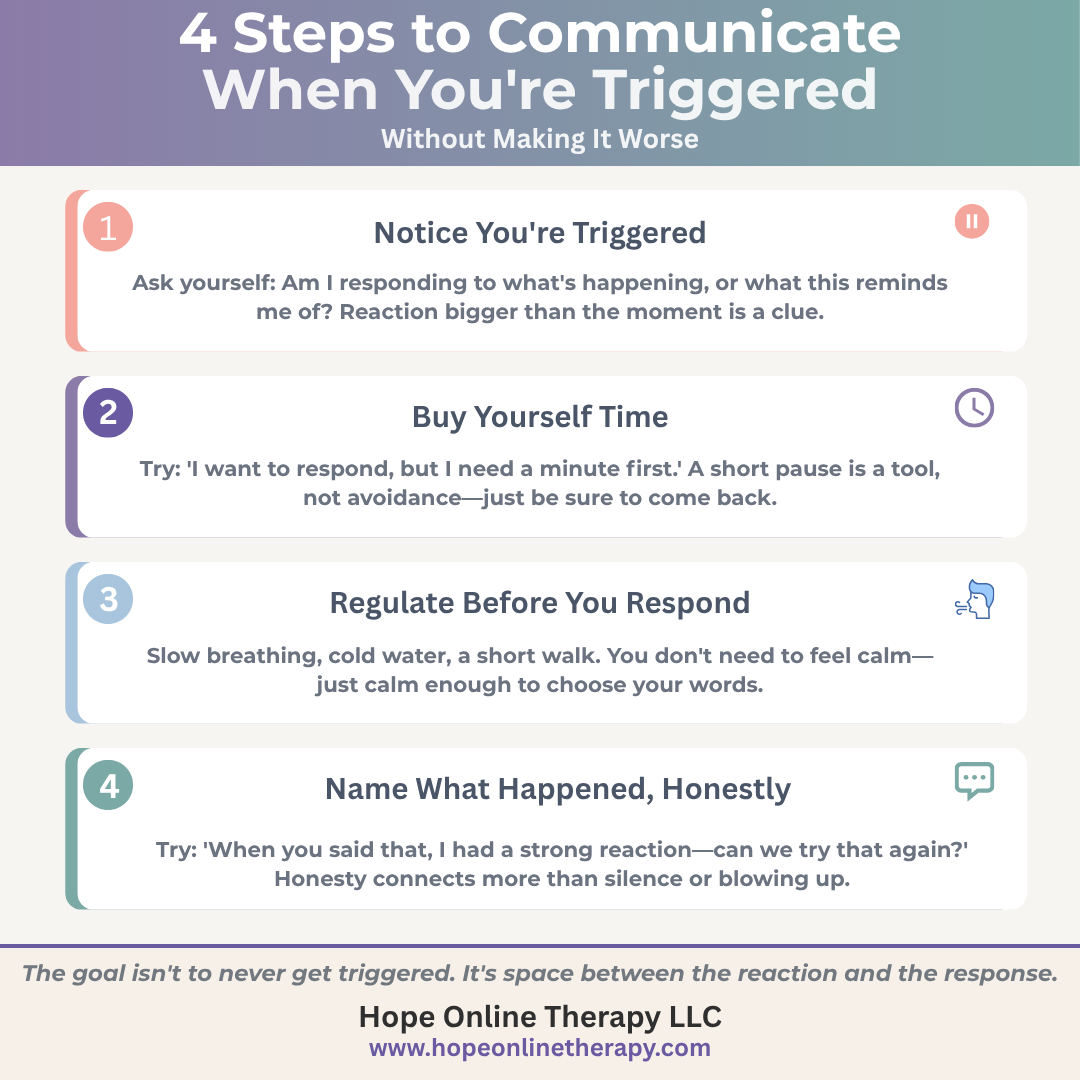
Save this for your next hard conversation 👆
What to Avoid While Triggered
Even with the best intentions, a few things reliably make triggered communication worse:
Avoid diagnosing the other person in the moment. "You're being manipulative" or "You always do this" tends to escalate rather than clarify, even if there's truth underneath it. Save pattern conversations for a calmer moment.
Avoid demanding an immediate resolution. Trying to fully resolve a conflict while either person is still activated usually just re-triggers the cycle. It's okay to pause and finish the conversation later.
Avoid using absolutes. "Always" and "never" tend to make the other person defensive, which escalates things further, regardless of how it feels true in the moment.
Avoid apologizing just to end the discomfort. A rushed, anxious apology to make the tension stop isn't the same as a genuine one, and it often leaves the actual issue unaddressed.
What to Do After the Moment Passes
Once things have settled, there's still useful work to do, for the relationship and for yourself.
Reflect honestly. What actually got triggered? Was it about this situation, or did it touch something older? You don't need to have this fully figured out, but a little curiosity here goes a long way.
Repair if needed. If you said something sharp or shut down completely, a simple repair goes further than you'd think: "I got really activated earlier and I don't think I communicated well. Can we try again?"
Notice patterns over time. If certain topics, tones, or dynamics reliably trigger you, that's useful information—not something to feel ashamed of. Understanding your own patterns (and sometimes working with a therapist to understand where they come from) makes each future instance a little more manageable.
Our post on cognitive distortions and how CBT helps is a useful next step if you notice your triggered thoughts tend to follow predictable patterns—like assuming the worst, mind-reading, or catastrophizing.
When This Is Bigger Than a Communication Skill
Sometimes triggered reactions are proportionate to a genuinely difficult moment, a rude comment, a broken boundary, real disrespect. Communication tools can help you respond well in those moments.
But sometimes the intensity of the reaction points to something deeper: old trauma, an anxious attachment pattern, or a nervous system that's chronically on high alert. If you notice:
The same intense reaction shows up across many different relationships or situations
You struggle to regulate even with time and space
Your reactions feel disconnected from what's actually happening in the present
These patterns are damaging relationships you care about, repeatedly
...this may be a sign that trauma or a deeper pattern is underneath what's happening, and it's worth exploring with a therapist rather than managing alone with communication scripts.
You're Not the Problem for Getting Triggered
Getting triggered doesn't mean you're broken, overreacting, or bad at relationships. It means your nervous system is doing exactly what nervous systems do, protecting you based on past experience, sometimes in situations where that protection isn't actually needed anymore.

The goal was never to stop having reactions. The goal is to build a little more space between the reaction and your response, enough space to choose words that reflect what you actually mean, instead of words that come from the most activated part of you.
That space is a skill. It takes practice, and it's completely learnable.
Need Support Managing Triggers in Communication?
If getting triggered is affecting your relationships, work, or peace of mind, therapy can help.
I work with adults in Texas and Idaho who are learning to understand their triggers, regulate their nervous systems, and communicate in ways that actually reflect what they mean, even in hard moments.
Virtual therapy means you can get support from home, on a schedule that works for you.
Schedule a Free Consultation – Let's talk about how therapy can help you communicate more clearly, even when you're activated.
You don't have to get this perfect. You just have to keep practicing the pause.