Coping with Back-to-School Anxiety: A Guide for Parents

The backpacks are bought. The school supplies are checked off the list. And underneath all the logistics, there's a feeling you might not be talking about: dread.
Maybe it's watching your child grow quiet and withdrawn as the first day approaches. Maybe it's the stomachaches that started showing up last week with no obvious cause. Maybe it's your own anxiety, about drop-off, about whether they'll make friends, or about whether you're doing enough to prepare them.
Back-to-school season isn't just a scheduling shift. For a lot of families, it's an anxiety trigger, for kids and parents alike.
And here's what makes it harder: everyone around you seems to be posting cheerful first-day photos and talking about how "ready" they are for the new routine. If your household is instead full of tears, resistance, or a knot in your own stomach, it can feel like you're doing something wrong.
You're not. Back-to-school anxiety is common, it's real, and there's a lot you can do to help your child, and yourself, move through it.
Why Back-to-School Anxiety Happens
Transitions are hard on the nervous system, even good ones. Going from unstructured summer days to early alarms, new teachers, new classrooms, and new social dynamics is a lot of change at once.
For kids, back-to-school anxiety often stems from:
Fear of the unknown (new teacher, new classroom, new schedule)
Social worries (Will I have friends? Will I sit alone at lunch?)
Academic pressure (Will the work be too hard? Will I fall behind?)
Separation anxiety, especially in younger children
Sensory overwhelm from noise, crowds, and new routines
Past negative experiences at school (bullying, academic struggles, a difficult teacher)
For parents, it often stems from:
Watching your child struggle and feeling helpless to fix it
Your own memories of school being difficult
Logistical overwhelm (schedules, forms, activities, childcare)
Worry about whether your child is "ready" compared to peers
Guilt about returning to work routines or less flexible schedules
Anticipating pushback, tears, or meltdowns before they even happen

Both of these are happening at the same time, in the same house, often feeding off each other. A child who senses a parent's anxiety may become more anxious themselves. A parent who's already stretched thin may have less capacity to stay calm during a child's meltdown. It's a loop, not a one-way street.
Understanding that this is a shared, physiological response, not a character flaw in your child or a parenting failure on your part, is the first step toward handling it well.
Signs Your Child Might Be Struggling (Beyond "I Don't Want to Go")
Kids don't always say "I'm anxious about school." Often, anxiety shows up sideways.
Watch for:
Stomachaches or headaches, especially on school mornings, that resolve once they know they don't have to go
Increased irritability or meltdowns around bedtime or morning routines
Trouble sleeping, or new nightmares
Regression in younger kids (clinginess, thumb-sucking, potty accidents)
Avoidance behaviors—dawdling, "forgetting" things, refusing to get dressed
Excessive questions about the school day, seeking repeated reassurance
Changes in appetite
New or worsening perfectionism about homework or performance
None of these mean something is deeply wrong. They're common signals of a nervous system trying to cope with change. But noticing the pattern helps you respond with the right kind of support instead of frustration.
How to Support an Anxious Child
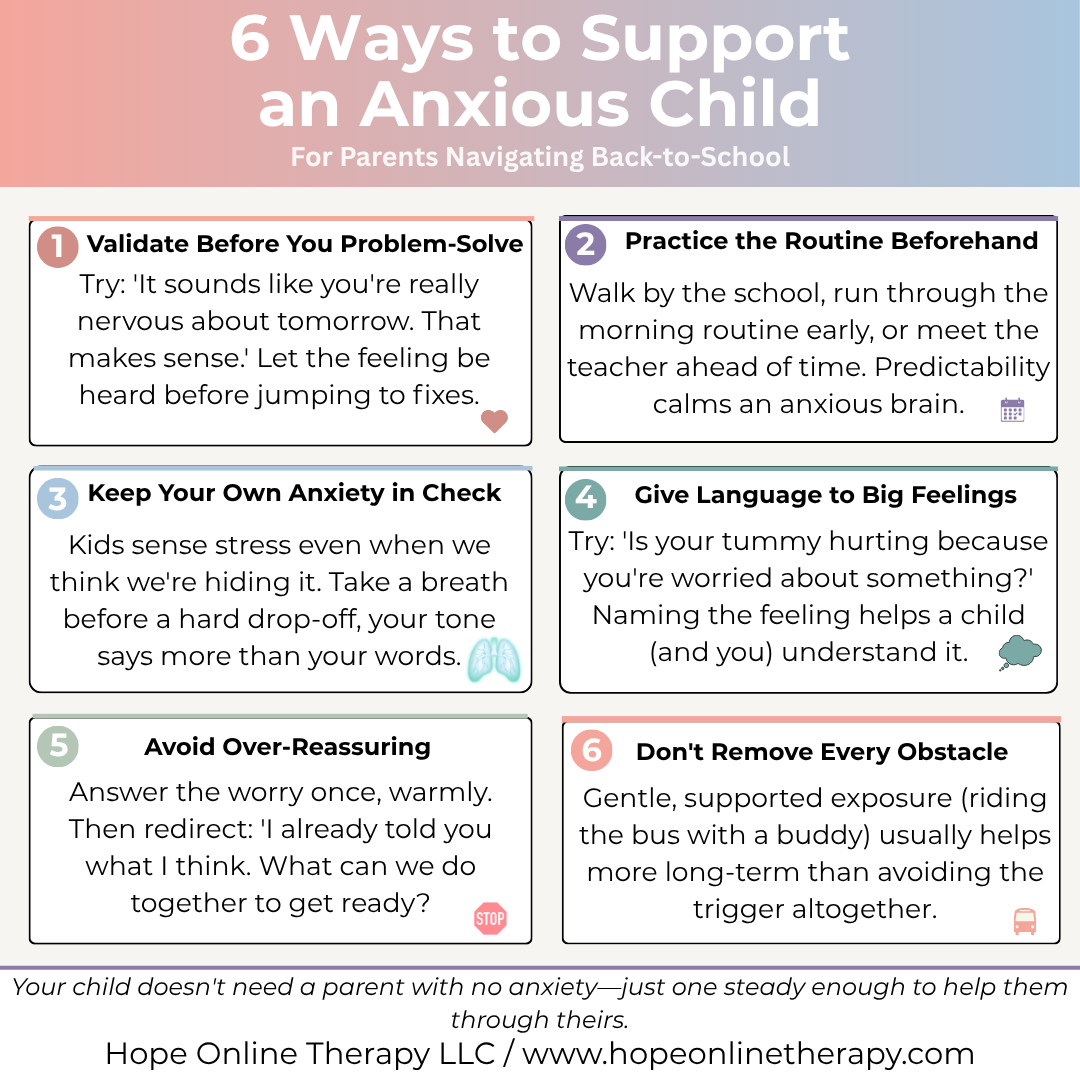
Save this before the first day 👆
Validate Before You Problem-Solve
When your child says "I don't want to go," the instinct is often to jump straight to reassurance or logic: "You'll be fine! You love school!" But minimizing the fear, even with good intentions, can make a child feel unheard, which often increases anxiety rather than easing it.
Try this instead: "It sounds like you're really nervous about tomorrow. That makes sense, it's a big change." Let the feeling be acknowledged before you move toward solutions.
Practice the Routine Before It's Real
Anxiety thrives on uncertainty. The more predictable you can make the transition, the less your child's brain has to brace for the unknown.
Walk or drive by the school beforehand
Practice the morning routine a few days early (without the pressure of actually having to leave)
If possible, meet the teacher or see the classroom ahead of time
Talk through what the day will look like, step by step
Keep Your Own Anxiety in Check (As Much As You Can)
Kids are remarkably attuned to parental stress, even when we think we're hiding it well. This doesn't mean you need to be perfectly calm, that's not realistic or necessary. But it does mean it's worth noticing when your own nerves are leaking into the interaction.
Try this: Before a hard drop-off, take a breath before you speak. Your tone often communicates more than your words. A steady "I love you, you've got this, I'll see you after school" lands very differently than the same words said in a rushed, anxious tone.
Give Language to Big Feelings
Younger kids especially may not have the words for what they're feeling. Giving them language helps them (and you) understand what's actually going on.
Try this: "Is your tummy hurting because you're worried about something?" or "On a scale of a little nervous to super nervous, how are you feeling about tomorrow?"
Avoid Over-Reassuring
It feels natural to answer anxious questions with more and more reassurance ("I promise you'll make friends, I promise it'll be fine"). But excessive reassurance can actually reinforce anxiety over time, because it teaches the brain that the worry needs to be soothed externally rather than tolerated.
Try this: Answer the question once, warmly and honestly. Then gently redirect: "I already told you what I think will happen. What's something we can do together to get ready?"
Don't Rush to Remove Every Obstacle
If your child is anxious about a specific part of the day, the bus, lunchroom, gym class, it can be tempting to arrange around it entirely. Sometimes accommodation is appropriate. But avoidance often makes anxiety bigger over time, not smaller. Gentle, supported exposure (riding the bus with a buddy the first week, practicing opening a lunch container at home) usually helps more in the long run than avoiding the trigger altogether.
If this pattern of anxiety and avoidance feels familiar or ongoing, our post on how to identify your triggers without reliving trauma may be a useful next read, especially if there's a specific past experience underlying the fear.
Supporting Teens Through Back-to-School Anxiety
Older kids and teens often experience back-to-school anxiety differently, less about separation, more about social pressure, identity, academic performance, and comparison.
What it can look like:
Increased time on phone/social media comparing themselves to peers
Perfectionism about grades or extracurriculars
Withdrawal or irritability rather than obvious "I'm scared"
Physical symptoms dismissed as "just tired"
Reluctance to talk about specific worries, even when something is clearly bothering them
What helps:
Asking open-ended questions instead of yes/no ones ("What are you most looking forward to? What's stressing you out most?")
Resisting the urge to immediately fix or minimize
Normalizing that anxiety about a new year is common, even among kids who "have it together"
Watching for perfectionism specifically, many teens carry pressure that looks like ambition but functions like anxiety
If your teen tends to overthink, hold impossibly high standards for themselves, or seems anxious despite being high-performing, our post on why smart people struggle with anxiety offers useful language for understanding (and gently naming) that pattern with them.
Managing Your Own Back-to-School Anxiety
Parents often put all their energy into managing their child's anxiety and none into their own. But your wellbeing matters here too, and your capacity to support your child depends on it.
Name What You're Actually Worried About
Vague dread is heavier than a specific concern. Are you worried about your child's social experience? Your own logistics? A past school year that was difficult? Getting specific makes the worry more manageable and often reveals which parts are within your control and which aren't.
Release the Pressure to Make It Perfect
You don't have to have the perfectly organized school year, the ideal morning routine, or a child who transitions flawlessly. "Good enough" mornings, everyone fed, dressed, and out the door, even if it wasn't calm, are still successful mornings.
Watch for Your Own Catastrophizing
It's easy to spiral: "If they struggle to make friends this year, it'll affect their whole life." Try catching these thoughts and asking: What's the evidence? What's more likely? This kind of thought-challenging is a core piece of CBT, which we cover in more depth in our post on cognitive distortions and how CBT helps.
Build in Your Own Decompression

If drop-off is hard, don't schedule something demanding immediately after. Give yourself even ten minutes to reset before diving into the rest of your day. Your nervous system needs a transition too.
Connect with Other Parents
You are not the only parent whose child cried at drop-off or whose own stomach was in knots on the first day. Talking honestly with other parents, rather than only seeing the curated, cheerful version on social media, can be enormously normalizing.
When It's More Than Normal Adjustment
Some anxiety around a new school year is expected and typically eases within the first few weeks as routines become familiar. But sometimes it signals something that needs more support.
Consider professional support if:
Anxiety persists well beyond the first few weeks of school
Physical symptoms (stomachaches, headaches) are frequent and significant
Your child is missing school regularly due to anxiety
There are signs of bullying, a difficult teacher relationship, or a learning difficulty underneath the anxiety
Your child's anxiety is affecting sleep, appetite, or mood beyond school days
Your own anxiety about the school year feels unmanageable or is affecting your daily functioning
A therapist can help determine whether what you're seeing is a normal transition, an anxiety pattern that needs specific tools, or something else that needs to be addressed.
You're Not Failing—You're Both Adjusting
If this school year is starting with tears, resistance, or your own quiet dread, you haven't done anything wrong. Transitions are hard, and back-to-school is one of the bigger ones your family will move through every single year.
Your child doesn't need a parent who has erased all their own anxiety. They need a parent who can stay steady enough to help them move through theirs. That's a realistic goal, not a perfect one.
Give it time. Give yourself grace. And know that the dread you're both feeling right now is very unlikely to be the way the whole year feels.
Need Support with Back-to-School Anxiety?
If your back-to-school anxiety is harder than you expected this year, therapy can help.
I work with parents in Texas and Idaho who are navigating school transitions, anxiety, and the everyday stress of raising kids in a demanding world.
Virtual therapy means you can get support without adding another thing to your already-full schedule.
Schedule a Free Consultation– Let's talk about how therapy can help you move through this transition with more ease.
You don't have to figure this out alone.