Cognitive Distortions That Keep You Stuck (And How CBT Helps You Break Free)
Your brain is lying to you. Not on purpose. Not maliciously. But it's telling you stories that aren't entirely true, and you're believing them.
"They didn't text back. They must not like me anymore."
"I made one mistake. I'm terrible at my job."
"They seemed quiet. They're definitely mad at me."
"If I don't do this perfectly, there's no point in doing it at all."
These thoughts feel like facts. They feel obvious, logical, true. But they're not facts, they are cognitive distortions. They are twisted patterns of thinking that your brain has gotten really good at.
And here's the thing: these distorted thoughts don't just feel bad. They keep you stuck. They fuel anxiety, depression, self-doubt, and relationship problems. They make you see threats that aren't there and miss possibilities that are.
The good news? Once you learn to recognize these patterns, you can start challenging them. And that's exactly what Cognitive Behavioral Therapy (CBT) helps you do.
CBT isn't about "positive thinking" or pretending everything's fine. It's about learning to see your thoughts more clearly, and choosing ones that actually serve you.
Let's talk about the most common cognitive distortions, how they show up in real life, and how CBT can help you break free from them.
What Are Cognitive Distortions?
Cognitive distortions are patterns of biased or irrational thinking. They're mental shortcuts your brain takes, shortcuts that distort reality in unhelpful ways.
Everyone has them. Your brain developed these patterns to help you make sense of the world quickly. But when these patterns become automatic and go unchallenged, they create problems.
They make you:
Misinterpret situations
Jump to worst-case conclusions
Blame yourself for things outside your control
See everything in extremes
Miss the bigger picture
Think of cognitive distortions like wearing glasses with the wrong prescription. Everything looks distorted, not because reality changed, but because your lens is off.
CBT helps you take off those glasses and see more clearly.
Cognitive distortions fuel anxiety—learn more about anxiety in relationships
The Most Common Cognitive Distortions (And How They Show Up)
1. All-or-Nothing Thinking (Black-and-White Thinking)
What it is: You see things in extremes. No middle ground, no gray area. It's perfect or it's a disaster. You're either a success or a total failure.
How it shows up:
"I ate one cookie. I've completely blown my diet."
"I didn't get the promotion. I'm a failure."
"They didn't like my idea. I'm terrible at my job."
"If I can't do it perfectly, there's no point in trying."
Why it's a problem: Life is rarely all-or-nothing. Most situations exist in the gray area. This distortion makes you feel like you're constantly failing when you're actually just being human.
Real-life example: You're trying to exercise more. You planned to work out five days this week but only made it three days. Instead of recognizing that three days is progress, you think "I failed. I can't stick to anything." So you give up entirely, even though three days was actually great.
2. Catastrophizing
What it is: You immediately jump to the worst possible outcome. Your brain goes straight to disaster.
How it shows up:
"My partner seems quiet. They're definitely going to break up with me."
"I have a headache. Do I have a brain tumor?"
"My boss wants to talk to me. I'm getting fired."
"They didn't respond to my text. They must hate me."
Why it's a problem: You're living in constant fear of things that probably won't happen. It creates anxiety, panic, and prevents you from seeing more likely (and less catastrophic) explanations.
Real-life example: Your friend cancels plans last minute. Instead of thinking "they're probably tired" or "something came up," your brain goes: "They don't actually want to hang out with me. They're pulling away. I'm losing this friendship." You spend the next two days anxious and upset—over something that never happened.
3. Mind Reading
What it is: You assume you know what others are thinking, usually assuming they're thinking something negative about you.
How it shows up:
"They didn't smile at me. They must be mad."
"She's being quiet. She thinks I'm annoying."
"He didn't laugh at my joke. He thinks I'm stupid."
"They're taking forever to respond. They're ignoring me on purpose."
Why it's a problem: You can't actually read minds. But when you assume you can, and assume the worst, you create problems that don't exist. You react to your assumptions instead of reality.
Real-life example: You text a friend and they don't respond for three hours. Your brain decides: "They're mad at me. They saw my text and chose not to respond. I must have said something wrong." So you send a follow-up: "Are you mad at me?" In reality, they were in a meeting and forgot to respond. But now they're confused about why you are asking if they're mad.
4. Overgeneralization
What it is: You take one negative experience and turn it into a never-ending pattern. One piece of evidence becomes "proof" that things will always be this way.
How it shows up:
"I failed this test. I'm bad at school."
"This relationship didn't work out. I'll never find anyone."
"I got rejected for one job. No one will ever hire me."
"They criticized my work. Everyone thinks I'm incompetent."
Why it's a problem: One data point doesn't define a pattern. But overgeneralizing makes you feel hopeless, like change is impossible.
Real-life example: You go on a first date and it doesn't go well. Instead of thinking "that person wasn't a good match," you conclude: "I'm terrible at dating. I'll always be alone. There's something wrong with me." One bad date becomes proof that you're undateable.
5. Personalization (and Blame)
What it is: You take responsibility for things that aren't your fault, or you blame yourself when something goes wrong, even when you had little or no control.
How it shows up:
"My partner is in a bad mood. I must have done something wrong."
"The meeting went badly. It's my fault."
"My friend is upset. I should have done more to help."
"My kid is struggling. I'm a bad parent."
Why it's a problem: You end up carrying the weight of things you can't control. You blame yourself for other people's emotions, outcomes, or circumstances, even when you're not responsible.
Real-life example: Your boss is short with you during a meeting. You immediately think: "I did something wrong. They're upset with me." You spend the rest of the day anxious, replaying the conversation. Later you find out your boss was dealing with a personal issue and it had nothing to do with you. But you had already spent hours feeling guilty about something that wasn't your fault.
6. Should Statements
What it is: You have rigid rules about how you, others, or the world "should" be. When reality doesn't match your "shoulds," you feel frustrated, guilty, or angry.
How it shows up:
"I should be further along in my career by now."
"I shouldn't feel anxious about this."
"They should have known what I needed."
"I should be able to handle this without help."
Why it's a problem: "Should" statements create unrealistic expectations and constant disappointment. They leave you feeling like you're always falling short, even when you're doing fine.
Real-life example: You're exhausted after a long week and spend Saturday on the couch. Instead of resting, you think: "I should be more productive. I should be working out. I should be doing something useful." So you feel guilty the entire time you're resting, which means you don't actually recover.
7. Emotional Reasoning
What it is: You believe that because you feel something, it must be true. Your emotions become evidence.
How it shows up:
"I feel like a failure, so I must be a failure."
"I feel anxious about this, so it must be dangerous."
"I feel guilty, so I must have done something wrong."
"I feel unlovable, so I must be unlovable."
Why it's a problem: Feelings are real, but they're not always accurate. Just because you feel something doesn't make it true. Emotional reasoning keeps you trapped in negative beliefs.
Real-life example: You're preparing for a presentation and feel terrified. Because you feel so anxious, you conclude: "I'm going to fail. This is going to be a disaster." So you consider canceling. But feeling anxious doesn't mean you're unprepared or that it will go badly, it just means you're nervous.
8. Mental Filter (Disqualifying the Positive)
What it is: You focus exclusively on the negative and filter out anything positive. Good things don't count, only the bad things do.
How it shows up:
You get 9 out of 10 positive comments, but that one negative comment is all you focus on.
"Sure, the presentation went well, but I stumbled over one sentence."
"They complimented me, but they were probably just being nice."
"I had a good day, but tomorrow will probably be terrible."
Why it's a problem: When you only see the negative, everything feels hopeless. You miss the evidence that contradicts your negative beliefs.
Real-life example: You receive a performance review at work. It's overwhelmingly positive, your boss praises your work, your attitude, your contributions. But there's one small area for improvement mentioned. You fixate on that. You leave the meeting thinking: "I'm not good enough. They think I'm failing." You completely dismiss all the praise.
Why Your Brain Does This
Before we talk about how to fix it, it helps to understand why your brain creates these distortions in the first place.
Your brain is wired for survival, not accuracy. It's designed to scan for threats, predict danger, and keep you safe. In our ancestors' world, that was helpful. Missing a threat could be deadly.
But in modern life, your brain still operates like it's scanning for predators. Except now the "threats" are social situations, work stress, and uncertain outcomes.
Cognitive distortions are your brain's way of trying to protect you. It's trying to:
Prepare you for the worst (catastrophizing)
Help you avoid rejection (mind reading)
Motivate you to do better (should statements)
Keep you vigilant (overgeneralization)
The problem is, these patterns don't actually protect you. They just make you miserable.
And here's the really important part: you're not doing this on purpose. These patterns are automatic. They're habits your brain has developed over time.
The good news? Habits can be changed. And that's where CBT comes in.
What Is CBT (Cognitive Behavioral Therapy)?
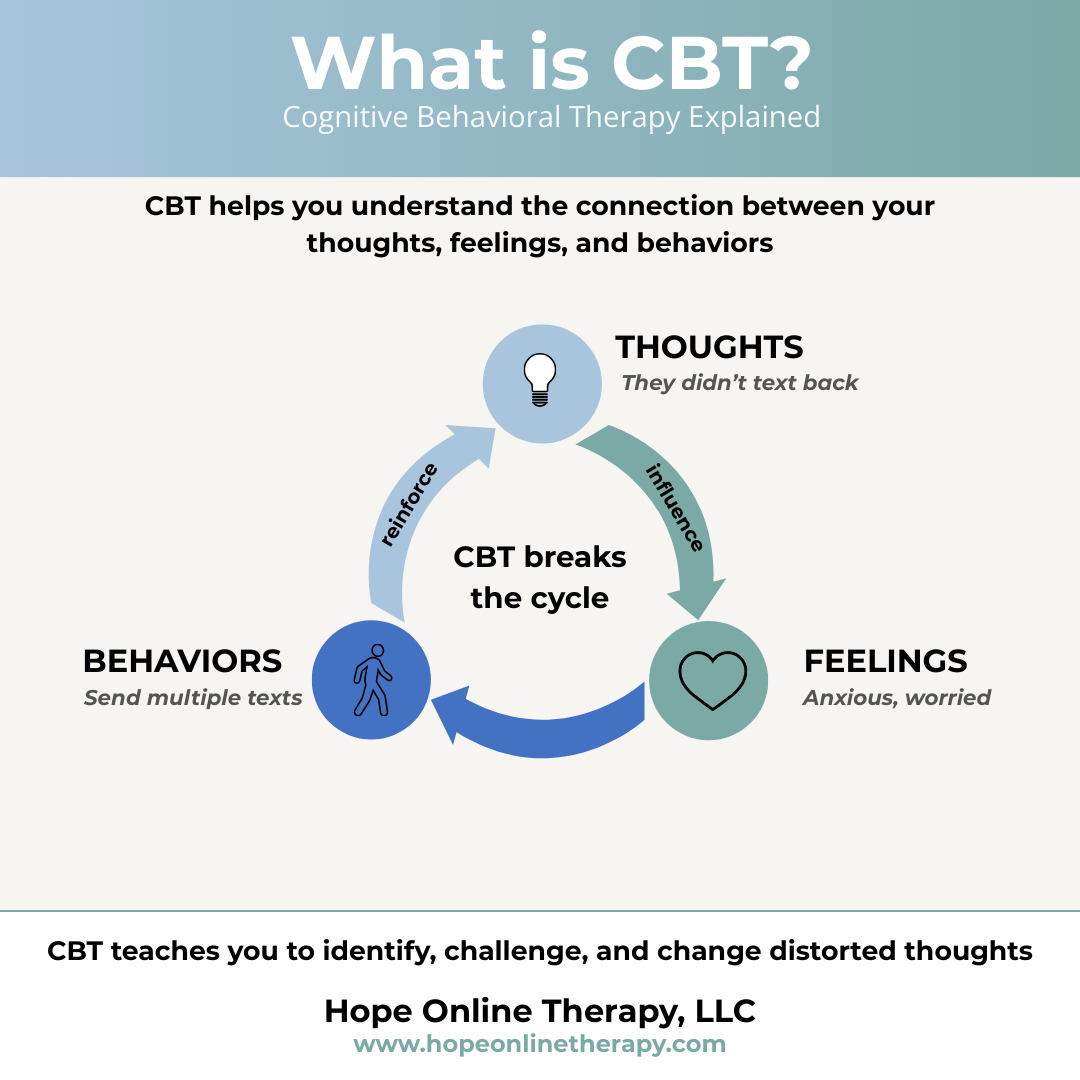
CBT is a type of therapy that focuses on the connection between your thoughts, feelings, and behaviors.
Here's the basic idea:
Your thoughts influence your feelings. Your feelings influence your behaviors. Your behaviors reinforce your thoughts.
It's a cycle. And when the thoughts are distorted, the whole cycle becomes problematic.
CBT helps you:
Identify the distorted thoughts
Challenge those thoughts with evidence
Replace them with more balanced, accurate thoughts
Change your feelings and behaviors as a result
CBT isn't about "thinking positive" or pretending problems don't exist. It's about thinking accurately. It's about seeing reality more clearly, including the good, the bad, and the in-between.
How CBT Works (In Real Life)
Let's walk through a real example of how CBT might work in therapy.
The Situation:
Your friend doesn't respond to your text for several hours.
The Automatic Thought:
"They're mad at me. They're ignoring me on purpose. I must have done something wrong."
The Feeling:
Anxious, guilty, sad.
The Behavior:
You send multiple follow-up texts. You replay your last conversation looking for what you did wrong. You avoid reaching out to other friends because you assume they're upset with you too.
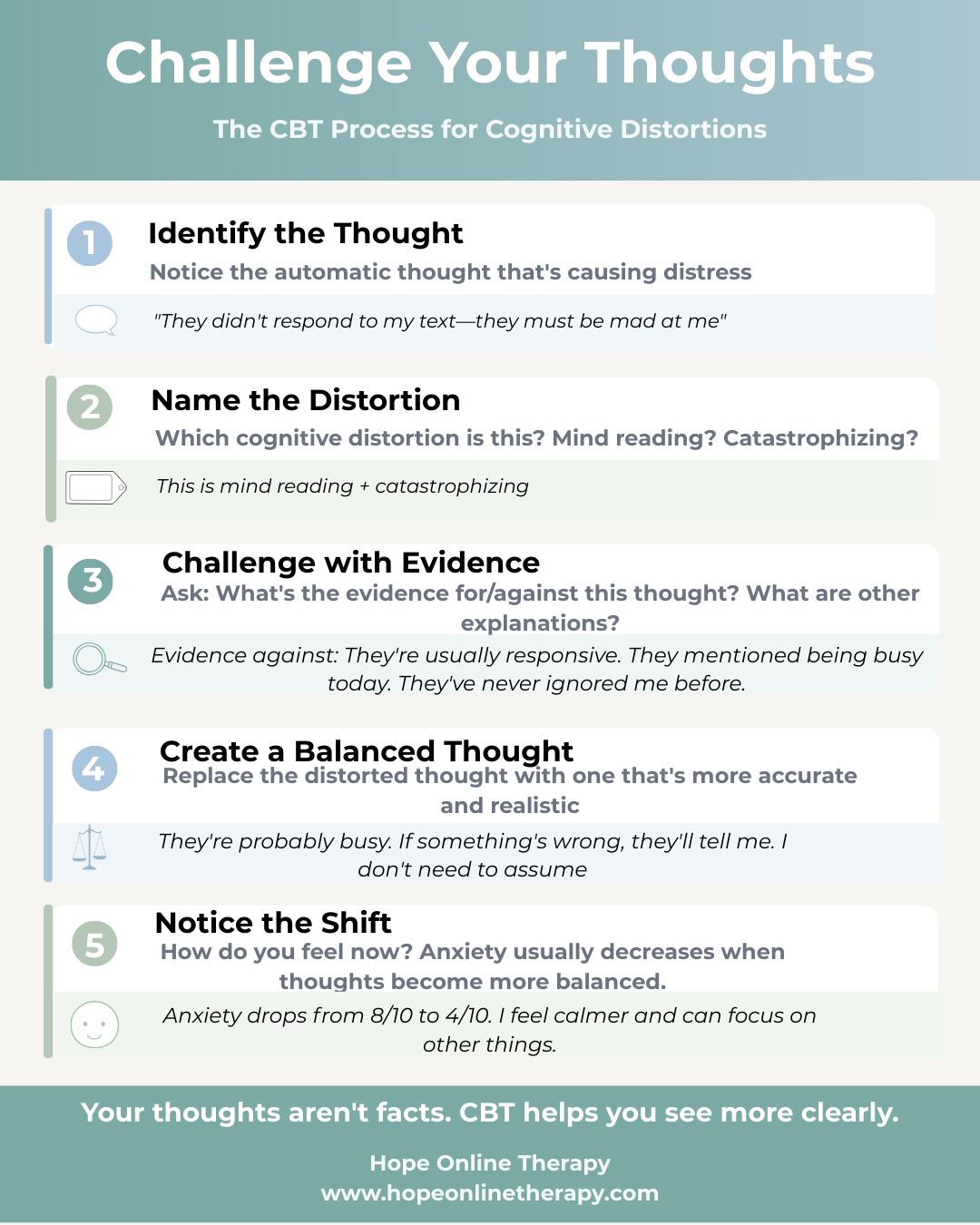
CBT Step 1: Identify the Distortion
In therapy, you'll learn to notice your cognitive distortions.
You will identify which type of distortion: Mind reading (assuming you know they're mad) and catastrophizing (jumping to worst-case scenario).
Just recognizing the pattern helps. It creates distance between you and the thought. Instead of "They're definitely mad at me," it becomes "I'm having the thought that they might be mad at me."
CBT Step 2: Challenge the Thought

Your therapist would help you ask:
What's the evidence for this thought? "They didn't respond for three hours."
What's the evidence against it? "They're usually responsive. They've been busy lately. They've never ignored me before. There are lots of reasons someone might not respond right away."
What are alternative explanations? "They're at work. Their phone died. They saw it and got distracted. They're dealing with something and will respond later."
What would you tell a friend in this situation? "I'd say they're probably just busy. Don't read into it."
What's the worst that could happen? Best that could happen? Most realistic? Worst: They're upset. Best: They didn't even see it yet. Most realistic: They're busy and will respond when they can.
CBT Step 3: Create a Balanced Thought
Instead of "They're ignoring me because they're mad," a more balanced thought might be:
"I don't know why they haven't responded yet. There are lots of possible reasons. If something's wrong, they'll tell me. I don't need to assume."
The Result:
The balanced thought changes how you feel (less anxious, less guilty) and how you behave (you don't send desperate follow-ups, you don't spiral into worry).
The situation didn't change, they still haven't responded. But your experience of it changed entirely.
That's the power of CBT.
CBT Isn't Just About Changing Thoughts
While challenging cognitive distortions is a huge part of CBT, it's not the only part.
CBT also includes:
Behavioral experiments: Testing your beliefs in real life. If you think "Everyone will judge me if I speak up in the meeting," you test that belief by speaking up and seeing what actually happens.
Exposure therapy: Gradually facing situations you've been avoiding (often used for anxiety, phobias, OCD).
Activity scheduling: Planning activities that improve mood and reduce avoidance.
Problem-solving skills: Learning to break down overwhelming problems into manageable steps.
Relaxation and grounding techniques: Managing physical symptoms of anxiety, and stress.
CBT is practical. It gives you tools you can use outside the therapy room. It's not just about insight, it's about change.
Does CBT Actually Work?
Yes. CBT is one of the most researched forms of therapy, and the evidence is strong.
Studies show CBT is effective for:
Depression
Anxiety disorders (GAD, social anxiety, panic disorder)
OCD
PTSD, however, I have found the EMDR works better for this.
Eating disorders
Insomnia
Chronic pain
And more
It's not a magic fix, and it's not instant. But it works, especially when you're actively engaged in the process.
What CBT Is Like in Therapy
If you're considering CBT, here's what you can expect:
It's structured. CBT tends to be more structured than some other types of therapy. You and your therapist set specific goals and work toward them systematically.
It's collaborative. You're an active participant. Your therapist isn't just listening, they're teaching you skills, guiding you through exercises, and working with you to challenge distorted thinking.
It's time-limited. CBT is often shorter-term than other therapies. Many people see improvement in 12-20 sessions (though this varies).
It involves homework. You'll likely have exercises to practice between sessions, tracking thoughts, trying behavioral experiments, practicing new skills.
It's focused on the present. While CBT acknowledges how the past shaped your thinking patterns, it focuses primarily on what's happening now and how to change it.
It's evidence-based. Your therapist will help you look at evidence, test beliefs, and see patterns, not just talk about feelings.
A Simple CBT Exercise You Can Try Right Now
Want to get a taste of how CBT works? Try this:
Thought Record Exercise
Identify a situation that upset you recently. Something small is fine.
Write down the automatic thought that came up. What did your brain immediately tell you?
Notice your feelings and rate their intensity (0-10). Anxious? Sad? Angry? How strong was it?
Identify the cognitive distortion. Which one (or more) does this fit?
Challenge the thought.
What's the evidence for it?
What's the evidence against it?
What are other possible explanations?
What would I tell a friend?
Write a more balanced thought. Not fake-positive. Just more accurate.
Re-rate your feelings. Did the intensity change?
This is a simplified version of what you'd do in CBT therapy. But even this basic exercise can help you start noticing patterns and creating distance from distorted thoughts.
CBT Isn't the Only Answer (But It's a Good One)
CBT isn't the right fit for everyone or every situation. Some people benefit more from other types of therapy—trauma-focused therapy, psychodynamic therapy, acceptance-based approaches.
But CBT is a great starting point for many people, especially if you're dealing with:
Anxiety
Depression
Negative thinking patterns
Self-doubt
Overthinking
Relationship issues driven by distorted thoughts
And even if you eventually explore other types of therapy, the skills you learn in CBT are tools you can use for life.
You Don't Have to Stay Stuck
Here's what I want you to hear: Your thoughts are not facts.
Just because your brain tells you something doesn't make it true. And when you learn to recognize and challenge the distorted thoughts, you start to see reality more clearly.
You are not broken. Your brain isn't defective. You've just developed some unhelpful thinking patterns, and those patterns can change.
CBT gives you the tools to do that. It's not about "positive thinking." It's not about pretending problems don't exist. It's about seeing things as they actually are, not as your anxiety, depression, or self-doubt tells you they are.
And when you start seeing more clearly, everything changes.
You stop catastrophizing about worst-case scenarios that never happen. You stop mind-reading and creating problems that don't exist. You stop beating yourself up with "shoulds" and all-or-nothing thinking. You stop letting distorted thoughts run your life.
That's freedom. And it's absolutely possible.
Ready to Challenge Your Cognitive Distortions?
If negative thinking patterns are keeping you stuck, fueling anxiety, depression, self-doubt, or relationship problems, CBT can help.
I work with adults in Texas and Idaho using evidence-based approaches like CBT to help you identify distorted thinking, challenge unhelpful patterns, and build skills that actually work.
Virtual therapy means you can start this work from home, on a schedule that fits your life.
Schedule a Free Consultation – Let's talk about how CBT can help you break free from the thoughts that are keeping you stuck.
You don't have to believe everything your brain tells you. Let's work on seeing more clearly, together.