The Sunday Night Dread: Why High-Achievers Can't Enjoy Their Weekends

It's 6 PM on Sunday. You've had a good weekend, maybe even a genuinely relaxing one. And then, seemingly out of nowhere, it hits you.
Your stomach tightens. Your mind starts running through Monday's meetings. You feel a heaviness settle in, like a switch flipped from "off" to "on-call." The rest of your evening is quietly ruined, even though nothing has actually happened yet.
You still have hours of your weekend left. But you've already left it.
If this happens to you almost every week, you're not alone, and you're not being dramatic. This is a real, well-documented phenomenon often called anticipatory anxiety. And it's especially common in high-achievers, perfectionists, and people with active, analytical minds.
Here's the frustrating part: you might be someone who's genuinely good at your job, who handles Mondays just fine once they arrive. But the dread on Sunday night happens anyway. It's not about whether you can handle the week. It's about what your nervous system does in anticipation of it.
Let's talk about why this happens, why it hits high-achievers especially hard, and what actually helps.
What's Actually Happening in Your Brain on Sunday Night
Sunday night dread isn't really about Sunday. It's about the transition your brain is anticipating, from rest to responsibility, from unstructured time to structured demands, from being off-duty to being "on."
Your brain does this because of a few overlapping processes:
1. Anticipatory anxiety kicks in before the event, not during it. Anxiety is often worse in anticipation than in the actual moment. Your brain runs simulations of the week ahead—meetings, deadlines, decisions, interactions—and reacts to those imagined scenarios as if they're happening right now. The dread you feel on Sunday is your nervous system responding to a week that hasn't started yet.
2. Your brain is scanning for problems. If you're someone with a highly analytical mind, your brain is wired to look ahead, spot potential issues, and prepare for them. This is useful at work. But on a Sunday evening, with no immediate task to solve, that same scanning turns inward and starts generating problems that don't exist yet, or blowing manageable ones out of proportion.
3. The contrast effect makes it worse. The sharper the contrast between how relaxed you feel on Saturday and how activated you feel returning to work-mode, the more jarring Sunday night feels. Ironically, people who rest well over the weekend sometimes feel the dread more intensely, because the drop-off from calm to anxious is so noticeable.
4. Your identity is tied to performance. For many high-achievers, self-worth is quietly wrapped up in how well they perform at work. Sunday night isn't just "the week is starting", it's "the evaluation period is starting again." That's a heavier thing to brace for than a calendar of tasks.
If this pattern of overthinking and anticipating problems sounds familiar, it connects closely to what we explored in why smart people struggle with anxiety—the same analytical strengths that make you good at your job are often what's fueling the dread.
Why High-Achievers Experience This More Intensely

Not everyone gets hit with Sunday night dread. The people who experience it most often share a few traits:
You care a lot about doing well. Indifference doesn't produce dread. Investment does. The more you care about performing well, being seen as competent, and meeting expectations, the more your brain treats Monday as high-stakes.
You carry unfinished mental loops from the previous week. High-achievers often end their work week with open tabs, tasks not fully wrapped up, decisions not fully made, emails not fully answered. Your brain doesn't like open loops. It keeps returning to them, especially when things go quiet.
You over-identify with your role. If a significant part of your identity is "the reliable one," "the high performer," or "the person who has it together," Monday isn't just a workday. It's a test of whether you can keep being that person.
You don't have a real transition ritual. Many high-achievers go from full productivity mode on Friday straight into "trying to relax" on Saturday, without any intentional decompression. Without a genuine off-ramp, the nervous system doesn't fully downshift, so by Sunday, it's already anticipating the next on-ramp.
If you recognize this pattern in your broader relationship with work, this ties closely into our post on anxiety in high-achievers. Sunday dread is often just one visible symptom of a larger pattern of achievement-linked anxiety.
Why "Just Relax" Doesn't Work
You've probably tried to talk yourself out of the dread. "It's fine. It's just work. I'll deal with it tomorrow." Sometimes that works for a few minutes. Usually, it doesn't stick.
That's because Sunday night dread isn't a logic problem, it's a nervous system response. You can't out-reason a stress response with a single reassuring thought, the same way you can't talk yourself out of a racing heart during a job interview.
This is why "just don't think about it" style advice tends to fail. Suppressing the thought doesn't calm the nervous system, it just pushes the anxiety underground, where it often resurfaces as irritability, restlessness, or trouble sleeping.
What actually helps is working with your nervous system, not against it.
What Actually Helps: Practical Strategies
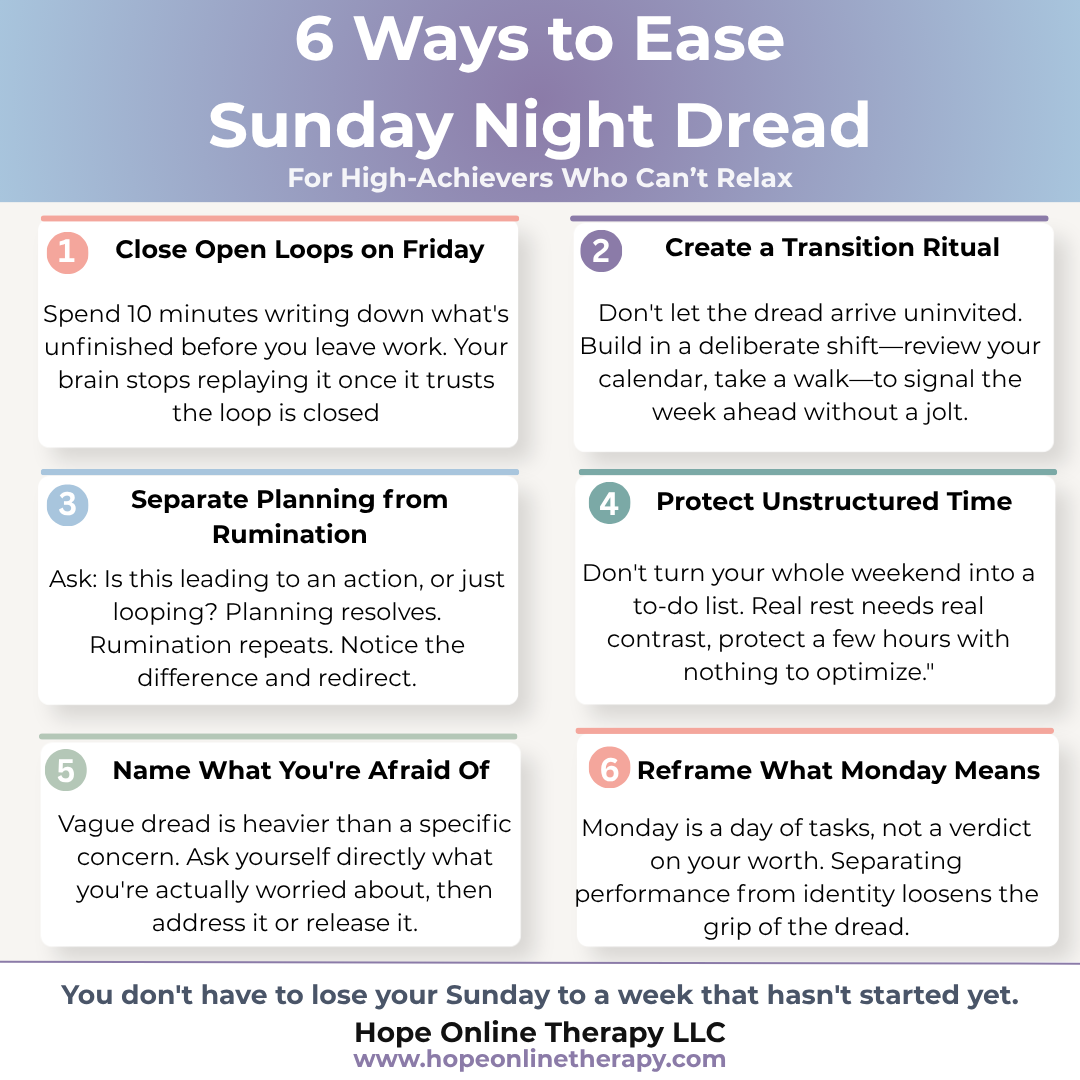
1. Close Your Open Loops on Friday, Not Sunday
Before you leave work on Friday, spend 10 minutes doing a quick brain dump: What's unfinished? What needs to happen Monday morning? Write it down somewhere you trust, not in your head.
Why it works: Your brain holds onto unfinished tasks because it doesn't trust that they'll get handled. Writing them down (with a plan, even a rough one) tells your brain the loop is closed for now. It can stop replaying it.
2. Create an Actual Transition Ritual on Sunday
Instead of letting the dread arrive uninvited around 6 PM, intentionally create a short transition into the week, on your terms, earlier in the day if needed.
This might look like:
Reviewing your calendar for 15 minutes so Monday isn't a surprise
Laying out clothes or prepping something small for the morning
A short walk specifically meant to mark "weekend is ending, and that's okay"
Why it works: When the brain doesn't get a clear signal that a transition is happening, it treats the shift as sudden and threatening. A deliberate, calm transition gives your nervous system time to adjust instead of jolting into anxiety.
3. Separate Preparation from Rumination
There's a difference between useful preparation ("I'll glance at my calendar so I know what's ahead") and anxious rumination ("What if Monday's meeting goes badly and everyone realizes I don't know what I'm doing?").
Try this: When you notice yourself thinking about the week ahead, ask: Is this planning, or is this worrying? If it's planning, it should lead to an action or a decision. If it's just looping without resolution, it's rumination, and that's the cue to redirect your attention.
(This distinction is explored in more depth in our post on cognitive distortions and CBT, including tools for challenging anxious thought loops.)
4. Protect One Genuinely Unstructured Block of Time

High-achievers often unconsciously turn their entire weekend into a to-do list, errands, plans, self-improvement, catching up. If every hour is optimized, there's no real rest, which means there's no real contrast between "on" and "off", which paradoxically makes the dread worse.
Try this: Protect at least a few hours over the weekend with zero productivity attached. Not "restful activities I should do," just unstructured time. Your nervous system needs actual downtime to register that rest happened.
5. Name What You're Actually Afraid Of
Often, the dread is vague, a general sense of doom, rather than a specific fear. Getting specific can shrink it.
Try this: Ask yourself directly: What am I actually worried will happen this week? Sometimes you'll find a real, addressable concern (a difficult conversation you're avoiding). Sometimes you'll find the fear doesn't hold up under examination once it's named. Either way, vague dread is harder to sit with than a specific, nameable concern.
6. Reframe What Monday Actually Means
If Monday feels like a referendum on your worth, it will always feel heavy. Try consciously separating your performance from your value as a person.
Try this: Before bed on Sunday, remind yourself: Monday is a day of tasks, not a verdict on who I am. It sounds simple, but repeating this can slowly loosen the grip of achievement-linked identity that fuels so much of this dread.
When Sunday Night Dread Is a Signal, Not Just a Habit
For some people, Sunday night dread is a mild, manageable pattern. For others, it's a weekly signal that something bigger needs attention.
Consider talking to a therapist if:
The dread starts earlier and earlier (Saturday, even Friday)
It's accompanied by physical symptoms—nausea, chest tightness, insomnia
You're dreading a job that's become genuinely unsustainable, not just uncomfortable
The anxiety doesn't ease once Monday actually arrives
You notice this pattern bleeding into other areas of your life
Sometimes Sunday night dread is just an anxious brain needing better tools. Sometimes it's a sign that your relationship with work, or your workplace itself, needs a closer look. A therapist can help you tell the difference.
You're Not Overreacting
If you've ever felt embarrassed by how much dread you feel over "just a workday," let this be permission to stop minimizing it.
Caring about your work, wanting to do well, and having a brain that plans ahead are not flaws. They're often exactly why you're good at what you do. The problem isn't that you care, it's that your nervous system hasn't learned how to care without bracing for impact every single week.
That's a learnable skill, not a personality flaw. And it's absolutely possible to walk into Monday without losing your Sunday evening to dread first.
Need Support Managing Anxiety Around Work?
If Sunday night dread, work-related anxiety, or the broader pattern of high-achievement stress is affecting your quality of life, therapy can help.
I work with adults in Texas and Idaho who are ready to build a healthier relationship with work, learning to manage anticipatory anxiety, protect real rest, and separate their worth from their performance.
Virtual therapy means you can get support from home, on a schedule that actually fits your life.
Schedule a Free Consultation– Let's talk about how therapy can help you get your Sunday evenings back.
You don't have to keep losing part of your weekend to a week that hasn't even started yet.
Disclaimer: This blog post is for informational purposes only and does not constitute medical advice. If you're experiencing a mental health crisis, please call 988 (Suicide & Crisis Lifeline) or go to your nearest emergency room.