How EMDR Works: A Guide for Skeptics
If someone told you that moving your eyes back and forth could help heal trauma, you'd probably be skeptical. I get it. When I first learned about EMDR (Eye Movement Desensitization and Reprocessing) in my training, I had questions too. It sounds too simple, too weird, maybe even a little gimmicky.
But here's the thing: EMDR is one of the most researched and effective treatments for trauma and PTSD available today. It's endorsed by the World Health Organization, the American Psychiatric Association, and the Department of Veterans Affairs. Millions of people have experienced real, lasting relief from symptoms that talk therapy alone couldn't touch.
So if you're skeptical about EMDR, you're not alone. Let's break down what it actually is, how it works, and why it might be exactly what you need.
What Is EMDR?

EMDR stands for Eye Movement Desensitization and Reprocessing. It's a structured therapy approach designed to help your brain process traumatic or distressing memories that are still affecting you today.
Unlike traditional talk therapy where you spend weeks or months discussing your past, EMDR helps your brain do what it's naturally designed to do: process and file away difficult experiences so they stop hijacking your present.
Think of it this way: When something traumatic happens, your brain is supposed to process it, learn from it, and store it as a memory that no longer causes distress. But sometimes, especially with trauma, that processing gets stuck. The memory stays "live" in your nervous system, which is why you can still feel triggered by things that happened years ago.
EMDR helps complete that processing.
The Science Behind EMDR
Here's where it gets interesting for skeptics: We actually have brain imaging studies showing what happens during EMDR.
When you experience trauma, the memory gets stored differently than normal memories. It stays in the emotional, reactive parts of your brain (the amygdala and limbic system) rather than moving to the more rational, storytelling part of your brain (the cortex).
That's why traumatic memories feel so different from regular memories. When you think about what you had for breakfast last Tuesday, you don't feel your heart race or your palms sweat. But trauma memories? They can feel like they're happening right now.
EMDR appears to help the brain transfer these stuck memories from the emotional center to the more rational part of your brain where they can be properly processed and stored. The bilateral stimulation (the eye movements or other alternating left-right stimulus) seems to activate the same brain mechanisms that naturally process memories during REM sleep.
It's not magic. It's neuroscience.
What EMDR Actually Looks Like
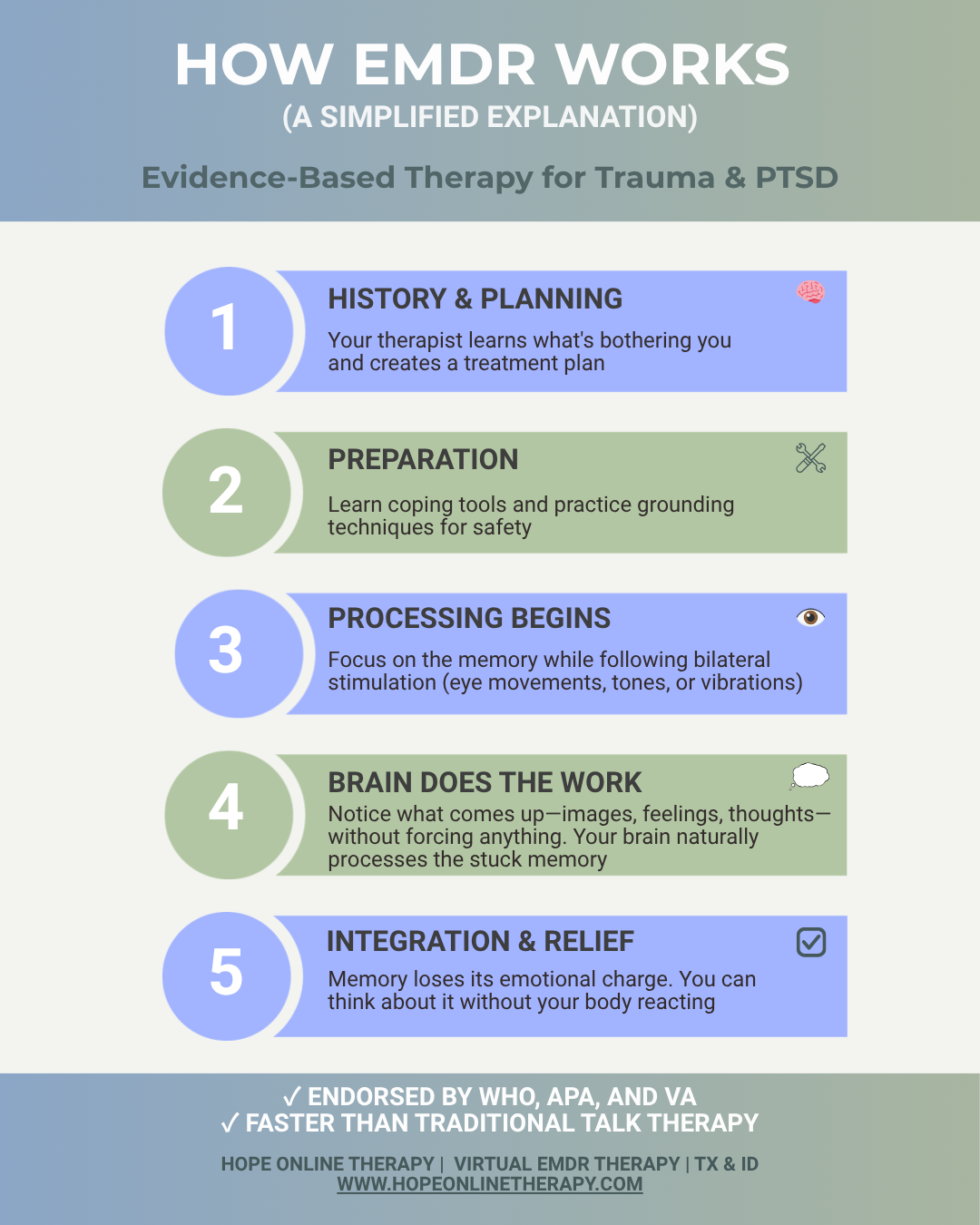
Let's demystify what happens in an EMDR session, because it's less dramatic than you might think.
Phase 1: History and Treatment Planning Your therapist learns about your history, what's bothering you now, and what you want to work on. This isn't dramatically different from any other therapy.
Phase 2: Preparation You learn some coping techniques and grounding exercises. Your therapist makes sure you're ready and have the tools to handle what might come up.
Phase 3: Assessment Your therapist helps you identify the specific memory to target, the negative belief connected to it (like "I'm not safe"), what you'd rather believe, how disturbing it feels, and where you feel it in your body. This creates a baseline to track your progress.
Phases 4-6: The Actual Processing This is where EMDR looks different. You'll focus on a specific traumatic memory while simultaneously experiencing bilateral stimulation. This might be:
Following your therapist's fingers moving back and forth with your eyes
Holding buzzers that vibrate alternating left and right in your hands
Listening to tones that alternate left and right through headphones (This is what I have my clients use through an app on their phone.)
You're not hypnotized. You're fully present and in control. You can stop anytime.
While the bilateral stimulation happens, you just notice what comes up—images, feelings, thoughts, body sensations. You're not trying to make anything happen. You're just observing while your brain does the work.
Sets of bilateral stimulation last about 30 - 60 seconds, then you pause and report what you noticed. Your therapist guides you through multiple sets until the memory loses its emotional charge.
Phases 7: Closure and Reevaluation Your therapist helps you return to a calm state and checks in on your progress in the next session.
What EMDR Feels Like
Here's what my clients typically report:
During processing:
The memory might feel less vivid or more distant
Physical sensations might shift or release
New insights or connections might emerge
Sometimes you feel emotional, sometimes you don't
It can feel weird, but not scary
After EMDR:
The memory doesn't disappear (that's not the goal)
But it no longer has the same emotional punch
You can think about it without your body reacting
Triggers that used to derail you don't anymore
You feel like you've finally "moved on"
One client described it as: "I still remember what happened, but it feels like a story I'm telling about someone else's life, not something that's still happening to me."

Addressing Common Skeptical Questions
"How can eye movements or bilateral sounds, possibly heal trauma?"
Fair question. The eye movements aren't magic—they're just one form of bilateral stimulation that seems to activate your brain's natural processing mechanisms. We don't fully understand every detail of how it works (just like we don't fully understand how antidepressants work), but brain imaging shows it does work.
"This sounds like pseudoscience."
EMDR has been studied in over 30 randomized controlled trials. It's recognized as an effective treatment by major health organizations worldwide. That's not pseudoscience, that's evidence-based treatment.
"I've tried talk therapy and it didn't work. Why would this be different?"
Talk therapy helps you understand your trauma. EMDR helps your brain process it. They're doing different things. Many of my clients spent years in talk therapy gaining insight but still feeling triggered. EMDR addresses what talk therapy can't reach, the way trauma is stored in your nervous system.
"I don't even remember specific traumatic events. Can EMDR still help?"
Yes. EMDR can target the symptoms, feelings, or beliefs without needing a specific memory. If you have anxiety, body sensations, or negative beliefs about yourself, those can be processed even without a clear memory attached.
"Does it work for things that aren't 'capital T' Trauma?"
Absolutely. While EMDR was originally developed for PTSD, it's effective for anxiety, depression, phobias, panic attacks, and even negative beliefs about yourself. If your nervous system is stuck in an unhelpful pattern, EMDR can help.
"How is this different from hypnosis?"
You're fully conscious and in control during EMDR. You can stop anytime, talk freely, and you remember everything. You're not in a trance or being told what to think. Your brain is doing the work, the therapist is just facilitating.
"Can you do EMDR virtually?"
Yes. I provide EMDR via telehealth using online platforms designed for it. Research shows virtual EMDR is just as effective as in-person sessions. Instead of following my fingers with your eyes, you wear headphones or earbuds while using an app that has a sound go back and forth between your ears.
What EMDR Can and Can't Do
EMDR is highly effective for:
PTSD and trauma
Anxiety disorders
Panic attacks
Phobias
Depression related to past experiences
Grief and loss
Performance anxiety
Disturbing memories that won't let go
EMDR isn't a magic bullet for:
Current life circumstances that need practical solutions
Personality disorders (though it can help with trauma within those)
Active substance abuse (you need to be stable first)
Situations where you need to develop new skills (though it can remove blocks to learning those skills)
How Long Does EMDR Take?
Here's where EMDR often surprises people: It typically works faster than traditional talk therapy.
For a single traumatic incident, you might see significant relief in 3-6 sessions. For complex trauma or multiple incidents, it takes longer, sometimes several months of weekly sessions.
But compare that to years of talk therapy that helps you understand your trauma but doesn't necessarily make you feel better, and EMDR's efficiency becomes clear.
Is EMDR Right for You?
EMDR might be worth trying if:
You've done talk therapy and gained insight but still feel stuck
You have specific traumatic memories that still bother you
You get triggered by things and don't understand why
Your body reacts to stress in ways that feel out of your control
You want to process trauma without having to tell the story repeatedly
You're skeptical of therapy in general but willing to try something evidence-based
EMDR might not be the first choice if:
You're currently in crisis and need stabilization first
You have significant dissociation that needs to be addressed
You're dealing with current abusive situations
You're not ready to feel the feelings that might come up
The Bottom Line for Skeptics
Look, I get it. EMDR sounds weird. Moving your eyes back and forth to heal trauma seems too simple to be true.
But here's what I know from nearly 10 years of practice: I've watched clients who spent years in traditional therapy finally get relief through EMDR. I've seen people stop being triggered by memories that haunted them for decades. I've witnessed nervous systems calm down and people reclaim their lives.
The research backs it up. The client outcomes speak for themselves. And if you're skeptical, that actually might make you a good candidate, because you'll pay attention to whether it's working for you.
EMDR isn't about belief. It's about giving your brain the opportunity to do what it's designed to do: process difficult experiences and move forward.
Ready to Try It?

If you're a skeptic who's willing to see if EMDR could work for you, let's talk. I provide EMDR therapy via secure telehealth to adults throughout Texas and Idaho.
During your free 15-minute consultation, you can ask me every skeptical question you have. I won't try to convince you of anything—I'll just give you the information you need to make an informed decision.
You've been skeptical long enough. Maybe it's time to see for yourself.
References for the Skeptics
If you want to dig into the research yourself:
World Health Organization (2013): Guidelines for the Management of Conditions Specifically Related to Stress
American Psychiatric Association (2004): Practice Guideline for the Treatment of Patients with Acute Stress Disorder and PTSD
Department of Veterans Affairs/Department of Defense Clinical Practice Guideline for PTSD
EMDR International Association: www.emdria.org
PubMed search "EMDR" returns over 300 peer-reviewed studies
Related Posts You Might Find Helpful:
What High-Functioning Depression Really Looks Like
5 Signs Your Anxiety Needs More Than Self-Help Books
When Therapy Should Be More Than Just Talking
Why Your Body Keeps the Score: Understanding Trauma Responses
Disclaimer: This blog post is for informational purposes only and does not constitute medical advice. If you're experiencing a mental health crisis, please call 988 (Suicide & Crisis Lifeline) or go to your nearest emergency room.