What EMDR Actually Does (And Why It Works When Talk Therapy Hasn't)
You've been in therapy before. You've talked about what happened. You understand it. You can explain how your childhood affected you, why that relationship was toxic, or how that traumatic event changed you.
But you're still triggered. You still have flashbacks. Your body still reacts like the threat is happening now. The anxiety hasn't lessened. The depression hasn't lifted.
You understand everything intellectually, but nothing has actually changed.
If this sounds familiar, the problem isn't you. The problem is that traditional talk therapy—while valuable—has limitations when it comes to trauma, anxiety, and experiences that are "stuck" in your nervous system.
This is where EMDR changes everything.
What EMDR Actually Is
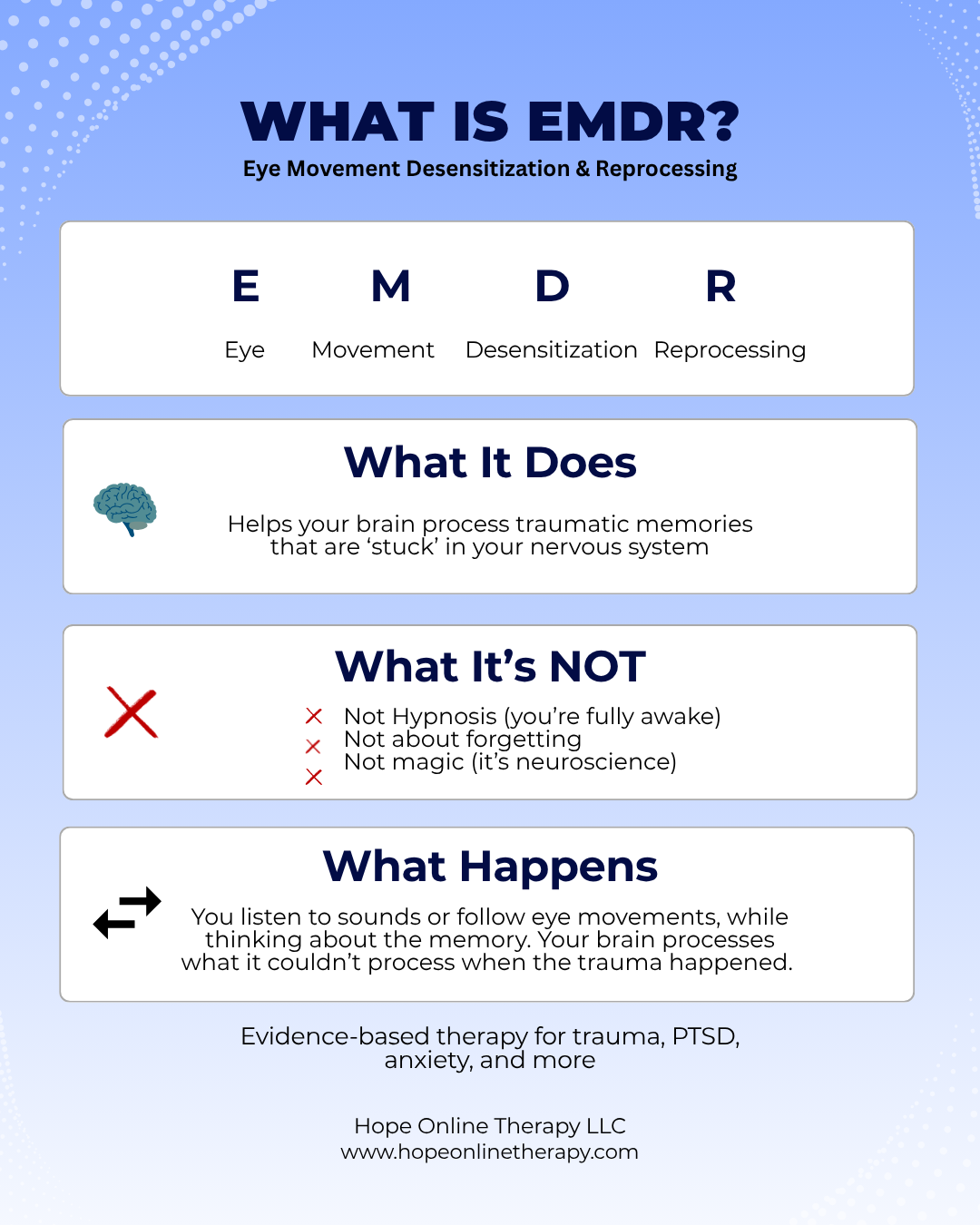
EMDR stands for Eye Movement Desensitization and Reprocessing. That's a mouthful, so let's break down what it actually means.
Eye Movement: You follow the therapist's hand moving back and forth (or watch a light, or listen to sounds on headphones (I use this)—there are different ways to do it). This bilateral stimulation activates both sides of your brain.
Desensitization: The emotional intensity of traumatic memories decreases. What once felt overwhelming becomes more manageable.
Reprocessing: Your brain processes the memory the way it should have been processed originally, filing it away as "something that happened in the past" rather than "something that's still threatening me now."
What it's NOT:
It's not hypnosis. You're fully awake and aware the entire time.
It's not about forgetting what happened. The memory stays; it just loses its power over you.
It's not magic. It's neuroscience-based therapy with decades of research backing it.
EMDR was originally developed to treat PTSD in combat veterans. But research has shown it's effective for anxiety, depression, phobias, panic attacks, and any experience that's left an emotional mark that won't fade through understanding alone.
Why Talk Therapy Isn't Always Enough
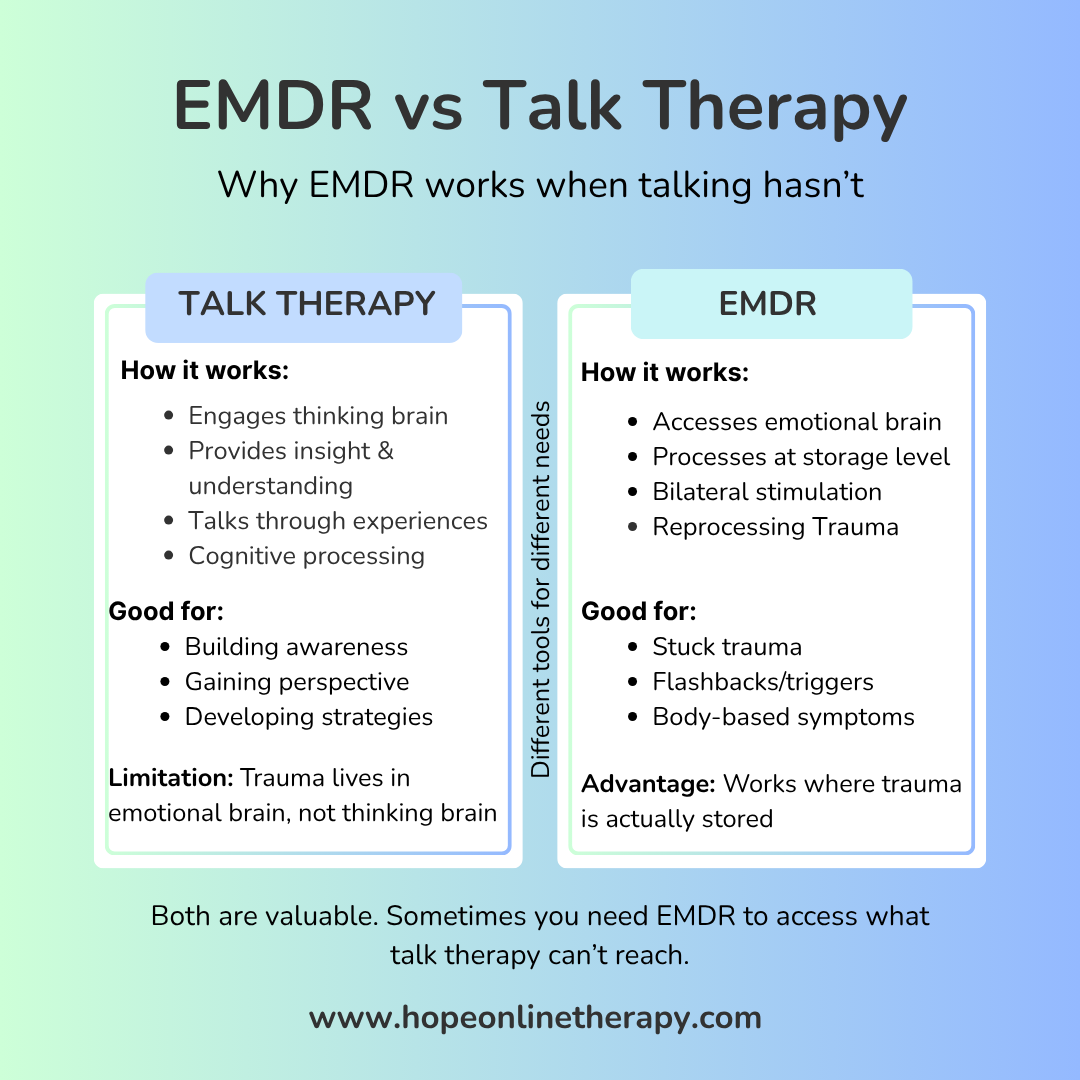
Talk therapy is helpful for many things. It provides insight, understanding, perspective, and support. But when it comes to trauma and deeply embedded emotional responses, talking has limitations.
Here's why:
Trauma is stored in a different part of your brain. Traumatic memories aren't stored like regular memories. They're fragmented, emotionally charged, and stuck in the limbic system, the part of your brain that handles emotions and survival responses, not logic and language.
When you talk about trauma, you're engaging your prefrontal cortex, your thinking, reasoning brain. But the trauma lives in your amygdala and other emotional processing centers. Talking reaches one part of your brain; the trauma lives in another.
Your body doesn't speak in words. Trauma gets stored in your body as sensations, muscle tension, hypervigilance, and nervous system activation. You can talk about what happened all day, but if your body still believes you're in danger, nothing changes.
Understanding doesn't equal processing. You can intellectually understand why you react the way you do without your emotional brain getting that message. That's why people say things like "I know logically I'm safe, but I don't feel safe."
Talking can actually reinforce the trauma. Every time you tell the story of what happened in vivid detail, you can re-activate the trauma response. Your brain experiences it again, which can make it feel more entrenched, not less.
EMDR works differently. It accesses the part of your brain where trauma is actually stored and helps it process in a way that talking alone can't achieve.
How EMDR Actually Works
The science behind EMDR is fascinating, and it explains why it works when other approaches haven't.
Your brain has a natural healing process. Just like your body knows how to heal a cut, your brain knows how to process difficult experiences and file them away as memories that don't keep hurting you.
But sometimes, especially with traumatic experiences, this natural process gets blocked. The memory stays "unprocessed"—stuck in your nervous system, triggering you as if the threat is still present.
Bilateral stimulation jumpstarts that processing. When you follow the eye movements (or use tapping, sounds, or other bilateral stimulation), you're activating both hemispheres of your brain simultaneously. This mimics what happens naturally during REM sleep, when your brain processes the day's experiences.
The bilateral stimulation helps your brain do what it was trying to do all along: process the experience, integrate it, and file it away as a "past" rather than a "present threat."
You're not just remembering, you're reprocessing. During EMDR, you think about the traumatic memory while doing bilateral stimulation. As you do, your brain starts making new connections. Insights emerge. Emotions shift. Physical sensations change. The memory itself begins to feel different.
It's not that you forget what happened. It's that your brain finally completes the processing it couldn't do when the trauma occurred.
Your nervous system updates its information. After EMDR processing, your body learns that the threat is over. You stop living in constant hypervigilance or shutdown. Your fight-flight-freeze responses stop activating when they're not needed.
The memory remains, but it loses its emotional charge. You can think about what happened without being flooded with overwhelming feelings. It becomes "something that happened to me" rather than "something that's still happening."
What EMDR Sessions Actually Look Like
If you've never done EMDR, the process might seem mysterious. Let's walk through what actually happens.
Phase 1: History & Preparation
Before we start processing trauma, we build a foundation. I learn about your history, current symptoms, and what you want to work on. We establish safety and teach you grounding techniques so you can handle whatever comes up during processing.
This isn't EMDR yet, this is making sure you're ready for it. You need tools in your toolbox before we open difficult material.
Phase 2: Targeting
We identify specific memories, situations, or beliefs to work on. What's the worst part of that memory? What negative belief do you have about yourself because of it? What would you rather believe?
You don't have to narrate every detail. You just need to identify what we're working on, your brain knows the rest.
Phase 3: Processing (The EMDR Itself)
This is where the bilateral stimulation happens. You focus on the target memory while listening to sounds (or following hand movements, etc.).
I'll ask you to "notice what comes up"—thoughts, feelings, sensations, images, or memories. You might feel emotions intensify, then decrease. You might have insights. You might remember things you'd forgotten. You might feel physical sensations shift.
We do this in "sets"—maybe 30-60 seconds of eye movements, then pause and check in. What are you noticing now? Then we do another set. And another. Each set moves the processing forward.
It's not always linear. Sometimes it gets more intense before it gets better. Sometimes memories link to other memories. Sometimes you feel nothing, then suddenly have a breakthrough. Every person's process is different.
Phase 4: Installation
Once the memory loses its charge, we strengthen the positive belief you want to have instead. "I'm safe now." "I did the best I could." "It wasn't my fault." We install this belief using more bilateral stimulation.
Phase 5: Body Scan
We check your body to make sure there's no residual distress stored physically. If there is, we process that too. Trauma lives in your body, so we make sure it's released from there.
Phase 6: Closure
We make sure you're grounded and stable before ending the session. I'll remind you of your coping tools and what to expect between sessions (you might have dreams, feel tired, or continue processing on your own).
Phase 7: Reevaluation
Next session, we check: Did the work stick? Do you still feel triggered by that memory? If yes, we process more. If no, we move to the next target.
What Makes EMDR Different from Other Therapies
You might be wondering: How is this different from exposure therapy, CBT, or just talking about trauma?
Different from Exposure Therapy:
Exposure therapy involves repeatedly confronting the traumatic memory or feared situation to reduce the fear response. It's based on habituation, if you experience the fear enough times without the bad thing happening, the fear decreases.
EMDR doesn't require you to repeatedly relive the trauma. You think about it while doing bilateral stimulation, but you're not forced to stay in the distress. If it becomes too intense, we stop and use grounding techniques. The goal isn't habituation; it's reprocessing.
Most people find EMDR less distressing than prolonged exposure therapy, and it often works faster.
Different from CBT:
CBT (Cognitive Behavioral Therapy) focuses on identifying and changing thought patterns and behaviors. It's excellent for many things such as, anxiety, depression, and negative thinking patterns.
But CBT works at the conscious, cognitive level. You learn to challenge and reframe thoughts. EMDR works at the deeper, emotional level where trauma is actually stored. You're not just changing how you think about something; you're changing how your brain has filed it away.
That said, CBT and EMDR work beautifully together. I use both, depending on what you need.
Different from Traditional Talk Therapy:
In traditional therapy, you talk through your experiences, gain insight, and build understanding. That's valuable.
But EMDR adds the bilateral stimulation component that helps your brain actually process what you're talking about. You're not just understanding the trauma; you're releasing it from your nervous system.
Also, you don't have to narrate every detail in EMDR. Your brain knows what happened. We just need to activate it and let the bilateral stimulation help it process.

What EMDR Helps With
EMDR was originally developed for PTSD, but research has shown it's effective for much more.
Trauma and PTSD are the most obvious applications. Single-incident trauma (assault, accident, natural disaster) or complex trauma (ongoing abuse, childhood trauma) both respond to EMDR.
Anxiety and Panic Attacks often have roots in unprocessed experiences. EMDR can target the experiences that created the anxiety or the first time you had a panic attack—and processing those can significantly reduce ongoing anxiety.
Depression that's connected to loss, trauma, or difficult life experiences can improve with EMDR. If your depression is rooted in unprocessed grief, childhood wounds, or internalized beliefs about your worth, EMDR addresses those directly.
Phobias respond remarkably well to EMDR. Whether it's fear of flying, driving, dogs, or something else, EMDR can process the experience that created the fear.
Performance Anxiety, for athletes, public speakers, or anyone whose anxiety interferes with their performance, can be addressed with EMDR.
Intrusive Thoughts that loop in your mind—whether they're about past events, fears, or disturbing images—can be processed with EMDR so they lose their intensity.
Physical Symptoms connected to trauma or anxiety (chronic pain, tension, digestive issues) can sometimes improve when the underlying trauma is processed.
Low Self-Worth and Negative Beliefs about yourself ("I'm not good enough," "I'm defective," "I'm unlovable") often come from early experiences. EMDR can process those experiences and change the beliefs.
Common Questions and Concerns About EMDR
"Will I have to relive the trauma?"
No. You'll think about it, but you won't be forced to recount every detail or stay in distress. If it becomes too intense, we stop and ground you. EMDR is designed to process trauma without re-traumatizing you.
"What if I can't remember everything that happened?"
You don't need complete memories. EMDR can work with fragments, feelings, sensations, or beliefs. Your brain fills in what it needs to.
"How is this not hypnosis?"
You're fully awake, aware, and in control the entire time. You can stop anytime. You're not in a trance, and I'm not planting suggestions. Bilateral stimulation is not hypnosis, it's activating your brain's natural processing system.
"Will I forget what happened?"
No. The memory stays. But it loses its emotional charge. Instead of feeling overwhelming, it becomes more like any other memory, something that happened in the past that doesn't control your present.
"How long does it take?"
It varies. Single-incident trauma might process in 3-5 sessions. Complex trauma or multiple targets might take 12-24 sessions or more. We track progress and adjust as needed.
"What if I get triggered between sessions?"
That's normal. Processing can continue between sessions, you might have dreams, feel emotional, or remember things. We prepare you with coping tools, and you can always email or call if you need support.
"Does it work for everyone?"
EMDR is highly effective for most people, but no therapy works for absolutely everyone. Some people need more preparation before processing. Some need a different approach. We'll figure out what works for you.
Why EMDR When You've Already Tried Therapy
Maybe you're reading this and thinking: "I've been in therapy before. I've talked about my trauma. I've worked on my anxiety. Why would EMDR be different?"
Here's the thing: If you've done talk therapy and still have flashbacks, get triggered, or feel like nothing has actually changed, it's not because you're not trying hard enough or because you're "too damaged."
It's because talking accesses one part of your brain, and trauma lives in another. EMDR bridges that gap.
If you:
Understand your trauma intellectually but still feel it emotionally
Know logically you're safe but your body doesn't believe it
Have insight into your patterns but can't change them
Still get triggered by reminders of past events
Have tried CBT, medication, or talk therapy with limited results
...then EMDR might be exactly what you need.
It's not about replacing everything you've done before. It's about adding a tool that works at the level where trauma is actually stored.
What Happens After EMDR
When EMDR works, and it often does, here's what people describe:
The memory loses its intensity. You can think about what happened without being flooded with overwhelming emotion. It's no longer vivid and present; it's past.
Triggers stop triggering you. The situations, sounds, smells, or reminders that used to send you into panic or shutdown no longer have that power.
Physical symptoms decrease. Tension, hypervigilance, sleep problems, and other body-based symptoms often improve when trauma is processed.
Beliefs about yourself shift. The deep-down conviction that you're broken, unlovable, or not good enough starts to change. New, healthier beliefs take root.
You feel more like yourself. The constant anxiety, the emotional numbness, the feeling of being stuck, these start to lift. You feel more present, more alive, more capable.
Relationships improve. When you're not triggered all the time, when your nervous system isn't stuck in protection mode, you can connect more authentically with people you love.
This doesn't mean life becomes perfect. It means past trauma stops controlling your present. You have more choice in how you respond. You're not at the mercy of your triggers anymore.

Is EMDR Right for You?
EMDR might be a good fit if:
You have trauma, PTSD, or distressing memories that won't fade
You've tried talk therapy and felt stuck
You understand your issues but can't seem to change them
You get triggered in ways you don't fully control
You want an approach that works with your brain and body, not just your thoughts
You're willing to do the work, even when it's uncomfortable
EMDR might not be the right fit (yet) if:
You're in active crisis needing stabilization first
You have severe dissociation (we'd need to prepare more carefully)
You're not ready to process difficult material
You're looking for a quick fix without doing the work
If you're not sure, that's what the free consultation is for. We can talk about whether EMDR makes sense for your specific situation.
Moving Forward
You've carried what happened long enough.
You've tried understanding it, talking about it, working through it. And maybe some of that helped. But if you're still triggered, still stuck, still feeling like past experiences control your present, there's another option.
EMDR doesn't make you forget. It helps you finally process what your brain couldn't process when it happened. It updates your nervous system's information so you stop reacting to the past as if it's still happening.
You don't have to keep living with flashbacks, triggers, anxiety, or the belief that you're broken. EMDR can help your brain do what it's been trying to do all along, heal.
You've done the hard work of surviving. Now let's do the work of healing.
Ready to Try EMDR?
If you're in Texas or Idaho and ready to address trauma, anxiety, or experiences that talk therapy hasn't resolved, let's talk.
I'm trained in EMDR and have used it for over seven years. I specialize in helping adults who've tried therapy before but are still struggling. Sometimes you need an approach that works at the level where trauma is actually stored.
Schedule a Free Consultation – Let's talk about whether EMDR is right for your situation and how it might help you finally feel better.
You don't have to stay stuck. EMDR might be exactly what you've been looking for.