The Caretaker's Dilemma: Why It's Easier to Help Others Than Yourself
You're the one everyone calls when they need support. The friend who always listens. The family member who shows up. The coworker who stays late to help. The partner who anticipates needs before they're spoken.
You're good at this. Really good. You know what people need, sometimes before they do. You can read a room, sense when someone's struggling, and know exactly what to say or do to make things better.
But when it comes to taking care of yourself, that's a different story.
You tell yourself you'll rest later. You'll prioritize yourself when things calm down. You'll ask for help when you really need it. But later never comes, things never calm down, and by the time you "really need it," you're already running on empty.
Welcome to the caretaker's dilemma: You're exceptional at building others up, but you have no idea how to do the same for yourself.
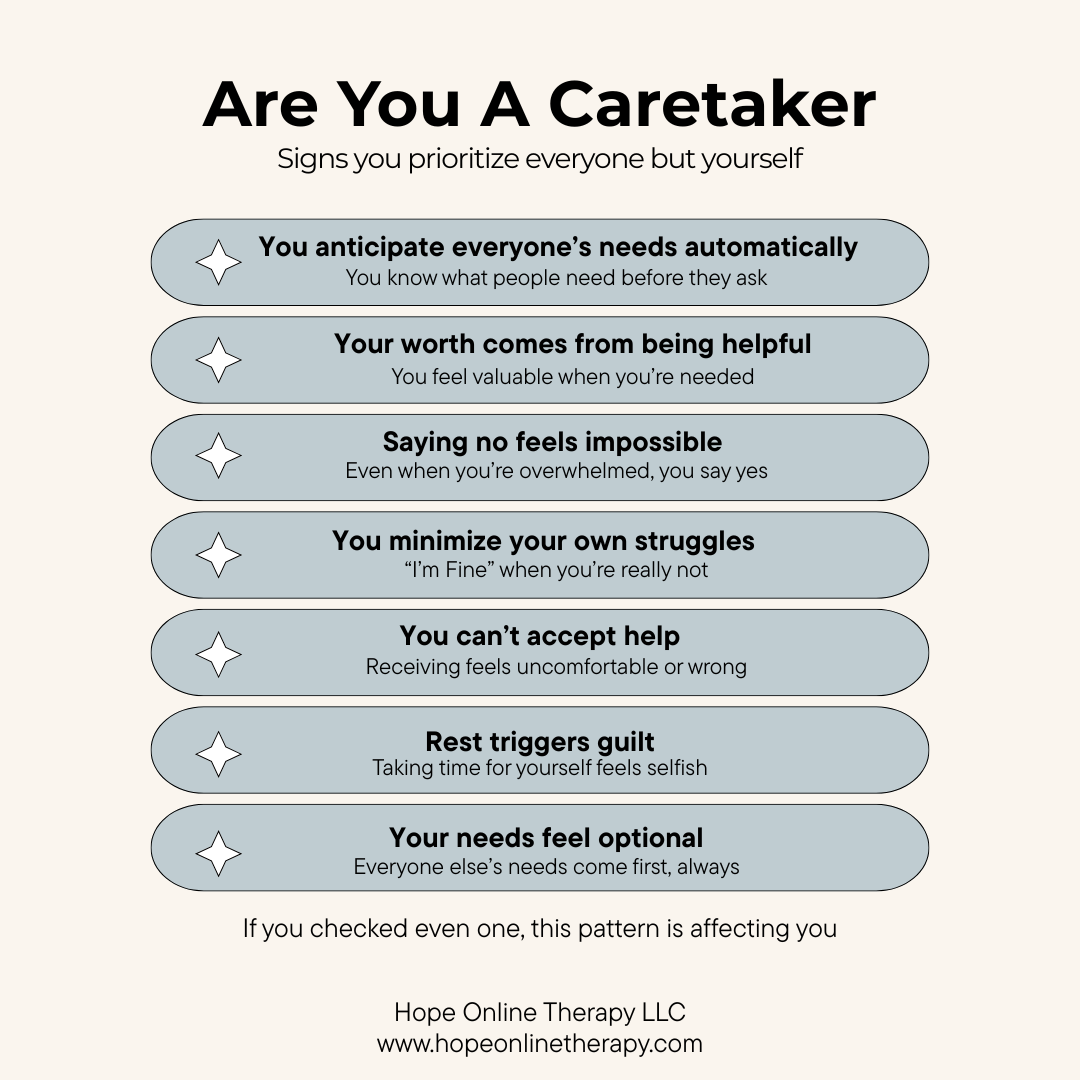
The Profile of a Caretaker
If you're reading this, you probably recognize yourself in these patterns:
You anticipate others' needs automatically. You notice when someone's tired, stressed, or upset—and you immediately think about what you can do to help. It's not even a conscious decision. It's just who you are.
You derive worth from being helpful. When you solve someone's problem, ease their burden, or make their day better, you feel valuable. Needed. Like you matter. Your identity is tied to what you do for others.
Saying no feels impossible. When someone asks for help, your immediate instinct is to say yes. Even if you're already overwhelmed, even if it means sacrificing your own needs, even if deep down you'd rather not, you will still say yes.
You minimize your own struggles. When someone asks how you are, you say "fine" even when you're not. Your problems feel smaller than everyone else's. Less worthy of attention. Easier to just handle on your own.
You're uncomfortable receiving help. When someone offers support, you deflect. "I'm okay, really." "It's not that bad." "I can handle it." Accepting help feels weak, burdensome, or like you're failing at being self-sufficient.
You feel guilty resting. Taking time for yourself feels selfish. Indulgent. Wrong. There's always something more productive you could be doing, someone else who needs you more.
Your own needs feel optional. You'll skip meals because you're helping someone. Cancel your plans to be there for a friend. Push through exhaustion because others are counting on you. Your needs are negotiable. Everyone else's aren't.
Sound familiar?
How You Got Here
You weren't born this way. Caretaking is learned.
Maybe you grew up in a household where you had to be the responsible one. Where one or both parents couldn't fully show up, so you learned to read the room, manage the mood, take care of your siblings, or even emotionally support your parents.
Maybe you got praise and attention for being helpful, mature, or "easy." Being the good kid, the responsible one, the helper became your identity. It's how you earned love or avoided conflict.
Maybe someone told you (directly or indirectly) that your needs were too much, too demanding, or a burden. So you learned to minimize them. To make yourself smaller. To be the one who gives instead of the one who needs.
Maybe you experienced trauma or instability, and taking care of others gave you a sense of control. If you could anticipate needs, prevent problems, or keep everyone happy, maybe you'd be safe.
Or maybe you're just naturally empathetic and compassionate, which is a gift. But somewhere along the way, that gift became distorted into an obligation. Into the belief that caring for yourself is selfish, and your value depends on how much you give to others.
Whatever the origin, the result is the same: You learned that your worth comes from what you do for others, and taking care of yourself feels wrong.
The Hidden Cost of Always Being the Caretaker
On the surface, being a caretaker looks noble. Selfless. Admirable. And in many ways, it is. The world needs people who care, who show up, who help.
But there's a cost that nobody talks about.
You're exhausted. Not just physically tired, bone-deep, soul-level exhaustion. The kind that sleep doesn't fix because you're depleting yourself faster than you can refill.
Resentment builds. You don't mean for it to happen. You genuinely want to help. But over time, saying yes when you mean no, giving when you have nothing left, and being there for everyone except yourself creates quiet resentment. You might not even recognize it at first, it shows up as irritability, withdrawal, or numbness.
Your own problems go unaddressed. While you're managing everyone else's lives, your anxiety grows, your depression deepens, your relationships suffer. You keep pushing your own struggles to the back burner, telling yourself you'll deal with them later. But later keeps getting delayed.
You lose yourself. When your entire identity is built on what you do for others, who are you when you're not helping someone? When you're alone, without someone to care for, you feel empty. Lost. Like you don't know who you are anymore.
People take advantage—sometimes without realizing it. When you never say no, never set boundaries, and always show up, people start expecting it. They don't see how much it costs you because you hide it so well. They assume you're fine because you always say you are.
You can't accept love. You're so used to being the giver that when someone tries to give to you, it feels uncomfortable. Wrong. You deflect compliments, refuse help, and struggle to believe that people care about you for who you are—not just what you do for them.
Your body starts keeping score. The anxiety you ignore shows up as chest tightness. The stress you push through becomes chronic headaches. The emotions you suppress manifest as digestive issues or insomnia. Your body is screaming for you to slow down, but you've learned to override those signals.
This isn't sustainable. And deep down, you know it.

Why Self-Care Advice Doesn't Work for Caretakers
You've probably been told to "practice self-care." Take a bath. Light a candle. Do yoga. Treat yourself.
And maybe you've tried. But it feels hollow. Like you're going through the motions of something that's supposed to help but doesn't address the real problem.
That's because the issue isn't that you don't know how to relax. The issue is that you've internalized beliefs that make self-care feel morally wrong.
"I don't deserve it." You believe care, rest, and kindness have to be earned. And no matter how much you do, it never feels like enough to justify taking care of yourself.
"Other people need it more." There's always someone struggling more than you. Someone who deserves support more. Your problems feel smaller by comparison, so taking time for yourself feels selfish.
"I should be able to handle this on my own." Needing help feels like failure. You're supposed to be strong, capable, self-sufficient. If you can't manage on your own, what does that say about you?
"Taking care of myself means letting people down." If you rest, someone might need you and you won't be there. If you set boundaries, people might be upset. Your availability is what makes you valuable.
"I don't even know what I need." You're so disconnected from your own needs that when someone asks what would help, you genuinely don't know. You've spent so long tuning into everyone else that you've lost the ability to tune into yourself.
These beliefs aren't something you can positive-think your way out of. They're deeply rooted patterns that require real work to change.
The Permission You're Waiting For
Here's what I want you to hear: You don't have to earn the right to take care of yourself!
Your needs aren't optional. They're not a luxury you get to prioritize once everyone else is taken care of. They're not less important than everyone else's needs.
You matter. Not because of what you do for others. Not because you're useful or helpful or reliable. You matter simply because you exist.
Taking care of yourself isn't selfish. It's necessary. You can't pour from an empty cup—not because you owe the world your service, but because you deserve to feel full.
Setting boundaries isn't letting people down. It's teaching them that you're a person with limits, not an infinite resource.

Asking for help isn't weakness. It's recognizing that humans aren't meant to carry everything alone.
Resting isn't laziness. It's how your body and mind repair and sustain themselves.
You're allowed to be a person with needs. You're allowed to prioritize yourself without guilt. You're allowed to say no. You're allowed to receive without immediately trying to give back.
You're allowed to be cared for, too.
What Actually Helps: Changing the Pattern
Real change for caretakers isn't about adding more self-care tasks to your to-do list. It's about addressing the beliefs and patterns that make self-care feel impossible in the first place.
1. Recognize Where This Came From
Understanding the origin of your caretaking patterns removes shame. You're not broken. You're not too sensitive. You learned this as a survival strategy or as the way to get love and approval.
Therapy helps you see how early experiences shaped these patterns—and how they're affecting you now. EMDR (Eye Movement Desensitization and Reprocessing) therapy can process the experiences that taught you your needs don't matter. CBT (Cognitive behavioral therapy) helps you identify and challenge the beliefs keeping you stuck.
2. Learn to Identify Your Own Needs
This sounds basic, but for many caretakers, it's revolutionary.
You've spent so long tuning into everyone else that you've lost touch with yourself. Learning to pause and ask "What do I actually need right now?" is a skill you have to rebuild.
Start small: Are you hungry? Tired? Overwhelmed? What would feel good? You don't have to act on every need immediately, but you have to start recognizing they exist.
3. Practice Setting Boundaries
Boundaries aren't walls. They're not rejecting people or being selfish. Boundaries are simply communicating your limits.
"I can't help with that right now, but I can help on Thursday."
"I need to check in with myself before I commit to that."
"I care about you, and I'm not available this weekend."
Boundaries feel uncomfortable at first—especially if people are used to you always saying yes. That discomfort doesn't mean you're doing something wrong. It means you're doing something new.
4. Challenge the Guilt
When you start prioritizing yourself, guilt will show up. "I should be helping them." "They need me." "What if they're upset?"
That guilt isn't proof you're doing something wrong. It's your old pattern protesting the change.
You can acknowledge the guilt and still take care of yourself. "I feel guilty, and I'm still going to rest." "This feels uncomfortable, and I'm still going to say no."
Over time, the guilt lessens. Your nervous system learns that prioritizing yourself is safe.
5. Work on Your Relationship with Receiving
Practice accepting help when it's offered. Let someone do something kind for you without immediately trying to return the favor. Notice your urge to deflect compliments—and resist it.
Receiving is hard for caretakers because it means being vulnerable, being seen as someone with needs. But relationships can't be one-way streets forever. People want to give to you, too. Let them.
6. Build a Different Sense of Worth
Your value isn't contingent on your usefulness. You are inherently worthy—not because of what you do, but because of who you are.
This is deep work. It requires unlearning years of conditioning that told you otherwise. But it's possible. Therapy helps you build a new foundation of self-worth that isn't dependent on productivity or service.
What This Looks Like in Practice
Let's be honest: You're not going to wake up tomorrow and suddenly be great at prioritizing yourself. This is gradual work. Progress, not perfection.
You might:
Say no to one request this week (even though it feels terrible)
Notice when you're minimizing your own struggle and pause instead of immediately helping someone else
Ask a friend for support instead of pretending you're fine
Cancel plans to rest without making up an elaborate excuse
Catch yourself overextending and pull back before you hit burnout
Accept a compliment without deflecting or returning one
Spend an hour doing something just for you without feeling guilty
These small shifts add up. Over time, you'll notice:
You have more energy because you're not depleting yourself constantly
Resentment decreases because you're honoring your limits
Relationships improve because people see the real you, not just the helpful version
Anxiety and depression lessen because you're addressing your needs instead of ignoring them
You feel more like yourself—because you're not performing a role anymore
You Can Be Compassionate AND Have Boundaries
Here's the fear: If you stop being the caretaker, you'll become cold, selfish, or uncaring.
That's not true.
You can be a compassionate, caring person who also has boundaries. You can help others without sacrificing yourself. You can say no and still be kind.
In fact, taking care of yourself makes you a better support to others. Not because you "owe" the world your service, but because you can't genuinely show up for people when you're running on empty.
But more importantly: You deserve care whether or not it makes you more helpful to others.
Your worthiness isn't dependent on your productivity. Your needs aren't less important than anyone else's. You're allowed to take up space, have limits, and prioritize yourself.
You've Taken Care of Everyone Else Long Enough
You're reading this because some part of you knows you can't keep going like this.
You're exhausted. You're resentful. You're losing yourself. And you're finally ready to admit that maybe, just maybe, you matter too.
You do. You always have. You just haven't been taught to believe it.
Taking care of yourself isn't selfish. It's overdue.
Setting boundaries isn't cruel. It's honest.
Asking for help isn't weakness. It's human.
Prioritizing your needs doesn't make you a bad person. It makes you a whole person.
You've spent years—maybe decades—being the one everyone leans on. Now it's time to let yourself be supported, too.
You don't have to figure out how to do this alone. That's the pattern you're trying to break.

When It's Time to Get Help
If you're recognizing yourself in this post—if you're exhausted, resentful, and lost under the weight of everyone else's needs, it might be time to talk to someone.
Therapy for caretakers isn't about learning to care less about people. It's about learning to include yourself in the circle of people you care for.
In therapy, you'll:
Understand where your caretaking patterns came from
Process the experiences that taught you your needs don't matter
Learn to identify and honor your own needs
Practice setting boundaries without guilt
Build a sense of worth that isn't tied to what you do for others
Develop a healthier relationship with giving and receiving
Address the anxiety, depression, or burnout that's been building
EMDR helps process the childhood experiences or trauma that created these patterns. CBT helps you identify and challenge the beliefs keeping you stuck. Mindfulness helps you reconnect with yourself and your needs.
Ready to Include Yourself in Your Circle of Care?
If you're tired of putting everyone else first and ready to build a healthier relationship with yourself, let's talk.
I specialize in working with caretakers, people-pleasers, and high-achievers who are exceptional at supporting others but struggle to extend that same compassion to themselves. Through EMDR, CBT, and mindfulness-based therapy, we'll work on the patterns keeping you stuck—so you can care for others without depleting yourself.
Virtual therapy for adults in Texas and Idaho. You don't have to carry this alone anymore.
Schedule a Free Consultation – Let's talk about how therapy can help you prioritize yourself without the guilt.
You've taken care of everyone else. Now it's your turn.