The High-Functioning Anxiety Trap: Why Looking 'Fine' Makes Everything Harder

You got the promotion. You're meeting deadlines. Your inbox is organized. From the outside, you're crushing it.
So why does it feel like you're drowning?
Welcome to high-functioning anxiety, the kind that doesn't show up on the surface but controls everything underneath, the kind that keeps you awake at 3 AM replaying conversations, the kind that makes your chest tight in meetings even though you know you're prepared, the kind that nobody sees because you've gotten really, really good at hiding it.
And that's exactly what makes it so exhausting.
What High-Functioning Anxiety Actually Looks Like
Forget the stereotype of someone who can't get out of bed or misses work. High-functioning anxiety looks like success with a side of silent suffering.
You show up. You perform. You deliver. But internally? You're running on fumes, second guessing every decision, and convinced that one mistake will expose you as the fraud you secretly fear you are.
High-functioning anxiety often shows up as:
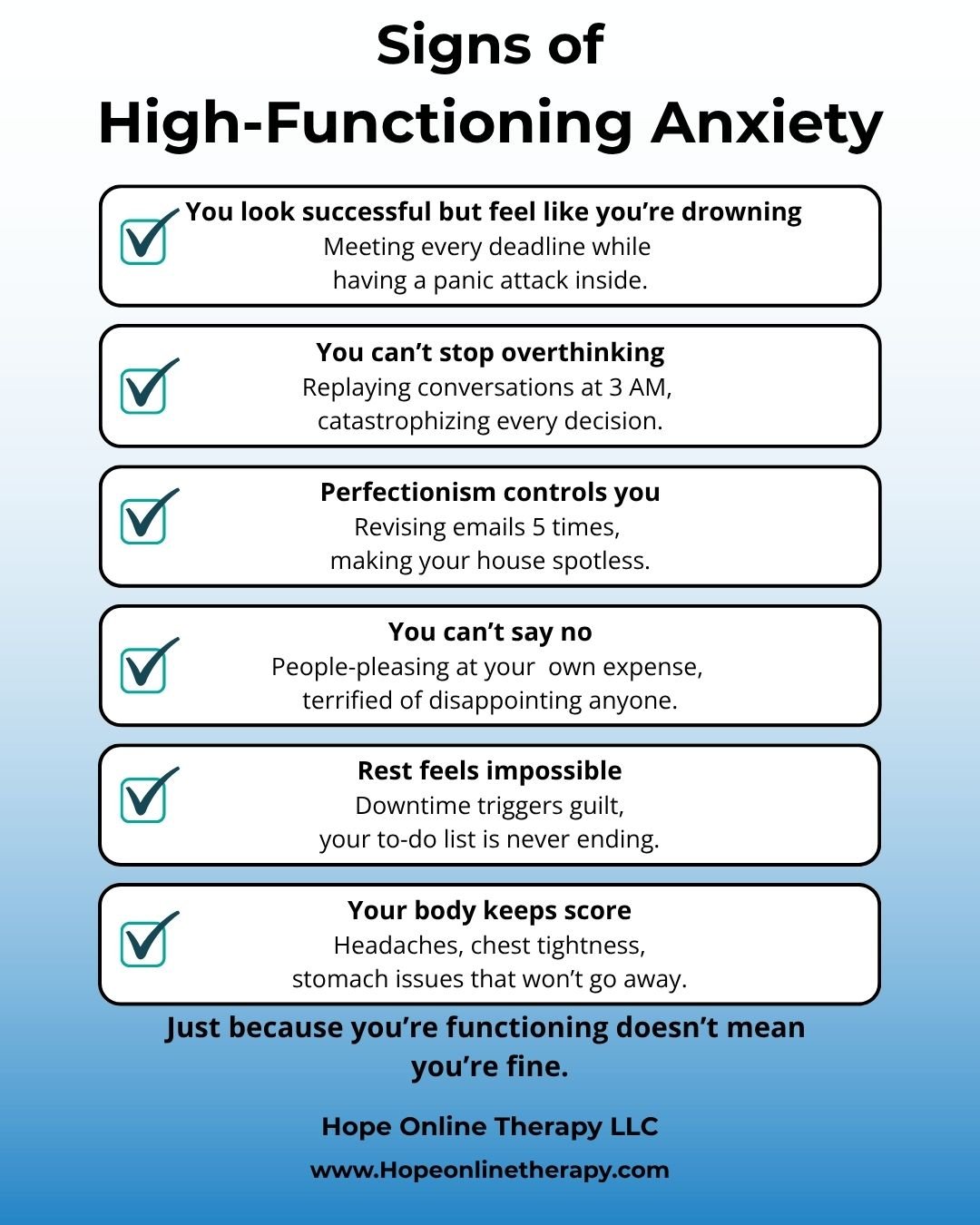
Perfectionism disguised as excellence. It's not about doing your best, it's about the terror of being anything less than perfect. You revise emails five times. You stay up late to make your home spotless. The bar keeps rising, and you're the one holding it.
People pleasing masked as being helpful. You say yes when you want to say no. You take on extra projects you don't have time for. You're terrified of disappointing anyone, so you disappoint yourself instead.
Overthinking that feels productive. You call it "being thorough" or "planning ahead," but really? You're mentally rehearsing every possible scenario, catastrophizing outcomes, and trying to control things that haven't even happened yet.
Physical symptoms you can't ignore anymore. The tension headaches. The tight chest. The stomach issues that flare before important meetings. Your body is screaming what your mind won't admit: this isn't sustainable.
The inability to rest without guilt. Downtime feels dangerous. If you're not producing, achieving, or crossing something off the list, you feel anxious. So you stay busy, exhausted but wired, unable to truly relax.
Sound familiar?
Why "Fine" Is Actually a Problem
Here's the trap: because you're high-functioning, people don't worry about you. You don't worry about you. After all, you're handling it, right?
Except you're not handling it. You are enduring it.
The pressure to maintain the image of having it together becomes its own source of anxiety. You can't let anyone see you struggling because that would mean you're not as capable as they think. So you keep the mask on, work harder, smile through it, and tell everyone you're fine.
Meanwhile, the gap between how you look and how you feel keeps widening.
The real cost of high-functioning anxiety:
You're successful, but you can't enjoy it. Every achievement feels temporary. Every compliment feels undeserved. You're waiting for the other shoe to drop.
Your relationships suffer in ways people don't see. You're present but not really there. You're listening but mentally running through your to-do list. You're avoiding conflict because you can't handle one more thing going wrong.
You're exhausted in a way sleep doesn't fix. It's not just physical tiredness, it's the bone deep fatigue of carrying constant worry while pretending you're not.
Your body starts keeping score. Anxiety doesn't stay mental forever. Eventually, it shows up as migraines, digestive issues, muscle tension, insomnia, or worse. Your nervous system is stuck in overdrive with no off switch.
Why High-Functioning Anxiety Is So Hard to Address
Part of what makes high-functioning anxiety so insidious is that it's rewarded. You get praised for being reliable, thorough, and dedicated. Your anxiety driven behaviors look like strengths.
So you keep going. And going. And going. And the anxiety gets normalized.
You tell yourself everyone feels this way. That stress is just part of being successful. That you should be grateful for what you have instead of complaining about how hard it feels.
But here's the truth: just because you can function doesn't mean you should have to function this way.
The Difference Between Healthy Striving and Anxiety Driven Achievement
There's a difference between being motivated and being terrified.
Healthy striving comes from wanting to do well. Anxiety driven achievement comes from fear of what happens if you don't.
Healthy striving allows for mistakes and learning. Anxiety driven achievement treats every error as evidence you're not good enough.
Healthy striving lets you rest when the work is done. Anxiety driven achievement never feels done because the next thing is already looming.
Healthy striving celebrates success. Anxiety driven achievement immediately moves the goalpost.
If your drive is fueled by fear, perfectionism, or the need to prove your worth, that's not ambition. That's anxiety wearing a productivity costume.
Why Traditional Advice Doesn't Help
If you've tried to deal with this before, you've probably heard:
"Just relax." (If you could, you would.)
"You're overthinking it." (That's literally the problem.)
"Practice self-care." (Another thing on the to-do list that you'll feel guilty about not doing perfectly.)
"You should be grateful for what you have." (Gratitude doesn't fix a dysregulated nervous system.)
These well meaning suggestions miss the point. High-functioning anxiety isn't something you can positive-think your way out of. It's not about trying harder or wanting it more.
It's about understanding what's actually happening in your brain and body and learning new ways to respond.
What Actually Helps: A Different Approach
Real change happens when you stop trying to manage symptoms and start addressing the root cause.
Understanding your nervous system: High-functioning anxiety keeps your nervous system stuck in threat mode. You're not broken, you're stuck in a pattern. Learning how your nervous system works takes away the shame and gives you a roadmap.
Identifying the beliefs driving your anxiety: "I have to be perfect or I'm worthless." "If I stop achieving, I have no value." "I can't let anyone down." These aren't facts, they're learned beliefs. They can be unlearned.
Processing what's underneath: Often, high-functioning anxiety is protecting you from something deeper such as old trauma, early messages about your worth, or experiences that taught you safety only comes from being perfect. Therapy helps you process what's driving you.
Learning to tolerate discomfort: Part of healing is building your capacity to sit with uncertainty, imperfection, and vulnerability without immediately trying to control or fix it. This doesn't mean suffering more, it means building resilience.
Developing new responses: CBT helps you catch the anxious thought patterns before they spiral. EMDR helps your brain reprocess the experiences that wired you this way. Mindfulness teaches your nervous system what safety actually feels like.
What Therapy Looks Like for High-Functioning Anxiety
You might be thinking: "I don't have time for therapy. I barely have time to breathe."
And that's exactly why you need it.
Therapy for high-functioning anxiety isn't about adding more to your plate. It's about understanding why your plate is always overflowing and learning to change the pattern.
In our work together, you will:
Learn why you're wired for anxiety (and how to rewire it). Understand the difference between real danger and perceived threat. Your brain doesn't know the difference, but you can teach it.
Identify your triggers before they derail you. You'll learn to recognize the early signs of anxiety escalation and intervene before you're in full panic mode.
Challenge the beliefs keeping you stuck. "I have to be perfect." "I can't let anyone down." We'll examine where these came from and whether they're actually true.
Process the experiences that created these patterns. EMDR helps your brain reprocess memories and experiences that keep your nervous system on high alert.
Build a new relationship with rest and imperfection. You'll learn that your worth isn't tied to your productivity and you’ll actually practice living that way.
You Don't Have to Earn the Right to Feel Better
Here's what I need you to hear: You don't have to hit rock bottom to deserve help.
You don't have to lose your job, destroy a relationship, or have a breakdown to justify getting support.
The fact that you're functioning doesn't mean you're fine. Just because others have it worse than you doesn't mean you're not struggling.
High-functioning anxiety is still anxiety. Just because you're good at hiding it doesn't make it less real.
The Path Forward
You've spent years proving you're capable. You've achieved, performed, and delivered. You've taken care of everyone else and kept all the plates spinning.
Now imagine what it would feel like to not have to prove anything. To feel calm instead of wired. To enjoy your success instead of fearing it'll disappear. To rest without guilt.
That's not a fantasy. That's what's possible when you address high-functioning anxiety at its root.
You don't have to keep white-knuckling your way through life. There's another way. You don't have to figure it out alone.
What To Do Right Now
If you're reading this and recognizing yourself, here's what comes next:
Acknowledge what's really happening. You're not just stressed. You're not just a perfectionist. This is anxiety, and it's affecting your life.
Stop waiting for it to get worse. You don't need a crisis to justify getting help. The fact that you're exhausted and struggling is enough.
Reach out. Working with a therapist who understands high-functioning anxiety changes everything. Not all therapy is the same. You need someone who gets that you're not falling apart, you're just tired of holding it all together.
Give yourself permission. You've spent your whole life taking care of others and meeting their expectations. Now, it’s time to prioritize your health and take care of you.
You've been strong long enough. Let's work on helping you feel better.
Ready to Address What's Really Going On?
If you're a high-achieving adult in Texas or Idaho who's tired of functioning at the expense of feeling good, let's talk.
I specialize in helping people who look successful on the outside but are struggling inside. EMDR, CBT, and mindfulness-based therapies can help you understand your anxiety, process what's driving it, and finally feel at ease.
Schedule a Free Consultation. Let's talk about what high-functioning anxiety really looks like for you and how we can address it together.
You don't have to keep pretending you're fine.
Your relationship might be one area where high-functioning anxiety is causing problems. Read about what to do when your partner suggest therapy.