Perfectionism, Anxiety, and Depression: The Connection You Might Be Missing

You're exhausted all the time, but you can't figure out why. You've accomplished so much, your career is good, your relationships are solid, you're doing everything "right", yet you feel anxious constantly and a heaviness sits in your chest that nothing seems to lift.
You wonder: Why am I depressed when my life looks fine? Why do I have so much anxiety when there's "nothing to be anxious about"?
Maybe you've never thought of yourself as a perfectionist. Perfectionists are the people obsessing over flaws, right? But what if perfectionism isn't always about the obvious things? What if it's quietly running your entire life, driving both your achievements and your suffering?
Here's what I've learned from years of working with adults: Many people don't realize perfectionism is the root of their anxiety and depression because they only see the achievements it produces.
They don't see the cost.
Today, we're going to change that. We're going to look at how perfectionism actually drives anxiety and depression, and more importantly, how to recognize if it's happening to you.
What Perfectionism Really Is

Before we go further, let's be clear about what perfectionism actually is. It's not:
Having high standards
Working hard
Caring about quality
Wanting to do well
Those are all healthy traits.
Perfectionism is the belief that your worth depends on how much you achieve and how flawlessly you perform.
It's the voice that says: "If I'm not perfect, I'm not good enough."
It's the conviction that mistakes = failure. That good enough = not acceptable. That rest = laziness. That asking for help = weakness.
Perfectionism isn't ambition. It's the prison ambition builds.
And here's the thing: Perfectionism feels productive, so you don't realize it's slowly destroying your mental health.
How Perfectionism Creates Anxiety
Let's trace the pathway from perfectionism to anxiety.
Step 1: The Standard is Impossibly High
When your worth depends on flawless performance, the bar is always too high. Not because external expectations are unreasonable, but because no standard is high enough when your self-worth is on the line.
You set a goal: "I'll work hard but still maintain work-life balance." But perfectionistic thinking warps it into: "I should excel at work, be a great partner, be a good friend, stay fit, keep the house clean, and have time for hobbies."
The standard doesn't make sense, but it feels necessary.
Step 2: You Start Looking for Threats to Perfect Performance
Now your brain is scanning for anything that could prevent you from meeting this impossible standard.
What if I make a mistake at work?
What if someone thinks I'm not competent?
What if I can't keep everything together?
What if I'm not doing enough?
Your threat-detection system is on high alert. Constantly vigilant. Always ready to spot the next thing you're failing at.
This is anxiety. This is hypervigilance. This is your nervous system in overdrive, trying to prevent the catastrophe of not being perfect.
Step 3: The Anxiety Gets Worse Because the Standard is Unachievable
No matter how hard you work, the perfect standard remains out of reach. So the anxiety doesn't resolve. It compounds.
You accomplish something, and instead of relief, you think: "But I should have done it better. Next time I need to work harder."
You complete a project, and instead of satisfaction, you obsess over what you could have done differently.
The anxiety never gets the message that you're safe, because the threat (being imperfect) is never actually resolved.
Step 4: Anxiety Becomes Your Baseline
Over time, anxiety stops being a response to a specific threat. It becomes your normal state. You're always slightly tense, always slightly worried, always bracing for the next failure.
You stop noticing it because it's always there.
This is when people come to me saying: "I'm just an anxious person." But they're not just an anxious person, they are a perfectionist whose anxiety has become chronic.
How Perfectionism Creates Depression
The pathway to depression is different, but it starts in the same place.
Step 1: The Goal Post Always Moves
You work incredibly hard and achieve something. You should feel proud, right?

But perfectionism doesn't allow that. Instead, your brain says: "Okay, you achieved that. Now you need to achieve the next thing. And do it better."
There is no finish line. There is no "good enough." There is no rest.
You're running on a treadmill that keeps speeding up.
Step 2: You Never Feel Good Enough
No matter what you accomplish, it's never quite enough. You're always slightly failing. Always slightly disappointing. Always slightly behind.
This isn't based in reality, it's based in perfectionism's lie that your worth is conditional on flawless performance.
Step 3: Chronic Unfulfillment Leads to Hopelessness
When you work so hard and still feel like you're failing, after months or years of this, something breaks.
You start to think: "Why do I even try? I'm never going to feel good enough."
You stop feeling motivated. You stop feeling hopeful. You start to feel numb.
This is depression. Not sadness. Not grief. Just... emptiness. The exhaustion of trying to meet an impossible standard forever.
Step 4: Depression and Perfectionism Feed Each Other
Now here's where it gets really dark:
Depression makes you tired, which makes it harder to maintain your perfect performance. So you start to fall short. Which triggers perfectionism's shame response: "I'm failing. I'm lazy. I'm not good enough."
Which makes the depression worse.
They become locked together. Perfectionism drives depression, and depression makes perfectionism feel more justified: "See? If I don't push harder, I'll fall apart completely."
The Perfectionism + Anxiety + Depression Cycle
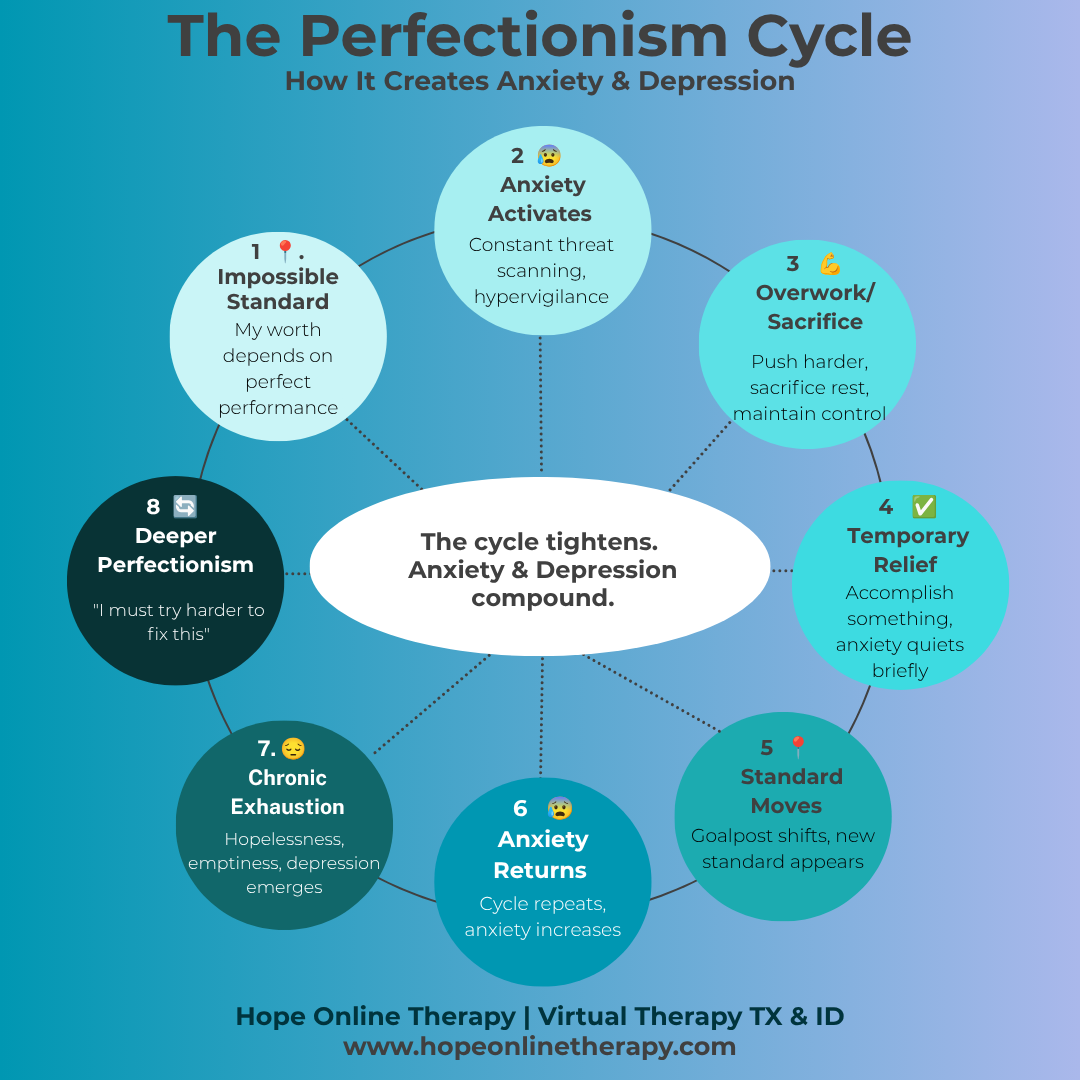
Let me map the complete cycle:
Perfectionism: "My worth depends on perfect performance"
Anxiety: "What if I fail? What if I'm not good enough?" (Constant threat scanning)
Behavioral Response: Work harder, do more, sacrifice sleep/rest/relationships to maintain the standard
Temporary Relief: You accomplish something, the anxiety quiets for a moment
New Standard: The goalpost moves, the anxiety returns
Depression: After years of this, you feel hopeless, exhausted, empty
Deeper Perfectionism: "I need to try even harder to fix this depression"
Worse Anxiety and Depression: The cycle tightens
Complete Exhaustion: You're now "high-functioning" but falling apart internally
You look fine on the outside. But inside, you're drowning.
Do You Have Perfectionism? A Self-Assessment
Not all perfectionists look the same. But here are signs that perfectionism might be driving your anxiety and depression:
About Your Standards:
You hold yourself to standards you'd never expect from others
You feel like you should always be doing more
You struggle to feel satisfied with your accomplishments
You often think "that was good, but I should have..."
Your definition of "good enough" keeps changing
You believe that if something's worth doing, it's worth doing perfectly
About Your Emotions:
You feel anxious even when things are going well
You worry about making mistakes long before they happen
You feel guilty when you rest or take time off
You feel like a failure even when you've objectively succeeded
You experience shame about things you didn't do "perfectly"
You feel exhausted but can't stop pushing
About Your Behavior:
You have trouble saying no to requests
You overcommit and then feel resentful
You struggle to delegate because "they won't do it right"
You work long hours and rarely take breaks
You compare yourself to others and always come up short
You procrastinate on things you care about because you're afraid you won't do them perfectly
About Your Relationships:
You're critical of others (though maybe not out loud)
You have high expectations for people in your life
You struggle to ask for help
You feel responsible for others' emotions or success
You hide parts of yourself because they're "not good enough"
About Your Self-Perception:
You define yourself by your accomplishments
You worry that people would leave if they saw the "real" you
You believe your value is conditional on what you produce
You struggle to accept compliments
You feel like an imposter despite evidence of your competence
Scoring:
0-5 checked: You might have some perfectionistic traits, but they may not be the main driver of your anxiety/depression
6-15 checked: Perfectionism is likely playing a significant role in your mental health
16+ checked: Perfectionism is probably a major factor in your anxiety and depression
Here's the important part: If you checked more than a few boxes, this doesn't mean you're broken or that you chose wrong. It means you've been operating under a belief system that's slowly been draining you.
And the good news? That can change.

Why Perfectionism Feels Necessary
Before we talk about solutions, it's important to understand why you haven't already quit perfectionism, even though it's making you miserable.
Perfectionism kept you safe.
Maybe perfectionism started because:
A parent's love felt conditional on achievement
You grew up in chaos and control felt protective
You learned that being "good" kept you out of trouble
You saw love and approval as something you had to earn
Your identity got built on being the competent one
Perfectionism worked. It got you places. It earned approval. It made you feel safe.
The problem is: It keeps working short-term while destroying you long-term.
You get the achievement. You get the recognition. But the cost is your mental health, your relationships, and your peace of mind.
And you've probably internalized the message so deeply that it doesn't even feel like perfectionism anymore. It just feels like reality: "This is how you have to be to be worthy."
The Truth Perfectionism Won't Let You Believe
Here's what perfectionism has convinced you is dangerous but is actually true:
You are worthy right now, exactly as you are.
Not because of what you've accomplished. Not because of how well you perform. Not because you're perfect.
But simply because you exist.
Your worth is not conditional. Your value is not earned. Your acceptability is not something you have to prove.
This isn't motivational poster language. This is the core belief you need to challenge perfectionism.
And I know that feels terrifying. Because if your worth isn't based on perfect performance, then what have you been killing yourself for?
That's the grief you have to process.
Beyond Self-Help: When Perfectionism Needs Therapy
Here's where I want to be honest: You can read all the self-help advice in the world about "good enough" and "self-compassion," and it might help a little. But if perfectionism is deeply rooted, if it's been your operating system for decades, you probably need more than ideas.
You need to process the beliefs underneath perfectionism.
This is where therapy becomes essential, not optional.
Specifically:
CBT (Cognitive Behavioral Therapy) helps you:
Identify the automatic thoughts driving perfectionism
Challenge the belief that your worth is conditional
Build new thought patterns
Change behaviors that reinforce perfectionism
EMDR (Eye Movement Desensitization and Reprocessing) helps you:
Process the early experiences that made perfectionism feel necessary
Release the nervous system activation around being "not good enough"
Resolve core wounds that perfectionism was protecting you from
Mindfulness-based therapy helps you:
Notice perfectionist thoughts without believing them
Develop self-compassion instead of self-criticism
Stay present instead of always striving
The combination often works best: Use CBT to change thought patterns, EMDR to process core wounds, and mindfulness to build new ways of being.
What Happens When You Release Perfectionism
I want to paint you a picture of what's possible on the other side of perfectionism:
You stop scanning for threats. Your nervous system finally relaxes. The constant background anxiety quiets.
You can feel satisfied. You accomplish something and you feel... good. Without immediately thinking about the next thing.
You have energy for things that matter. Instead of pouring everything into maintaining the perfect image, you have energy for people and experiences you actually value.
You can rest without guilt. Sleep becomes restorative instead of something you feel guilty about not maximizing.
You can be seen. You don't have to hide the parts of you that aren't perfect. People can know the real you.
You stop being exhausted. The low-level depression that felt like your baseline starts to lift.
Relationships improve. You stop being critical. You stop overworking. You're actually present.
This doesn't mean you stop caring about quality or working hard. It means you care about meaning more than perfection.
Start Here
If this resonates, you don't have to overhaul your entire belief system this week. Start small:
This week: Notice the perfectionist thoughts. Just notice. Don't judge them, don't try to fix them. Just see them: "There's perfectionism again."
Next week: Pick one area where the standard is impossibly high. What would "good enough" actually look like? Not perfect. Just... acceptable. Good enough.
Week three: Do that thing imperfectly. Let it be good enough. Notice the anxiety that comes up. That's your nervous system learning that imperfection doesn't mean catastrophe.
Week four: Tell one person one true thing about yourself that isn't perfect. One flaw. One struggle. One place where you're not measuring up.
Small steps. Consistent practice. Over time, the neural pathways that perfectionism carved start to heal.
When You're Ready for Support
If you've recognized yourself in this post and you're ready to actually shift the beliefs driving your perfectionism, you don't have to do it alone.
I work with adults throughout Texas and Idaho who look successful on the outside but are exhausted and anxious from trying to be perfect. Using CBT, EMDR, and mindfulness-based therapy, we work together to:

Identify the roots of your perfectionism
Challenge the belief that your worth is conditional
Process the experiences that made perfectionism feel necessary
Build sustainable standards based on actual values
Release the anxiety and depression perfectionism has been driving
Virtual therapy means you can start healing without adding another "should" to your life.
Book your free 15-minute consultation. We can talk about whether your perfectionism is driving your anxiety and depression, and what healing might look like for you.
You've been perfect for long enough. Maybe it's time to be human instead.
Lori Lieb, MS, LCPC
Hope Online Therapy, LLC
Virtual CBT, EMDR, and Mindfulness Therapy
Serving Texas & Idaho
Related Posts You Might Find Helpful:
Disclaimer: This blog post is for informational purposes only and does not constitute medical advice. If you're experiencing a mental health crisis, please call 988 (Suicide & Crisis Lifeline) or go to your nearest emergency room.