When Therapy Should Be More Than Just Talking
You've been in therapy for months. Maybe even years. Your therapist is good. You like them. You've gained real insight into your past, your patterns, and why you do the things you do.
But you still feel triggered by the same things. You still get anxious in the same situations. You still react in ways you wish you didn't.
And there's this quiet desperation that whispers: "Why isn't this working?"
Here's the hard truth: Talking about your trauma is not the same as processing it.
Understanding why you're anxious doesn't necessarily make the anxiety go away. Knowing why you have abandonment fears doesn't eliminate the panic when someone takes too long to text back. Intellectually understanding that you're not in danger doesn't stop your body from reacting like you are.
This isn't a failure of talk therapy. It's a limitation of it.
And it's exactly why therapy sometimes needs to be more than just talking.
The Talk Therapy Paradox

Talk therapy, which includes CBT, psychodynamic therapy, and most traditional counseling, is incredibly valuable. It helps you:
Understand the roots of your issues
Identify patterns and triggers
Develop insight into your behavior
Build coping strategies
Process emotions through conversation
But here's the paradox: The part of your brain that needs healing isn't the part that talks.
When you experience trauma, anxiety, or intense stress, the threat is processed in the limbic system and amygdala, the emotional, reactive parts of your brain. The memory gets stored with all the emotional charge still attached.
Meanwhile, your prefrontal cortex (the thinking, rational part) is offline. It can't help you in the moment. It can't logic your way out of panic.
So when you come to therapy and talk about your trauma, you're engaging your rational brain. You're thinking, analyzing, understanding. But the emotional part of your brain, the part that's actually stuck, is still waiting to be processed.
This is why you can have all the insight in the world and still feel triggered.
You understand intellectually that you're safe. But your nervous system doesn't believe you. Your body still reacts like the threat is real.
Talk therapy alone often gets you 70% of the way there. But that last 30%—the part where your nervous system actually believes you're safe, where memories lose their emotional charge, where triggers no longer control you—that requires something more.
What 'More' Looks Like

"More than just talking" doesn't mean your therapist is wrong or that you should quit therapy. It means adding an approach that targets the part of your brain that talk therapy can't reach.
The most researched, evidence-based approach for this is EMDR (Eye Movement Desensitization and Reprocessing).
But EMDR isn't the only option. Other approaches that go beyond pure talk include:
Somatic therapy (working with the body)
Neurofeedback (training your nervous system)
Internal Family Systems (IFS) (working with different parts of yourself)
Brainspotting (another bilateral stimulation approach)
Sensorimotor psychotherapy (body-based trauma work)
All of these share one thing in common: They don't just talk about the problem. They help your nervous system process it.
Why Talk Therapy Alone Isn't Enough for Trauma
Trauma is stored differently than regular memories. When something traumatic happens:
Your brain's threat-detection system goes into overdrive
The memory gets frozen with all the sensations, emotions, and beliefs attached
Your rational brain basically checks out
The memory stays "live" in your nervous system
Later, when something reminds you of that trauma, even something small, your amygdala reacts like the threat is happening right now. It doesn't have access to the information that you're actually safe. It doesn't listen to your rational brain saying "that was then, this is now."
Talk therapy can give you that information. But talk therapy can't make your nervous system believe it.
That's the difference between knowing and feeling. Between understanding and healing.

Why Insight Isn't Enough
One of the most frustrating things I hear from clients is: "I understand why I'm like this. I can see the pattern. But I still can't stop doing it."
This isn't because you're broken or doing therapy wrong. It's because understanding is processed in a different part of your brain than the trauma itself.
You can understand perfectly why you get anxious in crowds (maybe you were overwhelmed as a child). That understanding is real. That insight is valuable. But it lives in your prefrontal cortex, your thinking brain.
Your amygdala, the part that's actually triggering panic in crowds, doesn't care about your insights. It only responds to safety. And it doesn't learn safety through conversation.
It learns safety through a different process: the same process your brain uses to process normal memories.
Enter EMDR: Processing, Not Just Talking
This is where EMDR comes in.
EMDR doesn't ask you to talk more about your trauma. It doesn't ask you to think harder about it or gain more insight. Instead, it helps your brain do what it's designed to do naturally: process and file away difficult experiences.
During EMDR, you focus on the traumatic memory while experiencing bilateral stimulation (eye movements, alternating sounds, or vibrations). This activates the same neural pathways that activate during REM sleep, when your brain naturally processes difficult experiences.
Instead of just talking about the memory, your brain is actually processing it. Moving it from "this is happening now" to "this happened then."
The memory doesn't disappear. You still remember what occurred. But the emotional charge loosens. The triggers lose their power. Your nervous system finally believes that the threat has passed.
This is why clients often describe EMDR as: "I still remember it, but it doesn't feel like it's happening to me anymore."
How EMDR Differs From Talk Therapy
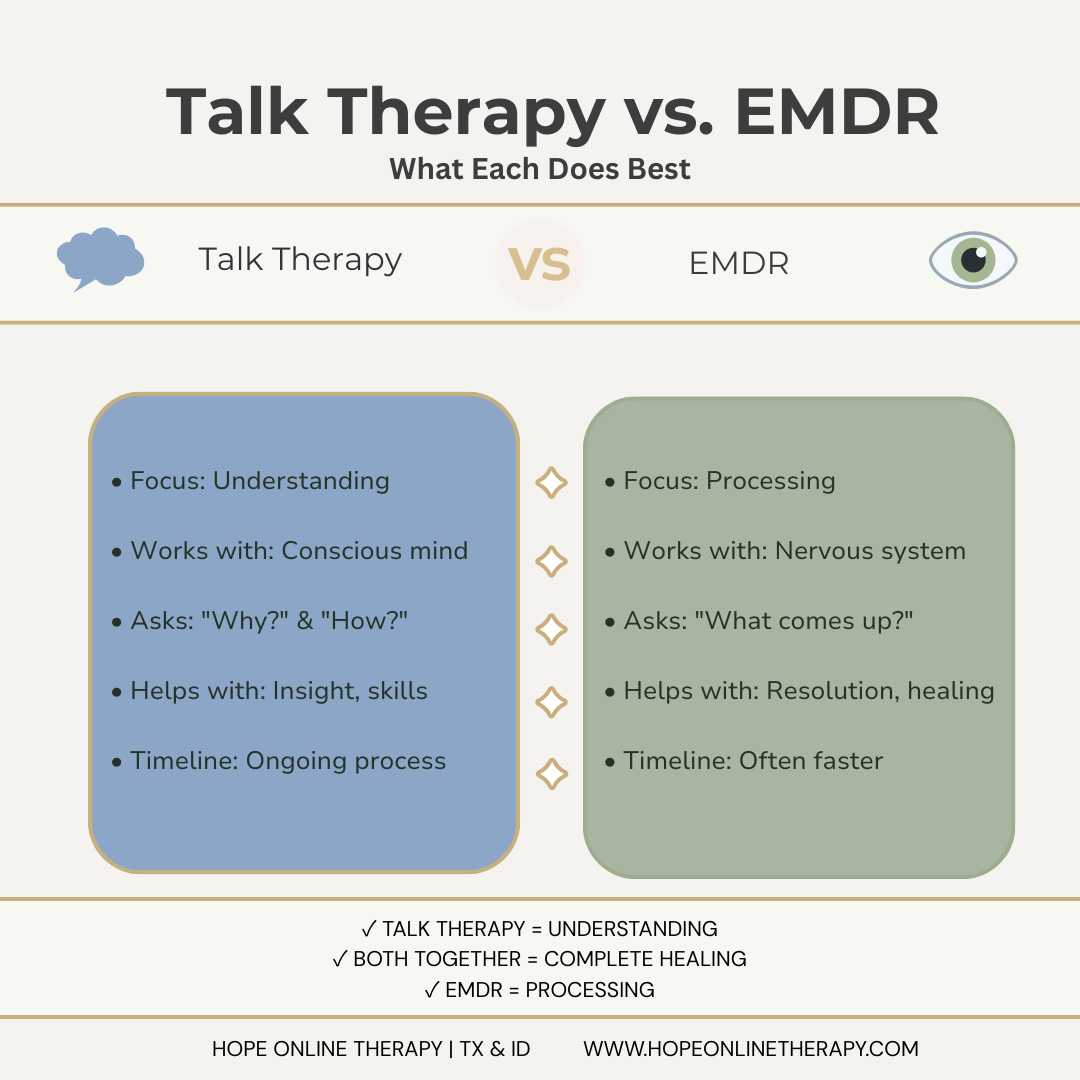
Talk Therapy:
Focuses on understanding
Works primarily with your conscious mind
Asks "why" questions
Helps you develop insight
Outcome: You understand your trauma better
EMDR:
Focuses on processing
Works with your nervous system
Doesn't require extensive talking
Helps your brain naturally resolve stuck memories
Outcome: Your body and mind are no longer triggered by the memory
They're not competing approaches. They're different approaches targeting different parts of the problem.
Think of it this way: Talk therapy helps you understand the landscape of your trauma. EMDR helps you actually walk through it and move past it.
Examples: When Talk Therapy Wasn't Enough
Sarah's Story: Sarah spent three years in therapy understanding her childhood abandonment. She could articulate exactly how it affected her relationships. She had all the insight. But she still panicked every time her partner went out of town. During EMDR, she processed the core memory of being left alone as a child. Three sessions in, her nervous system finally believed she was safe. The panic didn't disappear overnight, but it became manageable in a way years of talk therapy hadn't achieved.
Marcus's Story: Marcus was in therapy for PTSD from a car accident. He could talk about the accident in detail. He understood intellectually that he was safe. But his body still went into panic mode every time he got in a car. Talk therapy had helped with the anxiety about the anxiety. EMDR helped process the core trauma. After six sessions, he could drive without panic attacks for the first time in two years.
Jennifer's Story: Jennifer had done decades of therapy addressing her childhood trauma. She had more insight than most therapists. But certain situations still sent her into dissociation or intense fear responses she couldn't control. When she started EMDR, her body began to actually process what talk therapy had only helped her understand. The combination, years of therapy plus EMDR, created real, lasting change.
Signs Talk Therapy Alone Might Not Be Enough
You might benefit from EMDR or another processing-focused approach if:
You have insight but no relief: You understand your patterns, but they haven't changed
You're stuck in the same cycle: Despite months or years of therapy, you're repeating the same behaviors
Your body won't believe your rational mind: Logically you know you're safe, but your nervous system keeps reacting like you're in danger
You have specific traumatic memories that won't let go: Certain events keep intruding, even after talking about them extensively
You're managing symptoms but not healing: Talk therapy helps you cope, but you're not moving forward
You've hit a plateau: Therapy helped initially, but progress has stalled
You get triggered by things you can't explain: Reactions that don't match the current situation, but relate to past trauma
Can You Do Both? Talk Therapy + EMDR
Absolutely. In fact, combining talk therapy with EMDR often creates the most powerful healing.
Talk therapy helps you:
Develop self-awareness and understanding
Build skills and strategies
Process emotions verbally
Develop a secure relationship with your therapist
EMDR helps you:
Resolve core traumas at a nervous system level
Remove the emotional charge from memories
Break unhelpful neural patterns
Often achieve results faster
Many therapists integrate both approaches. Some clients do talk therapy for months, then add EMDR when they hit a plateau. Others start with EMDR to process core trauma, then use talk therapy to build understanding and skills.
The goal is the same: actual healing, not just understanding.
What EMDR Can't Do (And Why You Still Need Talk Therapy)
Let's be clear: EMDR isn't a magic cure-all. It's incredibly effective for trauma and anxiety, but it doesn't:
Build new skills: If you need to learn assertiveness, communication, or coping strategies, talk therapy is better for that
Address current life problems: If you're in an abusive relationship or dealing with active stressors, EMDR won't make those go away
Provide deep insight: Understanding your patterns still requires reflective, conversational work
Treat all mental health issues equally: EMDR is highly effective for trauma, PTSD, anxiety, and phobias, but other conditions may benefit more from other approaches
So talk therapy isn't wrong. It's just incomplete for trauma processing.
The ideal scenario: Use talk therapy for understanding, insight, skills, and the therapeutic relationship. Add EMDR when you're ready to actually process and resolve core traumas.
How to Know When It's Time to Try Something More
In your next therapy session, ask yourself:
Am I gaining insight and understanding? (If yes, talk therapy is working for that part)
Am I actually changing my reactions and behaviors? (If no, you might need more than talking)
Have I hit a plateau where progress has stalled? (Sign it's time to try something new)
Do I understand my trauma but still feel controlled by it? (Classic sign talk therapy needs support)
Am I ready to process at a deeper level? (You have to be willing—this work isn't passive)
If you answered "no" to #2 or #5, and "yes" to #3 or #4, it might be time to explore EMDR or another processing-focused approach.
The Conversation to Have With Your Therapist
If you're in therapy and wondering about EMDR, bring it up. A good therapist will:
Acknowledge that talk therapy has value AND limitations
Be honest about whether EMDR might help you
Refer you to an EMDR-trained therapist if they don't practice it
Not feel threatened by you exploring other approaches
A therapist who says "you just need to try harder with talk therapy" or "EMDR is just a fad" might not be the right fit for where you are now.
You deserve a therapist who can say: "You've done great work here. You have real insight. And I think processing this trauma at a nervous system level might be the next step. Here's someone I trust who specializes in that."
The Bottom Line

Talk therapy is not failing. Your brain is not broken. The approach was just incomplete.
Talk therapy is phenomenal for building understanding, developing skills, processing emotions, and creating a secure relationship where healing can happen. But for actual trauma processing, for getting your nervous system to believe you're safe, you often need something that targets the emotional brain directly.
That's where EMDR comes in.
It's not either/or. It's not that talk therapy was wrong. It's that you needed more than talking. You needed processing.
And there's nothing wrong with recognizing that and seeking it out.
Ready to Explore EMDR?
If you've been in therapy, gained insight, and still feel stuck, EMDR might be exactly what you need to move from understanding to healing.
I offer EMDR therapy via secure telehealth to adults throughout Texas and Idaho. I typically combine EMDR with the understanding and skills you've developed in other therapy, creating an integrated approach to healing.
During your free 15-minute consultation, we can talk about whether EMDR is right for you. You can ask any questions, and I'll be honest about whether I think it could help.
Book your free 15-minute consultation. Let's talk about moving from insight to healing.
You've done the hard work of understanding. Maybe it's time to do the deeper work of processing.
Lori Lieb, MS, LCPC
Hope Online Therapy, LLC
Virtual EMDR, CBT, and Mindfulness Therapy
Serving Texas & Idaho
Related Posts You Might Find Helpful:
The 'Should' Audit: Identifying Expectations That Are Crushing You
5 Signs Your Anxiety Needs More Than Self-Help Books
Disclaimer: This blog post is for informational purposes only and does not constitute medical advice. If you're experiencing a mental health crisis, please call 988 (Suicide & Crisis Lifeline) or go to your nearest emergency room.