Starting the New Year with Forgiveness: Healing Family Relationships
The holidays are over. The decorations are down. Life is returning to normal.
But maybe something from the holidays is still sitting heavy with you.
Maybe it was a comment your mom made. A passive-aggressive text from your sibling. The way your dad shut down your opinion—again. The uncle who monopolized every conversation. The family member who dug up old wounds or picked the same old fight.
You made it through the holidays. You smiled. You participated. But now that it's over, you're left with frustration, hurt, or anger that you're still carrying.
And you're wondering: Do I just keep feeling like this? Do I have to keep replaying what they said? Do I stay angry until next year's gathering?
Here's what you might not have considered: What if the way you're thinking about what happened is making it worse?
Not because your feelings aren't valid, they are. Not because the other person didn't do something hurtful, they might have.
But because the story you're telling yourself about what happened, about their intentions, about what it means, that story is keeping you stuck.
The start of a new year is a chance to reset. Not by pretending nothing happened, but by choosing a different way forward. A way that includes giving people the benefit of the doubt, challenging your assumptions, and, when appropriate, choosing forgiveness.
Not for them. For you.
The Stories We Tell Ourselves About Family
After a difficult holiday interaction, your brain immediately creates a story about what happened.
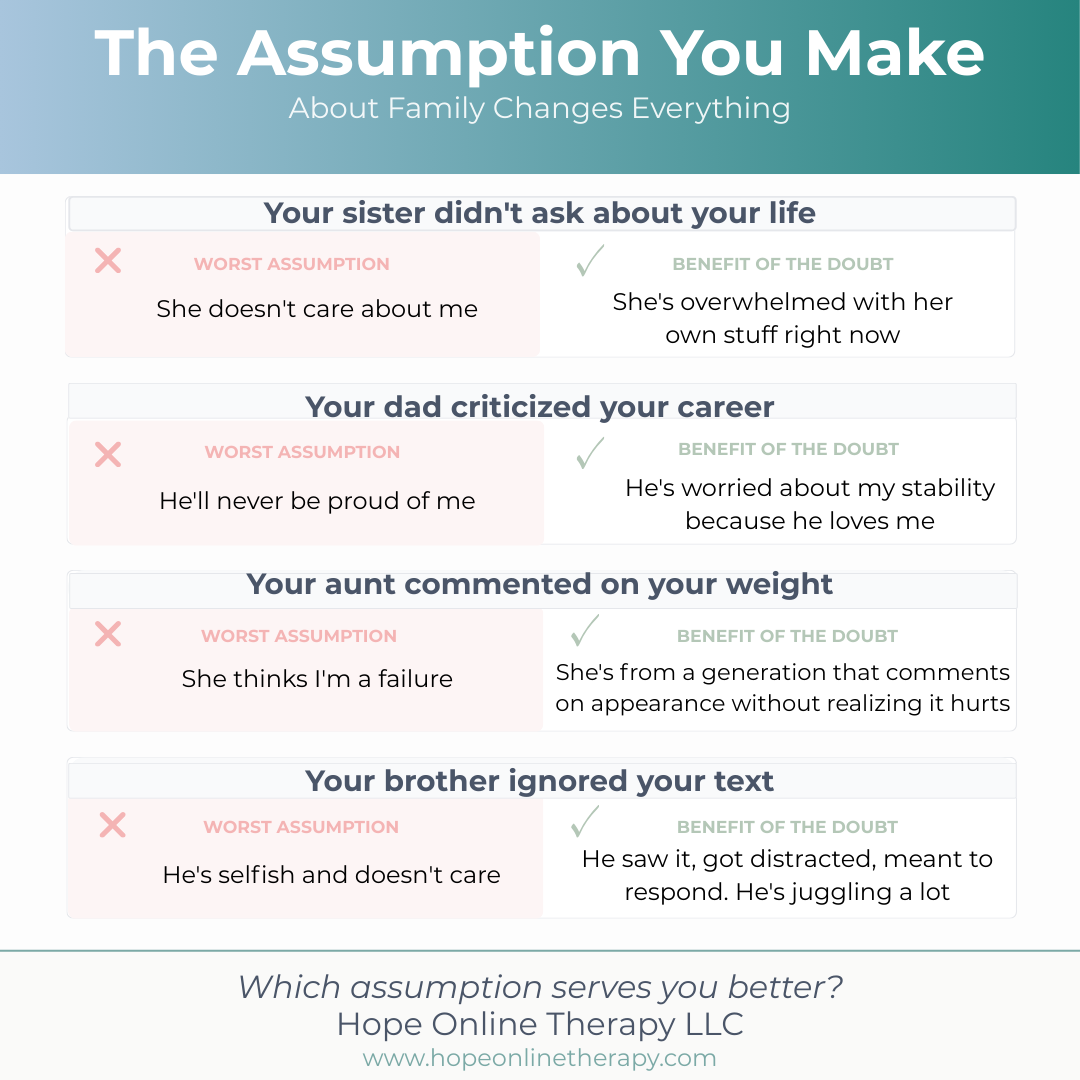
Your sister didn't ask about your life—she doesn't care about me.
Your dad criticized your career choice again—he'll never be proud of me.
Your aunt made a comment about your weight—she thinks I'm a failure.
Your brother ignored your text—he's always been selfish.
These stories feel true. They feel obvious. But here's the thing: they're assumptions. You've filled in the blanks with your interpretation—and often, that interpretation isn't generous.
You assumed the worst about their intentions. You assigned meaning that might not be accurate. And now you're angry, hurt, or resentful based on a story your brain created.
This is where the saying "we can be as happy as we make up our minds to be" actually has some truth to it—not because you can just decide to feel better, but because your thoughts influence your feelings.
When you assume your sister doesn't care, you feel hurt and distant.
When you assume your dad will never be proud, you feel defeated and resentful.
When you assume your aunt thinks you're a failure, you feel shame and anger.
But what if those assumptions aren't the only possible explanation? What if there's another story, one that's equally plausible, but far more generous?
What Happens When We Assume the Worst
When you hold onto negative assumptions about family members, something predictable happens: those assumptions grow.
You start looking for evidence that confirms your belief. Your brain becomes hyperaware of anything that supports the narrative. Your sister mentions something about herself, see, she never asks about me. Your dad offers advice, see, he's criticizing me again.
You talk about it with others. You vent to friends, your partner, other family members. "Can you believe what she said?" "He's always like this." And while venting can feel validating in the moment, it reinforces the negative story. Now other people are focusing on it too. The gossip and negativity grow.
You treat them according to your assumption. If you believe your brother is selfish, you act distant or cold. He notices and pulls back further. Now you have more "evidence" that he doesn't care. The assumption becomes a self-fulfilling prophecy.
Your relationship deteriorates. Distance increases. Resentment builds. Every future interaction is filtered through this lens. And the relationship you once had, or hoped to have, slips further away.
Here's the hard truth: holding onto anger and negative assumptions will never bring you happiness. It keeps you stuck. It keeps you hurt. And it prevents any chance of the relationship improving.
The Power of Assuming the Best

What if you flipped the script? What if, instead of assuming the worst, you gave them the benefit of the doubt?
Not because they deserve it. Not because what they did was okay. But because assuming the best changes how you experience the relationship, and how you show up in it.
Let's revisit those holiday examples with more generous assumptions:
Your sister didn't ask about your life.
Worst assumption: She doesn't care about me.
Benefit of the doubt: She's overwhelmed with her own stuff right now. She's distracted, not disinterested.
Your dad criticized your career choice.
Worst assumption: He'll never be proud of me.
Benefit of the doubt: He's worried about my stability because he loves me. He doesn't know how to express concern without it sounding like criticism.
Your aunt made a comment about your weight.
Worst assumption: She thinks I'm a failure.
Benefit of the doubt: She's from a generation that comments on appearance without realizing how hurtful it is. It's not about me, it's about her own discomfort.
Your brother ignored your text.
Worst assumption: He's selfish and doesn't care.
Benefit of the doubt: He saw it, meant to respond, and got distracted. He's juggling a lot right now.
Do you know which assumption is true? No. But the generous assumption is just as plausible as the negative one, and it leads to far less suffering.
Everyone Has a Story (Including That Obnoxious Uncle)
Think about the family member who irritates you most. Maybe it's the loud, obnoxious uncle who dominates every conversation. Maybe it's the relative who's always negative. Maybe it's the one who seems overly critical or distant.
Here's what you probably don't know: their story.
That loud, obnoxious uncle? Maybe he was bullied as a kid. Maybe he learned that being the loudest person in the room was the only way to be noticed. Maybe he's overcompensating for deep insecurity by pretending to have confidence.
The overly critical aunt? Maybe she grew up with a hyper-critical parent and genuinely thinks she's being helpful. Maybe perfectionism is the only way she learned to feel safe.
The distant cousin? Maybe they're dealing with depression. Maybe they're socially anxious. Maybe they've experienced loss or trauma that you know nothing about.
You don't know what someone's past trauma might be. You don't know what wounds they're carrying. You don't know what was triggered for them during the holidays.
Maybe a look, a tone of voice, or even a smell triggered you, and your normal, logical self went out the window. You reacted from a place of hurt, fear, or self-protection.
Guess what? That happens to other people too. Your family members get triggered. They react. They say things they don't mean or behave in ways that aren't their best selves.
When you remember that everyone has a story—that everyone is carrying something, it becomes easier to extend grace.
How Your Thoughts Shape Your Reality (The CBT Connection)
If you've read our post on cognitive distortions and CBT, you already know this: your thoughts aren't facts. They're interpretations.
And those interpretations shape how you feel and how you behave.
In CBT (Cognitive Behavioral Therapy), we learn that:
Your thoughts influence your feelings
Your feelings influence your behaviors
Your behaviors reinforce your thoughts
It's a cycle. And when your thoughts are distorted—when you assume the worst, mind-read, catastrophize, or overgeneralize, the cycle keeps you stuck in negativity.
But when you challenge those thoughts and replace them with more balanced, generous assumptions, the cycle changes.
You think: Maybe she's just overwhelmed right now instead of She doesn't care about me.
You feel: Less hurt, less resentful.
You behave: You reach out kindly instead of pulling away.
The relationship: Has a chance to improve.
This isn't about fake positivity or pretending problems don't exist. It's about choosing the interpretation that serves you, and your relationships, best.
The Forgiveness That Heals You
Let's talk about forgiveness. Because this is where people get stuck.
Forgiveness is not about excusing what someone did. It's not about pretending you weren't hurt. It's not about letting them off the hook.
Forgiveness is about letting go of the anger that's hurting you.
When you hold onto resentment, who suffers? You do. The other person might not even know you're upset. They're living their life while you're replaying the hurt over and over.
Forgiveness is a gift you give yourself. It's saying: I'm not going to let this keep poisoning me. I'm not going to carry this anger into the new year.
Here's the truth: forgiveness is healing for the forgiver.
It doesn't mean the relationship goes back to how it was. It doesn't mean you have to trust them again immediately. It doesn't mean you forget what happened.
It means you stop letting what they did control how you feel.

What Forgiveness Looks Like in Practice
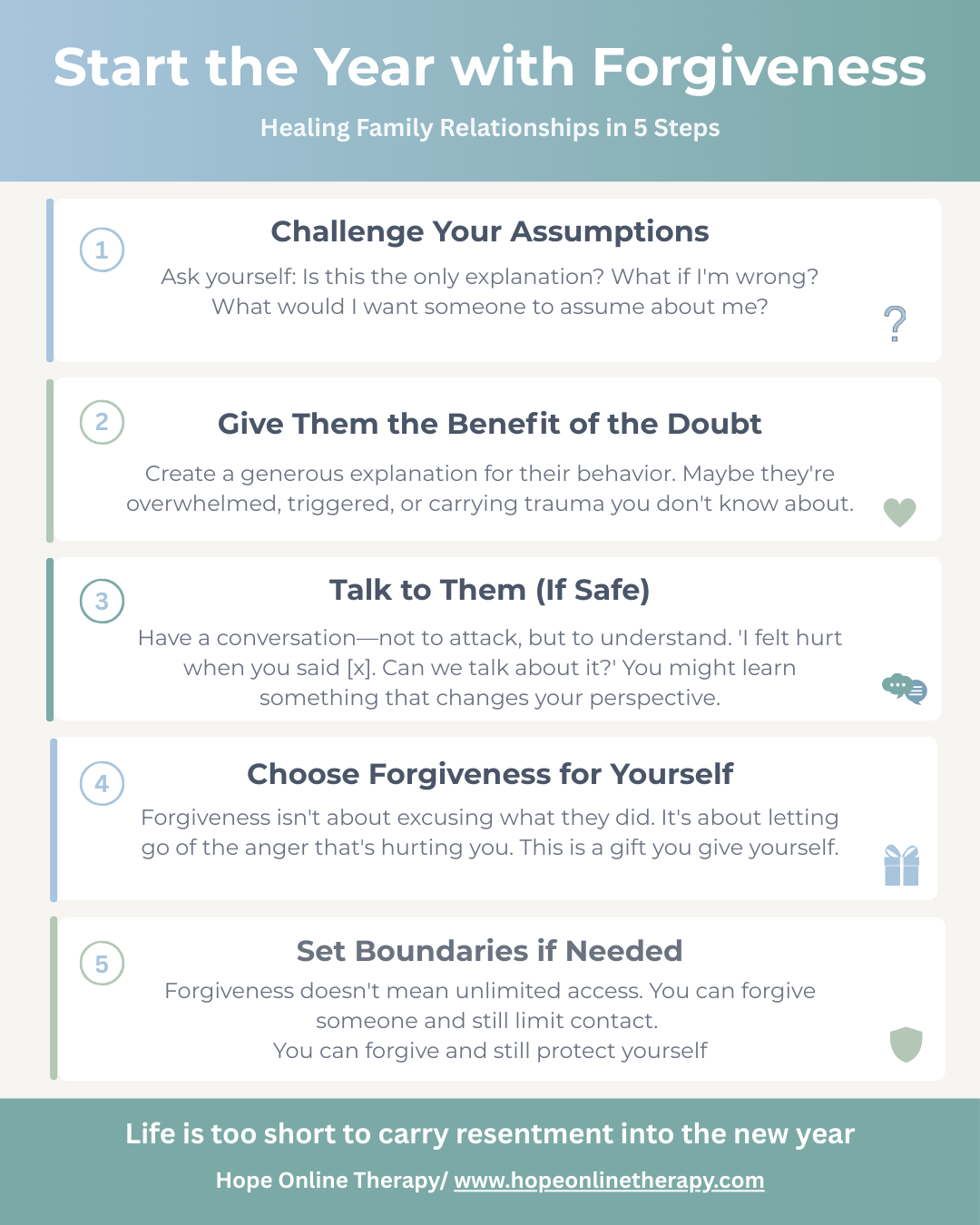
Talk to them. If it's safe and appropriate, have a conversation. Not to attack or blame, but to understand. "I felt hurt when you said [x]. Can we talk about it?" You might learn something that changes your perspective.
Seek to understand their story. Ask questions. Listen. Most hurtful behavior comes from pain, insecurity, or misunderstanding, not malice.
Challenge your assumptions. Before you decide they meant to hurt you, ask: What are other possible explanations? What would I want someone to assume about me if I messed up?
Set boundaries if needed. Forgiveness doesn't mean unlimited access. You can forgive and still limit contact. You can forgive and still protect yourself.
Let go of the mental replay. Stop rehashing the conversation with others. Stop building a case against them in your mind. When the thought comes up, acknowledge it and let it go.
Focus on what you can control. You can't control their behavior. You can control your response, your assumptions, and whether you carry resentment or let it go.
Give Them the Benefit of the Doubt (Because You'd Want the Same)
Here's the question that changes everything: Wouldn't you want someone to assume the best about you?
Haven't you ever said something that came out wrong? Haven't you been distracted and failed to notice someone needed you? Haven't you reacted poorly when you were stressed or overwhelmed?
Of course you have. You're human.
And when you mess up, don't you hope people will give you grace? That they'll assume you didn't mean to hurt them? That they'll see your good intentions even when your execution was flawed?
That's what benefit of the doubt looks like. And if you want it extended to you, you have to be willing to extend it to others.
This doesn't mean you're naive. It doesn't mean you ignore patterns of harmful behavior. It means you default to generosity when the evidence is ambiguous.
It means you ask questions before making assumptions. It means you give people a chance to explain. It means you remember that people are complicated, flawed, and doing their best, even when their best isn't great.
When Forgiveness Doesn't Mean Reconciliation
Here's where we need to draw an important line: forgiveness and reconciliation are not the same thing.
Forgiveness is internal. It's a decision you make for your own peace. You can forgive someone and never speak to them again.
Reconciliation is relational. It's rebuilding trust and connection. It requires both people to be willing and safe.
Not every relationship should be reconciled. And that's okay.
When Abuse or Serious Harm Was Involved
Let's be very clear: if there was abuse—physical, emotional, sexual—the advice in this post changes.
Forgiveness can still be healing for you. Letting go of the anger that's eating you alive is still valuable. But forgiveness does not mean putting yourself in a position to be hurt again.
You can forgive someone and still maintain distance. You can forgive someone and never trust them again. You can forgive someone and decide they don't get access to your life anymore.
Forgiveness is not the same as reconciliation. And reconciliation is not always safe or appropriate.
If abuse was involved, you need more than benefit-of-the-doubt thinking. You need:
Trauma therapy. Something like EMDR (Eye Movement Desensitization and Reprocessing) can help you process the trauma so it doesn't continue affecting your current relationships and life.
Boundaries work. Learning to set and maintain healthy boundaries is essential. A therapist can help you navigate what boundaries you need and how to enforce them.
Safety planning. If the person is still in your life or if contact is unavoidable, you need strategies to protect yourself.
Validation that your anger is justified. Abuse is not a misunderstanding. It's not something you need to give the benefit of the doubt about. Your anger, hurt, and decision to distance yourself are valid.
Forgiveness, in cases of abuse, is about freeing yourself from the grip of what happened, not about excusing it or allowing it to continue.
What If You Try and They Don't Change?
This is the fear, right? You extend grace. You give them the benefit of the doubt. You try to repair the relationship. And they don't meet you halfway. They don't change. They hurt you again.
Here's what you need to know: you can only control your side of the equation.
You can choose generous assumptions. You can choose forgiveness. You can choose to show up with kindness and openness.
But you can't make them do the same.
If you extend grace and they continue to hurt you, then you adjust. You set boundaries. You limit contact. You protect yourself.
But at least you'll know: you tried. You showed up with integrity. You didn't let bitterness keep you stuck. And that matters, for you.
Starting the New Year with a Clean Slate
The new year is symbolic. It's a fresh start. A chance to reset.
And part of that reset can be deciding: I'm not carrying this anger into the new year.
Not because the other person deserves forgiveness. Not because what happened was okay. But because you deserve peace.
You deserve to start the year without the weight of resentment. You deserve relationships that have a chance to grow instead of staying stuck in old patterns. You deserve to believe the best about people until you have clear evidence otherwise.
This is your invitation to try something different:
Challenge your negative assumptions. Ask yourself: Is this the only explanation? What if I'm wrong?
Give someone the benefit of the doubt. Choose the generous interpretation when you're unsure.
Talk to them. Have the conversation you've been avoiding. Ask questions. Seek to understand their story.
Let go of what you can't control. You can't change the past. You can't make them apologize or see your side. But you can choose how you carry it forward.
Choose forgiveness—for yourself. Decide that you're not going to let this keep hurting you. You're letting it go.
Life is too short to stay angry at family. Life is too short to keep replaying old hurts. Life is too short to assume the worst when you could assume the best.
When You Need Help
If you're struggling with forgiveness, if family relationships feel impossible, if old wounds keep reopening, you don't have to figure this out alone.
Therapy can help you:
Process hurt and resentment in a healthy way
Challenge the negative assumptions keeping you stuck
Learn how to set and maintain boundaries
Decide what forgiveness looks like for you
Work through trauma if abuse was involved
Sometimes the patterns are too deep to untangle on your own. And that's okay. Asking for help is not a sign of weakness, it's a sign that you're serious about healing.
You Deserve Peace This Year
The holidays might have been hard. Family might be complicated. Old wounds might have resurfaced.
But you don't have to carry that into the new year.
You get to decide: Am I going to keep assuming the worst, or am I going to try assuming the best?
You get to decide: Am I going to hold onto this anger, or am I going to choose forgiveness—for my own peace?
You get to decide: Am I going to let this relationship stay broken, or am I going to see if there's a chance to repair it?
Not every relationship can or should be saved. But you won't know unless you try. And even if it doesn't work out, at least you'll know you showed up with grace.
Everyone has a story. Even the family members who frustrate you most. And when you approach them with curiosity instead of judgment, with benefit of the doubt instead of assumptions, you might be surprised what you learn.
You deserve relationships that don't weigh you down. You deserve to start the new year with peace instead of resentment.
And that starts with the assumptions you make, and the forgiveness you choose.

Need Support with Family Relationships and Forgiveness?
If you're struggling to forgive family members, if resentment is affecting your peace, or if past family trauma is impacting your current life, therapy can help.
I work with adults in Texas and Idaho who are ready to heal family relationships, process old wounds, and build healthier patterns moving forward.
If trauma or abuse was involved, I offer evidence-based trauma therapy including EMDR to help you process what happened and reclaim your peace.
Virtual therapy means you can do this important work from the comfort of home, on your schedule.
Schedule a Free Consultation – Let's talk about how therapy can help you start the new year with more peace and healthier relationships.
You don't have to carry old resentments into the new year. Let's work on healing, together.