Fight, Flight, or Freeze: Why You React the Way You Do… And How to Change It
You snap at your partner over something small. Or, you shut down completely and can't find the right words. Or, you leave the room, maybe even the building, without explanation.

Later, you feel ashamed. You don't understand why you reacted that way. You tell yourself you'll do better next time. But when the same situation happens again, your body takes over before your brain can catch up.
Sound familiar?
These reactions aren't character flaws. They are not signs you're broken or weak. They're your nervous system doing exactly what it's designed to do, protect you from a perceived threat.
The problem? Your nervous system can't always tell the difference between real danger and everyday stress. And it's operating on patterns formed years, sometimes decades, ago.
Understanding fight, flight, or freeze responses changes everything. Not just intellectually, but in your body. Because once you know what's happening and why, you can actually change how you respond.
What Fight, Flight, or Freeze Actually Means
Your nervous system has one primary job: keep you alive.
When it perceives danger, whether that's a physical threat or something that reminds you of past danger, it activates your stress response. This happens automatically, faster than conscious thought, in the part of your brain that handles survival.
You have three main options:
Fight: Confront the threat. Your body floods with adrenaline. You might get angry, argumentative, defensive, or aggressive. Your jaw clenches. Your fists tighten. You're ready for battle.
Flight: Escape the threat. Your heart races. You feel an urgent need to leave. You might physically exit or mentally check out. Your legs feel restless. You need space, distance, to get out.
Freeze: When fighting or fleeing aren't options, you shut down. You go numb, can't think clearly, can't find the right words. You feel paralyzed or disconnected, like you're watching yourself from outside your body.
These aren't conscious choices. Your nervous system decides in milliseconds based on what's worked before and what feels safest in the moment.
Why You React the Way You Do
Your nervous system learns from experience, especially early experiences and traumatic ones.
If you grew up in an environment where conflict was scary, your nervous system might default to freeze or flight. Speaking up wasn't safe, so you learned to shut down or disappear.
If you learned that anger got results or that you had to stand your ground to survive, your nervous system might jump straight to fight. Defensiveness became your protection.
If certain situations, tones of voice or types of conflict remind your body of past danger; even if you don't consciously remember, your nervous system reacts as if that old threat is happening now.
Here's what makes this so frustrating:
Your logical brain knows you're not actually in danger. You know your partner asking about the dishes isn't a threat. You know your boss giving feedback isn't going to hurt you. You know the conflict at work isn't life or death.
But your nervous system doesn't care what your logical brain thinks. It operates on pattern recognition and survival instinct. And, it operates much faster than your thinking brain, often in just fractions of a second.
By the time you realize what's happening, you're already snapping, shutting down, or walking out.
Common Triggers and What They Really Mean
Triggers aren't random. They're specific situations, tones, or circumstances that remind your nervous system of past threats.
Conflict or disagreement: If past conflict meant danger, yelling, violence, rejection, abandonment, your nervous system treats all conflict as potentially dangerous. Even calm, necessary conversations can trigger a response.
Criticism or feedback: If early experiences taught you that mistakes meant punishment, shame, or loss of love, feedback feels like a threat to your safety or worth. Your body reacts before you can process that this feedback may actually be constructive.
Feeling controlled or trapped: If you've experienced situations where you had no choice, no voice, or no escape, anything that feels like loss of control can trigger flight or freeze. Even reasonable requests can feel like demands.
Certain tones of voice: A sharp tone, raised voice, or certain inflections can instantly activate your stress response if they match tones that preceded danger in your past.
Being caught off-guard: If past trauma involved being surprised, feeling ambushed, or unexpected situations—even positive ones—your nervous system can be triggered into protection mode.
Feeling misunderstood or dismissed: If your feelings were regularly invalidated or ignored, situations where you feel unheard can trigger fight (arguing to be heard) or freeze (giving up on being understood).
The key insight: You're not just reacting to what's happening now. You're really reacting to what your nervous system thinks is happening based on what has happened in the past.
The Shame Cycle That Keeps You Stuck
Here's how it usually goes:
Something triggers you. Your nervous system takes over. You fight, flee, or freeze. Then, when the reaction passes, shame floods in.
Why did I snap like that? Why can't I just stay calm? What's wrong with me? I should be able to handle this. Normal people don't react this way.
The shame makes you feel more broken, more defective, more anxious about the next time. Which makes your nervous system more vigilant. Which makes you more likely to get triggered. Which leads to more shame.
And the cycle continues.
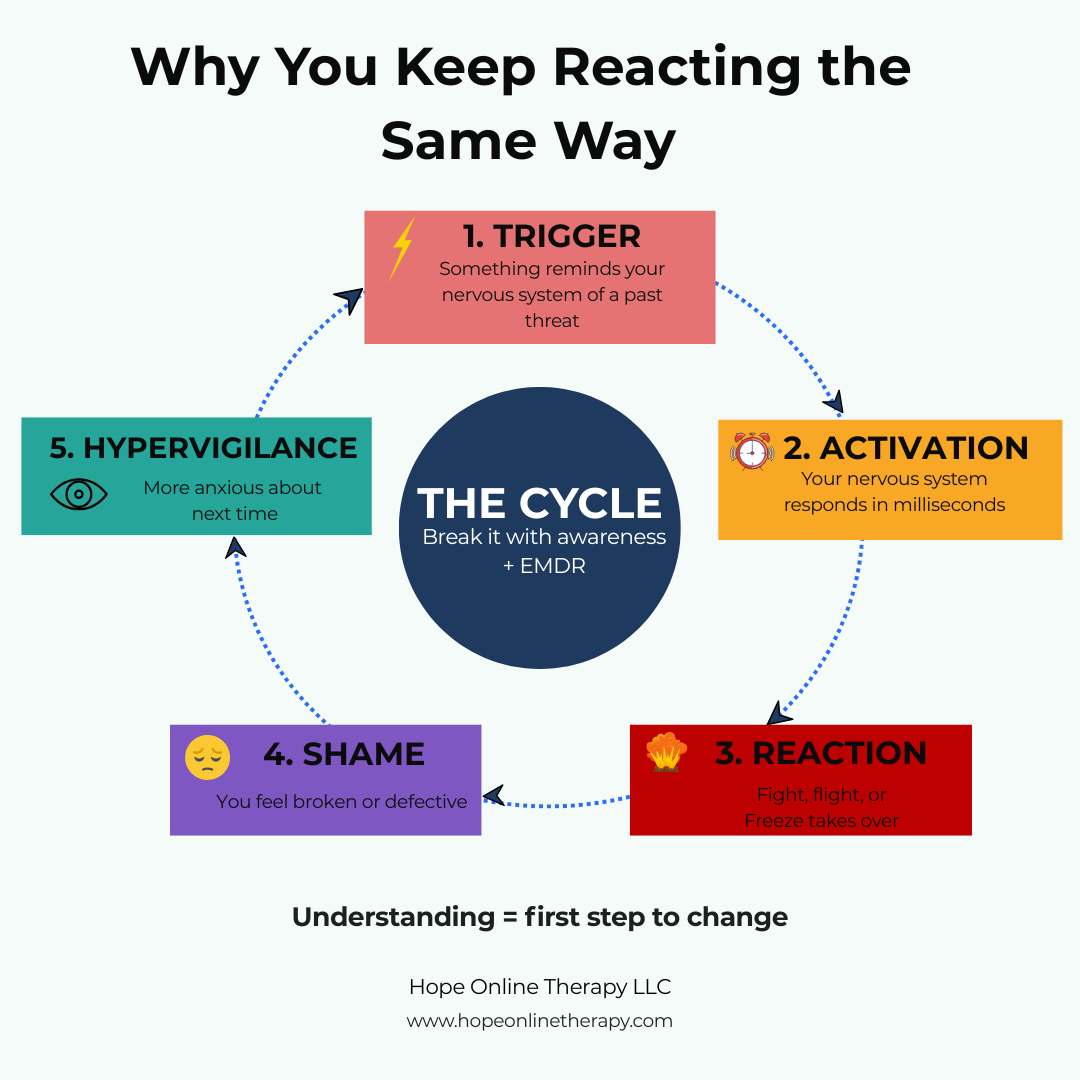
Here's what you need to know: These reactions don't mean you're broken. They mean your nervous system is doing its job the best it can; the problem is it's working with outdated information.
Your body is protecting you from threats that existed in your past but may not exist in your present.
The goal isn't to shame yourself for having these reactions. The goal is to update your nervous system's threat detection system.
Why Understanding This Changes Everything
When you understand fight, flight, or freeze as nervous system responses rather than character flaws, everything changes.
You can recognize what's happening in real time. Instead of "I'm so angry" or "I can't handle this," you can now think "My nervous system is activated. I'm in fight/flight/freeze mode."
You can communicate differently. "I'm getting triggered and need a minute" is clearer and less blaming than disappearing without explanation or lashing out.
You can start tracking your patterns. When do you fight? When do you flee? When do you freeze? What are your specific triggers? Awareness is the first step to change.
You can have compassion for yourself. Your reactions make sense when you understand they're survival responses. You're not defective, you're protective.
You can begin to intervene. Once you understand what's happening, you can learn techniques to help your nervous system down-regulate before you fully react.
What Actually Helps: Retraining Your Nervous System
You can't think your way out of a nervous system response. But you can retrain how your nervous system reacts.
1. Learn to Recognize Your Early Warning Signs
Your body gives you signals before you fully react. Learning to catch them early gives you a chance to intervene.
Fight warning signs:
Jaw clenching
Fists tightening
Heat rising in your face or chest
Feeling defensive or argumentative
Sharp, cutting thoughts
Flight warning signs:
Heart racing
Restless legs
Scanning for exits
Urgent need to leave or move
Feeling trapped or cornered
Freeze warning signs:
Going blank or numb
Can't find words
Feeling disconnected or "not here"
Heaviness or paralysis
Watching yourself from outside
Practice noticing these in moments when the stakes are lower so you can recognize them when it truly matters.
2. Create Space Between Trigger and Response
You can't always prevent the activation, but you can slow down your response.
Name what's happening: "I'm getting triggered right now." Naming it engages your thinking brain and creates a tiny bit of distance.
Use a grounding technique: Feel your feet on the floor. Notice five things you can see. If possible, hold ice or splash cold water on your face. Physical grounding helps bring you back to the present.
Pause the conversation: "I need a few minutes. I'm not leaving and I’ll come back as soon as I can." Then, actually come back! This builds trust and gives your nervous system time to settle.
Breathe differently: Extend your exhale longer than your inhale. This signals your nervous system that you're safe. (Inhale for a count of 4, exhale for a count of 6.)
3. Process What's Underneath with EMDR
This is where EMDR (Eye Movement Desensitization and Reprocessing) therapy becomes incredibly powerful.
EMDR helps your brain reprocess the experiences that created these patterns. It doesn't erase memories, but it helps your nervous system update its threat detection system.
When you process old trauma or difficult experiences with EMDR:
Your body learns those threats are in the past, not present
Your nervous system can distinguish between then and now
Your automatic responses begin to change
You have more choice in how you react
Many people who've done EMDR describe it as finally being free from reactions they couldn't control before. The triggers don't disappear completely, but they lose their overwhelming power.
4. Build Nervous System Regulation Skills
Your nervous system needs to learn what safety feels like.
Mindfulness practice helps you stay present instead of getting pulled into past patterns. Even five minutes a day builds your capacity to observe your reactions without being controlled by them.
Somatic work teaches you to discharge stored stress and tension. Your body holds trauma—helping it release that trauma can free you from its hold and change how you respond.
Co-regulation with a safe person (like a therapist) teaches your nervous system what calm, connected safety feels like. Over time, you can access that on your own.
Consistent routines that signal safety to your nervous system such as regular sleep, movement, and nourishment, make you less reactive overall.
5. Challenge the Thoughts That Keep You Activated
CBT (Cognitive Behavioral Therapy) helps you identify and change the thought patterns that keep your nervous system on high alert.
Thoughts like "I can't trust anyone," "I'm not safe," "Something bad is going to happen," or "I have to be perfect or I'm worthless" keep your threat-detection system hypersensitive.
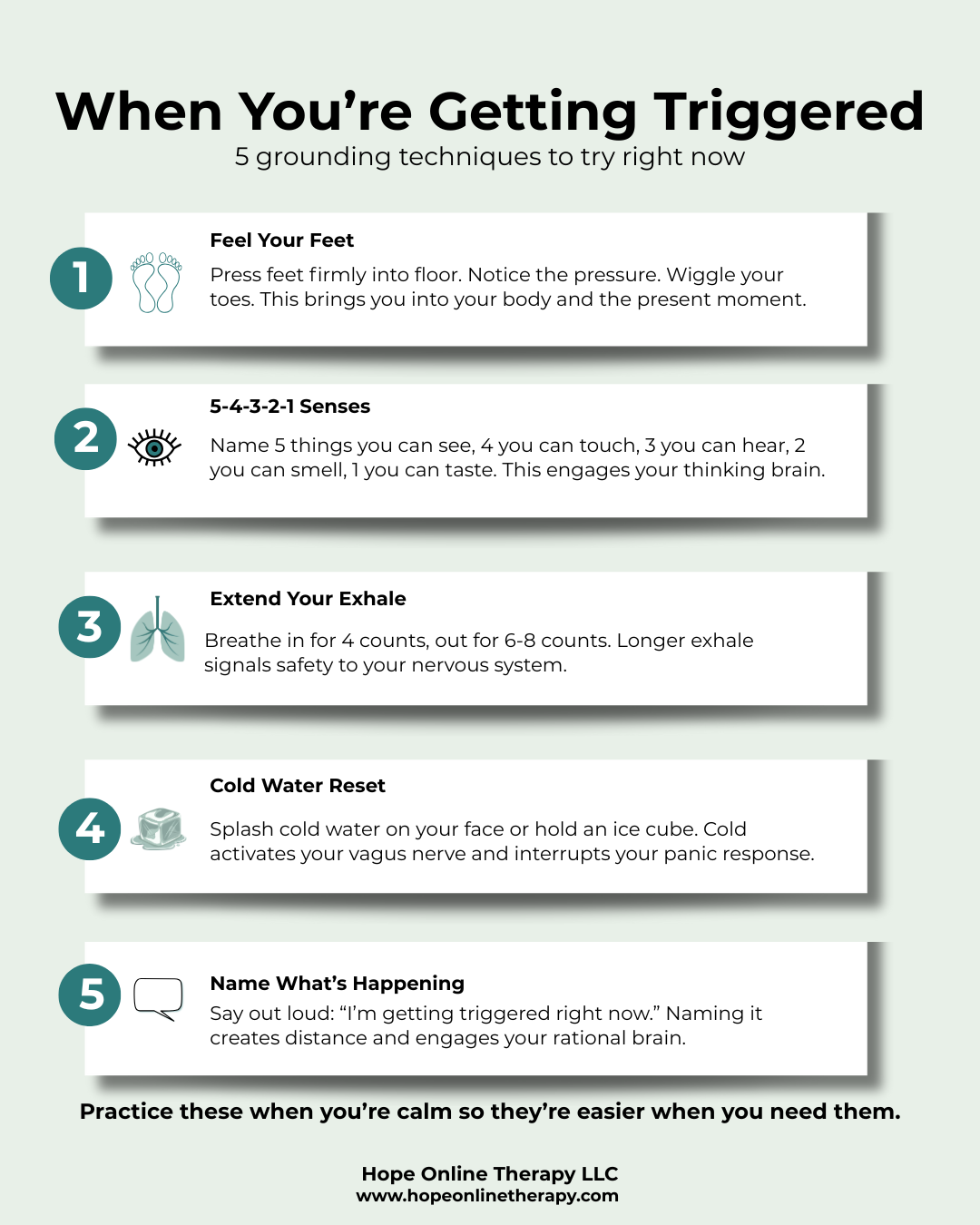
💡 Pro tip: Screenshot this and set it as your phone wallpaper for a week. When you need it most, it'll be right there.
Working with these thoughts, examining the evidence, identifying cognitive distortions, and practicing more balanced thinking helps your nervous system calm down.
What This Looks Like in Real Life
Let's say you're triggered by conflict. Your partner wants to talk about something difficult. In the past, you might have immediately shut down (freeze) or gotten defensive (fight) without understanding why.
With awareness and practice:
You notice your early warning signs, your chest tightens, and you feel the urge to leave. You recognize: "I'm getting activated."
You name it: "I'm noticing I'm getting triggered right now. This is important and I want to hear you, but I need to ground myself first."
You use a technique: Feet on floor, three deep breaths with longer exhales, notice your surroundings.
You check in with yourself: "Am I actually in danger right now? No. My nervous system is reacting to past experiences, not this moment."
You continue the conversation, not perfectly, but with more presence and choice than before.
Over time, with EMDR and continued practice:
The same trigger happens, but your body's response is less intense. You can stay present more easily. The conversation feels hard but manageable instead of threatening.
This is what healing looks like. Not never being triggered, but having more capacity, more choice, and more understanding of what's happening.
You're Not Broken. You're Wired for Protection
Your fight, flight, or freeze responses exist for a reason. They've kept you safe when you needed protection.
But if they're activating in situations where you're actually safe—where the threat is in the past, not the present—then your nervous system needs help updating its information.
This isn't something you can logically think your way out of. You need approaches that work with your nervous system, not against it.
EMDR, somatic work, mindfulness, and nervous system education can help you move from reactive to responsive. From controlled by your triggers to understanding them.
You don't have to live at the mercy of reactions you don't understand. You can learn to work with your nervous system instead of against it.
What to Do Next
If you're recognizing yourself in this post, and if you're tired of reactions you can't control, patterns you don't understand, or the shame that follows, here's what comes next.
Start tracking your patterns. Notice when you fight, flee, or freeze. What triggered it? What were your early warning signs? No judgment, just observation.
Practice one grounding technique. Pick one thing, feet on floor, longer exhales, or cold water, and use it when you notice you’re being triggered. Build this skill in low-stakes moments.
Consider EMDR therapy. If your reactions are rooted in past trauma or difficult experiences, EMDR can help your nervous system finally update its threat detection system.
Be patient with yourself. These patterns formed over years. They won't change overnight. Progress isn't linear, every moment of awareness is progress.
You're not defective. You're not too sensitive. You're not broken.
Your nervous system is doing its job. Now it's time to help it learn that you're safe.

Ready to Understand Your Nervous System?
If you're in Texas or Idaho and ready to stop being controlled by reactions you don't understand, let's talk.
I specialize in EMDR therapy for trauma, anxiety, and stress. Together, we'll help your nervous system learn the difference between past threats and present safety, so you can choose how to respond instead of reacting blindly.
Schedule a Free Consultation Let's talk about your specific patterns and how EMDR can help you change them.
You don't have to keep fighting, fleeing, or freezing. There's another way, a better way. Let me help you find that path.