When Your Partner Says ‘You Need Help’: Transforming a Relationship Crisis into a Turning Point
"I can't do this anymore."
"Something has to change."
"I think you need to talk to someone."
Maybe they said it during an argument. Maybe they said it calmly, with tears in their eyes. Maybe they've been hinting at it for months and finally said it out loud.
However it came out, those words hit hard. They feel like rejection, failure, or proof that you're broken. Your first reaction might be defensiveness, shame, or shutting down completely.
But here's what I want you to consider: This might be the most loving thing your partner has ever said to you.
Not because you're broken, or because they're right and you're wrong. It’s because they are seeing something you can't see, and they care enough to risk the discomfort of saying it.
Why This Moment Matters
When your partner suggests therapy, it usually means one of two things has happened.
Either they've watched you struggle for a long time. Struggling with anxiety, depression, anger, shutting down, or patterns you can't seem to break, and they don't know how else to help you. They're not trying to fix you. They're trying to help you find someone who can.
Or, your relationship is reaching a breaking point. The same arguments keep happening. The same wounds keep reopening. The distance between you is growing. They're exhausted, you're exhausted, and neither of you knows how to break the cycle.
Sometimes it's both.
What makes this moment so significant is that it's often the first time someone says out loud what you've maybe been feeling inside: Something isn't working. And I don't know how to fix it alone.
The Shame That Makes Everything Harder
If your first reaction is shame, you're not alone.
Hearing "you need help" can feel like:
You've failed at being a good partner
You're too much, too difficult, too broken
Your struggles are now someone else's burden
You should have been able to handle this on your own
And if you're someone who prides yourself on being strong, capable, or the one everyone else leans on? This suggestion can feel like proof that you're not who you thought you were.
But here's the truth shame doesn't want you to hear: Needing support isn't a weakness. It's being human.
You wouldn't expect yourself to set a broken bone without help. You wouldn't feel shame about seeing a doctor for chest pain or persistent headaches. And yet, when it comes to emotional pain, relationship patterns, or anxiety that's affecting your life, we somehow expect ourselves to figure it out alone.
That expectation isn't fair. And, it's not helpful.
What Your Partner Is Really Saying
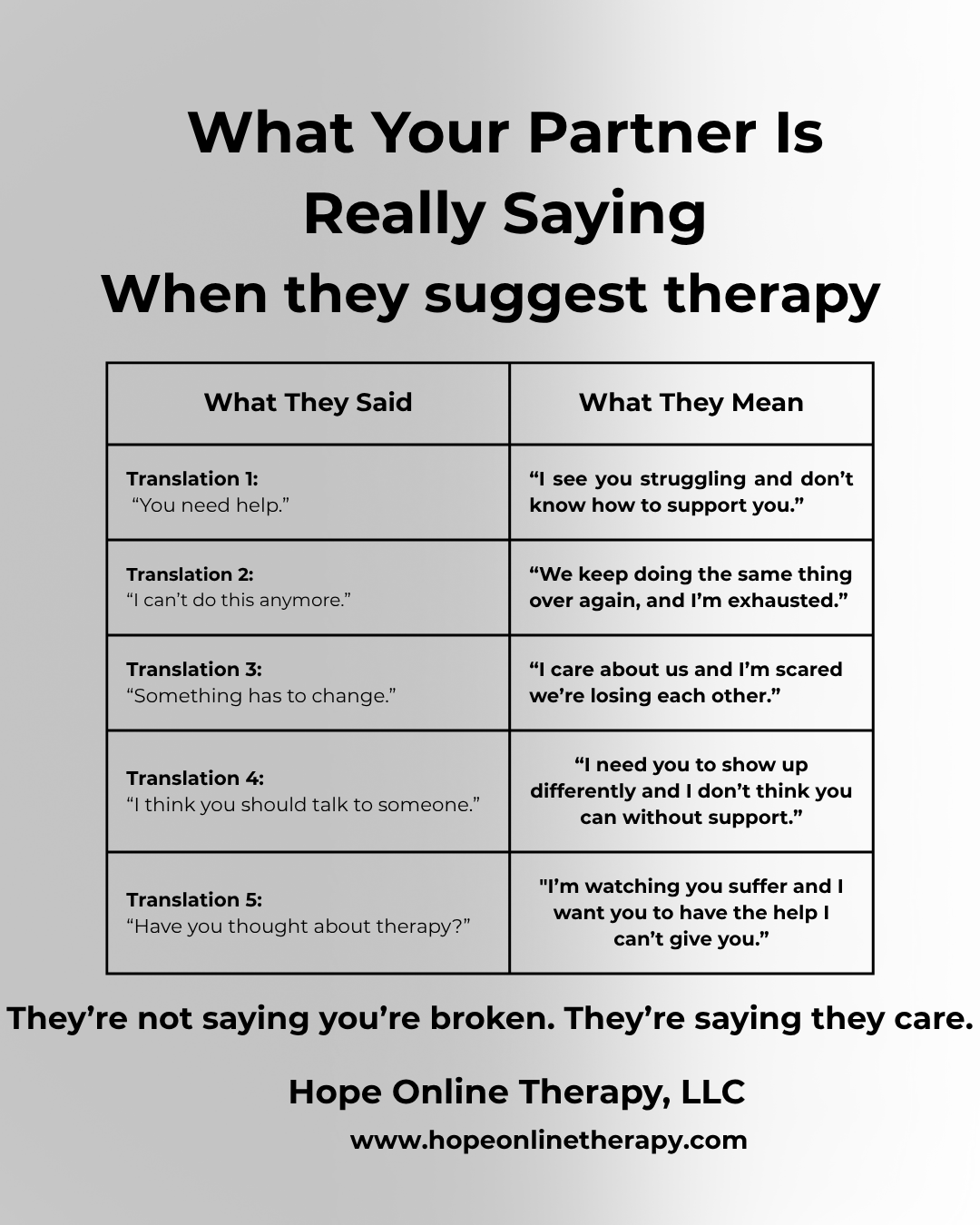
When someone you love suggests therapy, they're usually not saying "you're broken and I can't deal with you anymore."
What they're often actually saying is:
"I see you struggling and I don't know how to help." They've tried listening, supporting, reassuring, or giving advice. Nothing seems to work. They're out of tools, and they want you to have access to someone who has the tools they don't.
"Our patterns aren't changing and I don't know how to break them." The same arguments, the same hurts, the same distance keeps happening. They recognize that good intentions aren't enough. Something deeper needs to shift.
"I care about you and I'm scared." They're watching anxiety take over your life, depression dim your light, or anger explode in ways that scare both of you. They're worried. Not because you're a burden, but because they love you.
"I need you to show up differently and I don't think you can without support." This one's harder to hear, but sometimes it's the most honest. They need something to change in how you engage, communicate, or manage your emotions. They don't think you can do it alone. And honestly? They might be right.
Why Defensiveness Keeps You Stuck
When someone suggests therapy, the immediate impulse is often to defend yourself.
"I don't need therapy. You're the one who..."
"There's nothing wrong with me. If you would just..."
"I'm fine. You're overreacting."
Defensiveness is a protection mechanism. It makes sense. But it also keeps you stuck exactly where you are.
When you're defensive, you can't be curious. You can't ask "What are they seeing that I'm not seeing?" You can't consider that maybe, just maybe, they have a point—not because you're broken, but because you have patterns that are in your blind spot.
Consider this: If multiple people in your life—your partner, your doctor, a friend—have suggested therapy, what are the chances they're all wrong and you're the only one who sees things clearly?
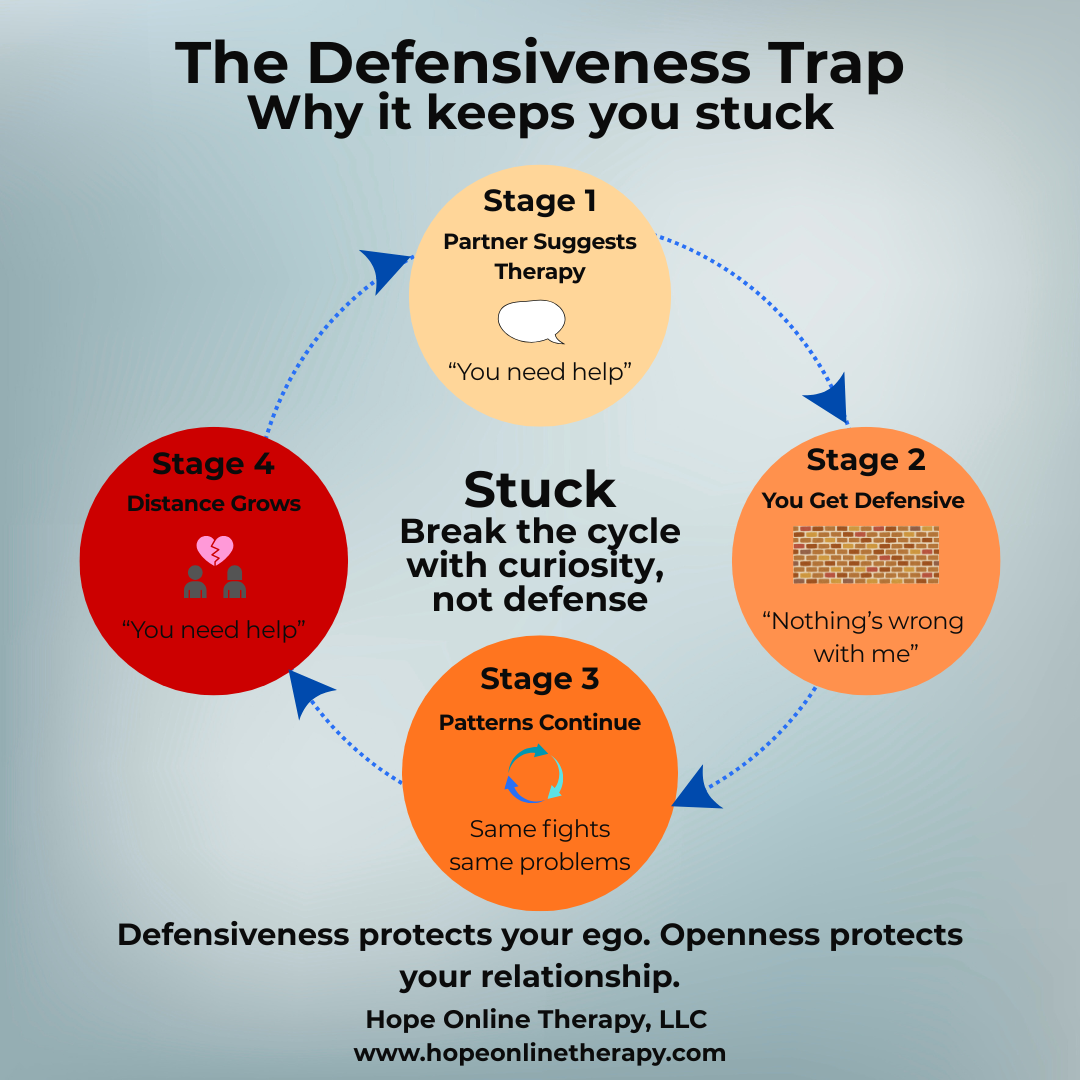
I'm not saying they're automatically right. But I am saying their perspective is worth considering.
The Relationship Patterns That Bring People to Therapy
Let's be honest about what's often happening when a partner says "you need help."
The same fight on repeat. Different trigger, same explosion. You both know exactly how it will go: what you'll say, how they'll respond, where it ends. Nothing changes because the real issue isn't what you're fighting about, it's the pattern underneath.
Emotional reactivity you can't control. You snap, shut down, or leave before you can think. Later, you feel ashamed. You promise it won't happen again. But the next time you're triggered, your nervous system takes over before your good intentions can.
Walls that won't come down. You've stopped sharing. They've stopped asking. The intimacy is gone. You're roommates who occasionally argue. Neither of you knows how to bridge the distance anymore.
Anxiety or depression affecting everything. You're irritable, withdrawn, or overwhelmed. You know you're not fully present. They know it too. The relationship is suffering under the weight of something that isn't about the relationship, but it's still destroying it.
Old wounds that won't heal. Something happened, a betrayal, a loss, a trauma, and neither of you can move past it. It comes up in every argument. It colors every interaction. The hurt is as fresh as it was when it happened.
Sound familiar?
These patterns don't resolve through willpower or good intentions. They need someone outside the dynamic who can help you see what you're both caught in, and show you how to do it differently.
What If They're the Problem, Not You?
Maybe you're reading this thinking: "But they're the one who needs therapy. I'm just reacting to what they're doing."
Fair question. And sometimes, you're right. Sometimes your partner is projecting, avoiding their own issues, or refusing to look at their role in the dynamic.
But here's what I've learned in years of working with people: It's rarely that clean.
Even if your partner has significant issues, your response to those issues is still yours to work on. Even if they're the one who starts the fight, how you engage (or disengage) is within your control. Even if you're "just reacting," you can learn to respond differently.
Going to therapy isn't admitting you're the problem. It's saying "I'm willing to work on my part."
And honestly, sometimes the best way to shift a relationship dynamic is for one person to change how they show up. When you stop participating in the old dance, the dance has to change.
Plus, individual therapy gives you clarity. If your partner really is the issue and unwilling to work on it, therapy helps you see that clearly and decide what you want to do about it.
When It's More Than Just Relationship Stuff

Sometimes the reason your partner is suggesting therapy has less to do with your relationship and more to do with watching you suffer.
They see your anxiety spiraling. They watch you cancel plans, avoid situations, or white-knuckle your way through daily life. They notice you're not sleeping, not eating, not taking care of yourself.
They see the depression settling in. How you've lost interest in things you used to love, how hard it is for you to get out of bed, or how you go through the motions but aren't really there.
They see the aftermath of your trauma, the nightmares, the hypervigilance, the triggers you can't explain, the ways your body keeps score even when you think you're fine.
They're not trying to fix you or change you. They're watching someone they love struggle, and they don't know how to help.
This isn't about your relationship being broken. It's about them seeing you're not okay, and wanting you to have support.
What Individual Therapy Can Do for Your Relationship
You might be thinking: "If it's a relationship problem, shouldn't we go to couples therapy?"
Maybe. But often, individual therapy is exactly what's needed first. Here's why:
You learn to understand your own patterns. Why do you shut down in conflict? Why does criticism feel so threatening? Why do you explode over small things? Understanding your triggers and reactions changes how you show up in the relationship.
You process what you're bringing to the table. Old trauma, childhood wounds, anxiety, depression, these affect how you relate to your partner. Working through them in individual therapy means you're not expecting your partner to heal what only you can heal.
You develop tools that work. CBT teaches you to interrupt anxious thought spirals before they escalate. EMDR helps you process trauma so it stops hijacking your present relationships. Mindfulness helps you stay present instead of reactive.
You show your partner you're willing to work on yourself. This alone can shift the dynamic. When your partner sees you taking their concern seriously, trying to change, and doing the work, it creates hope. Hope changes everything.
You get clarity on what's actually happening. Is this a relationship that needs work? Or a relationship that's not healthy for you? Sometimes you can't see clearly from inside the dynamic. A therapist helps you sort that out.
The Vulnerability of Showing Up
Here's what makes going to therapy after your partner suggests it so hard: It requires vulnerability.
You have to admit you don't have it all figured out. You have to say out loud the things you've been trying to hide or manage on your own. You have to let someone see the parts of yourself you're not proud of.
And then, you have to go back to your partner and tell them you're going to therapy. That you heard them. That you're working on it.
That's terrifying. What if they use it against you? What if admitting you need help makes them respect you less? What if you're doing all this work and they still leave?
Those fears are valid. And they're also the exact things that keep people stuck in patterns that destroy relationships.
The truth is: Vulnerability is the only path to real intimacy. Pretending you're fine when you're not creates distance. Admitting you're struggling and doing something about it creates connection.
Your partner doesn't need you to be perfect. They need you to be honest. And to try.
What Therapy Actually Looks Like
If you've never been to therapy, the unknown might be part of what's holding you back.
Here's what it's not:
Lying on a couch talking about your childhood for years
Someone telling you what to do
Admitting you're crazy or broken
Expensive and endless
Here's what it actually is:
You meet with someone (in person or virtually) who specializes in what you're dealing with—anxiety, trauma, relationship patterns, depression, whatever brought you there.
In the first session, you talk about what's going on, what you want to change, and what you've tried before. They ask questions. You start to get a sense of whether you click with them.
If you do, you keep going. Weekly or biweekly sessions. You talk, but you also learn tools. If you're doing EMDR, you'll work on reprocessing memories or experiences that are still affecting you. If you're doing CBT, you'll work on changing thought patterns. You'll get homework—things to practice between sessions.
And slowly, things start to shift. You notice you're reacting less intensely. You're catching yourself before you escalate. You understand yourself better. Your partner notices too.
That's what therapy looks like. It's work, but it's not mysterious or scary. It's just... effective.

Making the Decision
So your partner said you need help. What now?
You have a choice to make. Not whether they're right or wrong. Not whether you're broken or fine. But whether you're willing to consider that something could be better.
Ask yourself:
Is my relationship suffering? Are we having the same fights, the same distance, the same pain on repeat?
Am I struggling with anxiety, depression, or past trauma that's affecting my life?
Do I react in ways I don't like, and feel powerless to change?
Have multiple people suggested I might benefit from talking to someone?
Do I want things to be different?
If you answered yes to even one of these, therapy is worth considering.
This doesn't mean:
You're admitting defeat
You're the problem and your partner is perfect
You're weak or broken
It means:
You're willing to work on your part
You're open to understanding yourself better
You care about your relationships enough to try
You're ready to stop suffering and start healing
What If You Go to Therapy and Your Partner Still Leaves You?
This is the fear underneath everything, isn't it?
What if you do all this work, face your shame, show up to therapy, work on your patterns, and they leave anyway?
Here's the hard truth: That could happen. Sometimes relationships end even when both people are trying. Sometimes the damage is too deep. Sometimes people grow apart.
But here's the other truth: If you don't go to therapy, they're probably going to leave anyway. And you'll be left with the same patterns that destroyed this relationship, ready to destroy the next one too.
If you go to therapy:
You give your relationship the best possible chance to not just survive, but to thrive
You learn about yourself in ways that benefit you regardless of what happens with this relationship
You develop tools you'll use for the rest of your life
You break patterns instead of repeating them
You show up as the partner you want to be, no matter the outcome
Even if this relationship doesn't survive, you will. And you'll be better equipped for whatever comes next.
Taking the First Step
If you're reading this and something is resonating, here's what to do:
Talk to your partner. Not defensively. Not to explain why you're fine. But to say: "I heard you. I've been thinking about what you said. I want to look into therapy."
That sentence alone will probably shift something between you. It says: I'm listening. I care about us. I'm willing to try.
Find a therapist who specializes in what you need. If anxiety is the issue, find someone who does CBT or EMDR. If trauma is underneath everything, find someone trained in trauma work like EMDR. If relationship patterns are the problem, find someone who understands attachment and communication.
Give it a real try. Not one session. At least 4-6 sessions to see if it's helping. Change doesn't happen overnight, but you should start noticing something shifting. And, do the work; homework is designed to teach you new tools.
Keep your partner in the loop (without oversharing). You don't need to report every detail of your sessions, but letting them know you're going, that you're working on things, and that you appreciate their patience goes a long way.
The Gift Hidden in the Relationship Crisis
Your partner saying "you need help" might be the hardest thing you've heard in your relationship.
But it might also be the catalyst that changes everything.
Not because you're broken and need fixing. But because someone who loves you is seeing what you can't see from the inside, and they're giving you a chance to change it before it's too late.
This moment, right now, is a choice point.
You can choose to defend, deny, and keep doing what you've been doing. Or you can choose to be curious, get help, and see what changes when you do.
Your relationship might survive this. Or it might not.
But either way, you get to become someone who faces hard truths, does the work, and shows up differently.
That person? That's who you want to be. Not just for your partner.
For yourself.
Ready to Turn Your Relationship Crisis Into a Turning Point?
If your partner's words landed hard and you're ready to do something about it, let's talk.
I specialize in working with individuals navigating relationship stress, anxiety, trauma, and patterns that keep repeating. Through EMDR, CBT, and mindfulness-based therapy, we'll work on understanding your triggers, processing what's underneath, and giving you tools that actually work.
Virtual therapy for adults in Texas & Idaho. You don't have to figure this out alone.
Schedule a Free Consultation – Let's talk about what's happening in your relationship and how individual therapy can help.
Sometimes the most loving thing you can do for your relationship is work on yourself. This is that moment.