The 'Should' Audit: Identifying Expectations That Are Crushing You

"I should be further along in my career by now."
"I should be a better parent."
"I should be able to handle this without feeling so stressed."
"I should have my life together."
How many times today have you thought the word "should"? If you're like most of my clients, the answer is: more times than you can count.
Here's what I've learned from over 10 years as a therapist: The word "should" is one of the most destructive words in the English language. It's a quiet assassin of mental health, masquerading as motivation while actually crushing you under the weight of impossible expectations.
Today, we're going to do something different. We're going to audit your "shoulds" and figure out which ones are helping you and which ones are slowly destroying you.
What Is a 'Should'?
A "should" is an expectation—usually unexamined—about how you're supposed to be, what you're supposed to do, or how your life is supposed to look.

Some shoulds come from:
Your family: "You should get married and have kids by 30"
Society: "You should love your job and be passionate about your work"
Your past self: "I should still be able to do what I could at 25"
Social media: "I should have a beautiful home, perfect body, and exciting weekends"
Your profession: "I should never make mistakes or need help"
Your gender: "Men should be strong" or "Women should be nurturing"
The problem? Most of these expectations aren't actually yours. You've internalized them so deeply that you think they're your own values, but they're not. They're someone else's rulebook for how you should live your life.
And they're exhausting you.
The Hidden Cost of 'Shoulds'
Here's what happens when you live your life driven by shoulds:

Physical symptoms: You feel tired all the time, even after sleeping. Your shoulders are tight. Your jaw is clenched. You get headaches or stomach issues that doctors can't explain.
Emotional symptoms: You feel guilty when you rest. Ashamed when you're not productive. Anxious about disappointing people. Resentful that you're doing everything "right" but still feel miserable.
Behavioral symptoms: You overcommit and then resent your commitments. You say yes when you mean no. You push yourself past exhaustion. You compare yourself to everyone and always come up short.
The worst part? You think this is normal. You think everyone feels this way. You think the solution is to try harder, do more, be better.
But the solution isn't more effort. It's examining which expectations are actually serving you and which ones are crushing you.
The 'Should' Audit: How It Works
This is a CBT-based exercise I do with clients who are high-functioning but miserable. It's simple, but it's not easy. You'll need:
30 minutes of uninterrupted time
A notebook or document
Brutal honesty
Ready? Let's go.
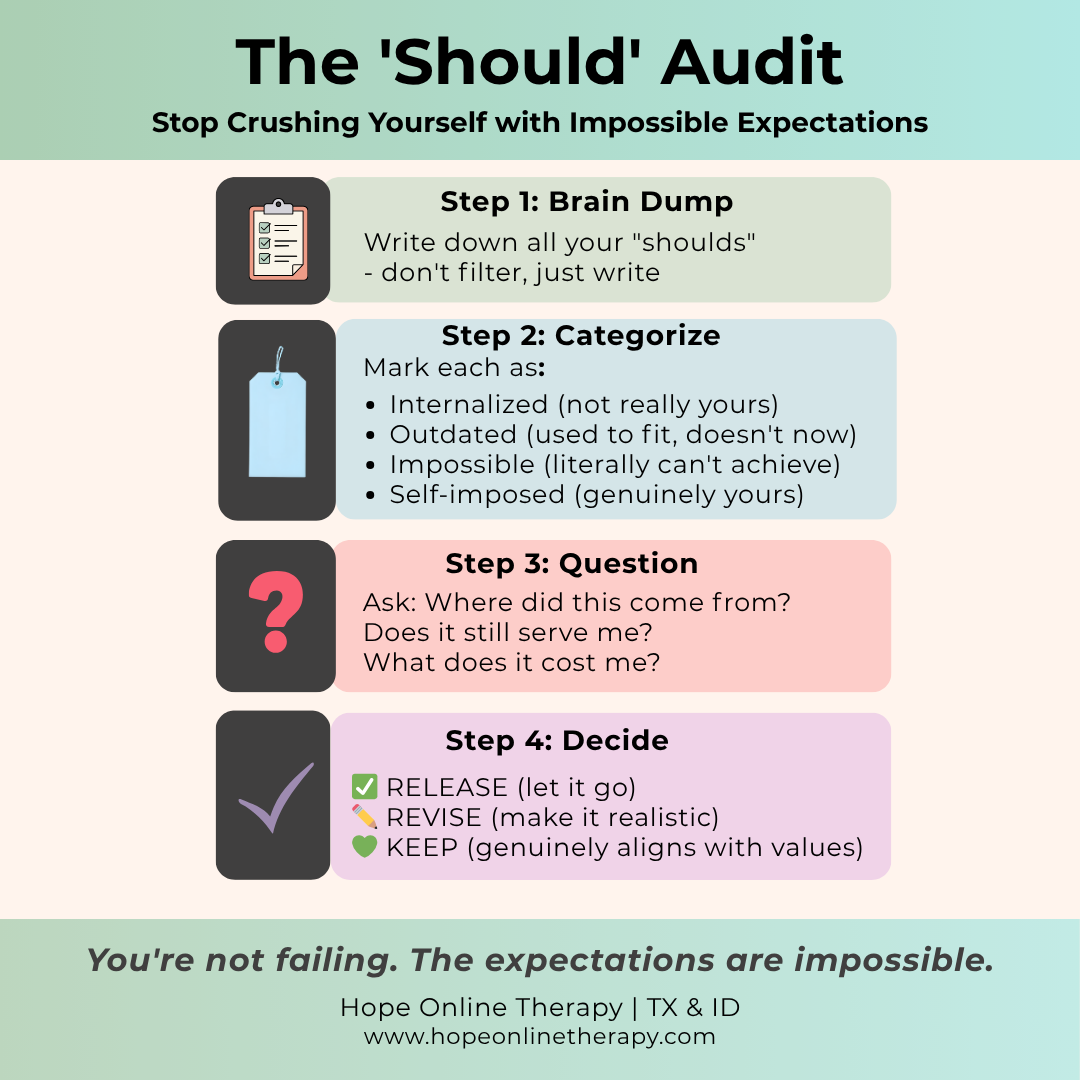
Step 1: Brain Dump All Your 'Shoulds'

Set a timer for 10 minutes. Write down every "should" that runs through your head. Don't filter. Don't judge. Just write.
Prompt yourself with these categories:
Work/Career:
I should _______________
My career should _______________
By now, I should _______________
Relationships:
I should be _______________
My partner should _______________
I should make my family _______________
Parenting (if applicable):
I should _______________
My kids should _______________
Good parents should _______________
Self-Care/Health:
I should _______________
My body should _______________
I should be able to _______________
Home/Life Admin:
My house should _______________
I should _______________
I should be better at _______________
Social:
I should _______________
Good friends should _______________
I should be more _______________
Write everything. The ridiculous ones, the impossible ones, the contradictory ones. All of it.
Step 2: Categorize Your 'Shoulds'
Now go through your list and mark each "should" with one of these labels:
Internalized (I): Expectation from family, society, or culture that you've absorbed Self-imposed (S): Something you genuinely believe matters to you Outdated (O): Something that was true at one point but no longer fits your life Impossible (X): Expectation that's literally not achievable Conflicting (C): Contradicts another should on your list
Most people discover that 70-80% of their shoulds are internalized (I) or outdated (O). These are the ones crushing you.
Step 3: Question Each 'Should'
For every should on your list, ask these questions:
Where did this come from? Who told you this was important? When did you start believing it?
Is this still true for me? Does this expectation align with who you actually are and what you actually value right now?
What does this cost me? What do you sacrifice to meet this expectation? Energy? Time? Joy? Authenticity?
What happens if I don't meet it? Real consequences or just guilt/shame?
If this expectation disappeared, what would I do differently? This question reveals what you actually want.
Step 4: Rewrite, Release, or Revise
Now comes the hard part. For each should, decide:
RELEASE: This expectation doesn't serve me. I'm letting it go.
Cross it out. Say out loud: "I'm releasing this expectation."
Replace with: "I get to choose _____________"
REVISE: This matters to me, but the standard is unrealistic.
Rewrite it as a more reasonable expectation
Example: "I should keep a perfect house" → "I value a home that feels comfortable and clean enough for my mental health"
KEEP: This genuinely aligns with my values and improves my life.
Reframe as a choice: "I choose to _____ because _____"
Example: "I should be honest" → "I choose to be honest because integrity matters to me"
Real Examples
Example 1: "I should love being a stay-at-home mom because I chose this."
Category: Internalized
Question: What does this cost? Constant guilt when I'm bored or frustrated. Feeling like a failure.
Decision: RELEASE. "I can be a great mom AND miss adult conversation and intellectual challenge. Both are true."
Example 2: "I should be able to handle stress without therapy because I'm a man."
Category: Internalized (gender expectation)
Cost: Suffering in silence. Relationships deteriorating. Anxiety getting worse.
Decision: RELEASE. "Strength is knowing when to get help, not suffering alone."
Example 3: "I should exercise 5 days a week like I used to."
Category: Outdated (from pre-kids, different job, younger body)
Cost: Guilt every day I don't work out. Starting and stopping programs repeatedly.
Decision: REVISE. "I move my body in ways that feel good 3 times a week. Some weeks that's yoga, some weeks it's a walk."
Example 4: "I should be making six figures by age 35."
Category: Self-imposed (but based on comparison)
Question: Is this still true for me? Honestly, I care more about work-life balance now.
Decision: RELEASE. "I choose a career that lets me be present for my family, even if it pays less."
What Happens After the Audit
Here's what my clients typically experience after doing this work:
Immediate relief: Just naming the expectations and seeing them on paper creates distance. You realize how many voices are in your head that aren't actually yours.
Grief: Some expectations were tied to an identity or future you thought you'd have. It's okay to mourn that.
Clarity: You start to see what you actually value versus what you think you should value.
Permission: You give yourself permission to want what you want, not what you're supposed to want.
Energy: When you stop pouring energy into impossible expectations, you have energy for things that actually matter.
But also—pushback: Your brain will resist. It's been using these shoulds as a map for how to be acceptable, lovable, and worthy. Without them, you might feel untethered at first.
This is normal. This is part of the process.

The ‘Shoulds’ Will Come Back
Here's the truth: You can't eliminate all shoulds forever. New ones will creep in. Old ones will resurface when you're stressed or around certain people.
The goal isn't to never have shoulds. The goal is to:
Notice them when they show up
Question whether they serve you
Choose consciously which ones to keep
Think of this as an ongoing practice, not a one-time fix.
Monthly check-in questions:
What new shoulds have shown up this month?
Which old shoulds am I slipping back into?
What's one should I could release right now?
When 'Shoulds' Become a Mental Health Issue
Sometimes, the weight of shoulds isn't just stressful, it's crushing. If your shoulds are driving:
Anxiety that's affecting your daily functioning
Depression from constantly feeling like you're failing
Panic attacks about not being enough
Perfectionism that's paralyzing you
Burnout from trying to meet impossible standards
You might need more than a self-audit. You might need professional support.
Therapy, specifically CBT and mindfulness-based approaches, can help you:
Identify core beliefs driving your shoulds
Challenge automatic thoughts
Develop self-compassion
Set boundaries based on your actual values
Process the grief of letting go of who you thought you should be
Permission Slips You Might Need
Sometimes you need someone to give you permission to let go. So here it is:
You have permission to:
Want something different than you wanted five years ago
Not have it all figured out
Prioritize your mental health over productivity
Disappoint people by setting boundaries
Rest without earning it
Be successful without sacrificing your wellbeing
Ask for help
Be good enough instead of perfect
Change your mind about what matters
Live according to your values, not someone else's
Start Small
Don't try to overhaul your entire life in one afternoon. That's just another should: "I should be able to fix this immediately."
Instead:
This week: Just do the brain dump. Write down your shoulds. See them.
Next week: Categorize them. Notice patterns.
Week three: Pick ONE should to release. Just one.
Week four: Notice what changes when that expectation loosens.
Small steps compound over time.
The Bottom Line
You are not failing. The expectations are impossible.
You are not weak for struggling. You're human trying to meet superhuman standards.
You are not broken for feeling exhausted. You're exhausted because you're carrying expectations that were never meant to be yours.
The 'Should' Audit isn't about lowering your standards or giving up on growth. It's about making sure the standards you're holding yourself to are actually yours, and actually achievable.
It's about reclaiming your energy from expectations that don't serve you so you can pour it into things that actually matter.
It's about the radical act of choosing yourself, your values, your version of a meaningful life.
Ready to Let Go?
If this resonates and you're realizing the weight of your shoulds is affecting your mental health, you don't have to carry this alone.
I work with high-functioning adults throughout Texas and Idaho who look successful on the outside but feel like they're drowning under impossible expectations. Using CBT, EMDR, and mindfulness-based therapy, we work together to:
Identify and challenge the beliefs driving your shoulds
Develop self-compassion instead of self-criticism
Create sustainable expectations based on your actual values
Release the guilt and shame that comes with not being "enough"
Virtual therapy means you don't have to add another should: "I should make time for in-person appointments." We meet wherever you are.
Book your free 15-minute consultation. Let's talk about which shoulds are crushing you and how to find relief.
You've been trying to meet impossible standards long enough. Maybe it's time to question the standards themselves.
Lori Lieb, MS, LCPC
Hope Online Therapy, LLC
Virtual CBT, EMDR, and Mindfulness Therapy
Serving Texas & Idaho
Related Posts You Might Find Helpful:
Disclaimer: This blog post is for informational purposes only and does not constitute medical advice. If you're experiencing a mental health crisis, please call 988 (Suicide & Crisis Lifeline) or go to your nearest emergency room.