Setting Boundaries Without Guilt: A Guide for Chronic People-Pleasers
You said yes when you wanted to say no. Again.
Now you're overcommitted, resentful, and exhausted, but you'll still show up with a smile because you don't want to let anyone down. You'll stay late, take on the extra project, host the dinner, listen to the friend who only calls when they need something, and swallow your own needs because someone else's seem more important.
And afterward, you'll feel that familiar mix of frustration and guilt. Frustrated that you keep doing this. Guilty for even feeling frustrated.
If this sounds like you, you're not selfish for wanting it to stop. You're not mean for wanting to say no. You're not a bad person for having limits.
You're a people-pleaser. And you're exhausted.
The good news? You can learn to set boundaries without guilt. It takes practice, and it's uncomfortable at first, but it is possible. And on the other side of that discomfort is something you might have forgotten you deserve: a life where your needs matter too.
What Is People-Pleasing, Really?
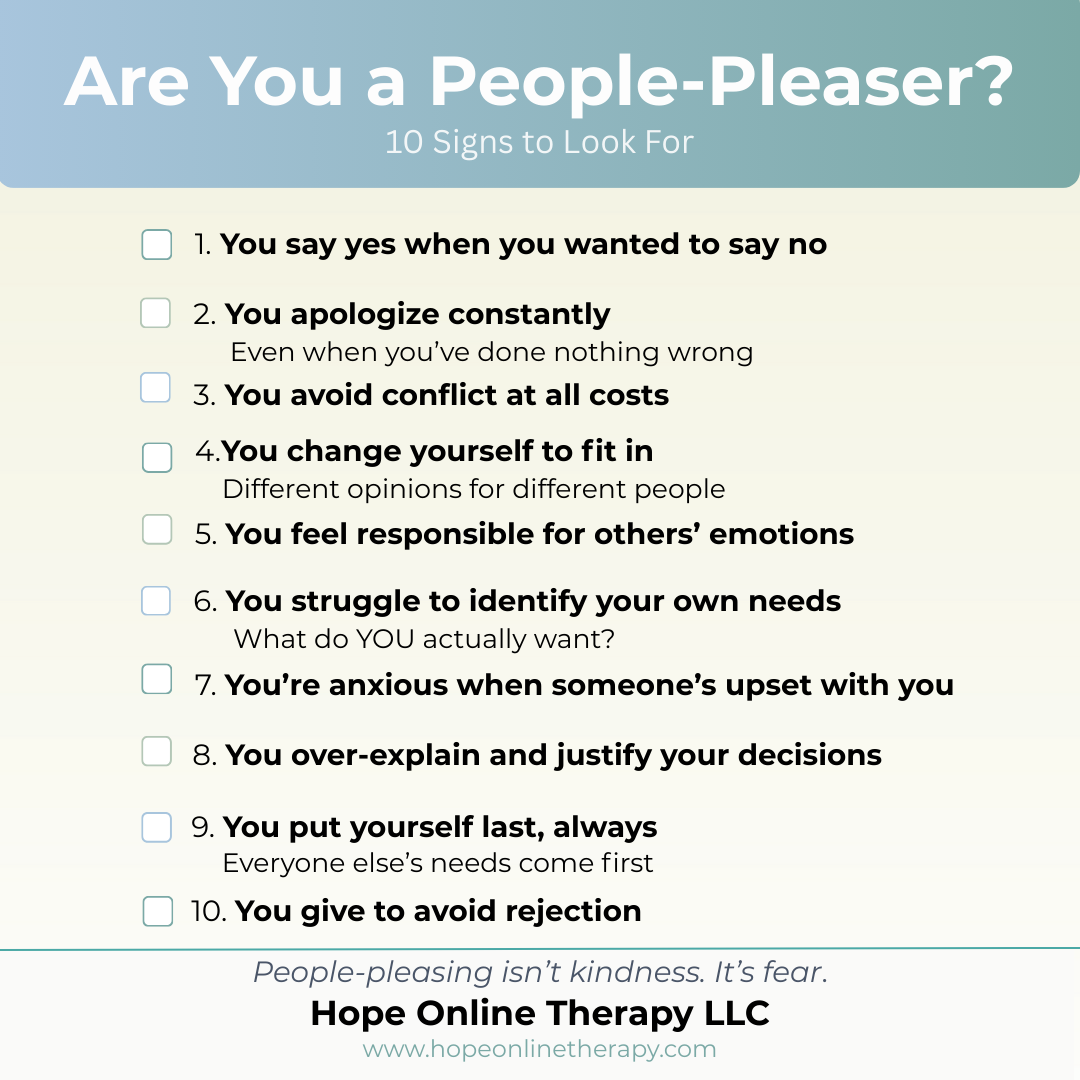
People-pleasing isn't just being nice. It's a pattern of prioritizing others' needs, feelings, and expectations over your own, often at significant cost to yourself.
It looks like:
Saying yes when you want to say no
Apologizing constantly, even when you've done nothing wrong
Avoiding conflict at all costs
Changing your opinions or preferences to match whoever you're with
Taking responsibility for other people's emotions
Feeling responsible for making everyone happy
Struggling to identify what you actually want or need
Feeling anxious when someone is upset with you
Over-explaining or justifying your decisions
Putting yourself last, always
People-pleasing often gets mistaken for kindness or generosity. But there's a key difference: kindness comes from a genuine desire to help. People-pleasing comes from fear: fear of rejection, conflict, abandonment, or being seen as difficult or selfish.
When you're kind, you give freely. When you're people-pleasing, you give to manage how others perceive you or to avoid negative consequences.
One feels like a choice. The other feels like survival.
Where Does People-Pleasing Come From?
You weren't born a people-pleaser. You learned it, usually in childhood, and usually because it kept you safe.
Childhood experiences that often create people-pleasers:
Inconsistent or conditional love. If affection from caregivers depended on your behavior, achievements, or being "good," you learned that love had to be earned. Being agreeable and anticipating others' needs became a strategy for maintaining connection.
Growing up with a parent who had mental health struggles, addiction, or volatile emotions. When a caregiver's mood was unpredictable, you may have learned to become hypervigilant at reading the room, managing emotions, and keeping the peace to stay safe.
Being parentified. If you were expected to take care of siblings, manage household responsibilities, or emotionally support a parent, you learned that your role was to give, not receive.
Experiencing criticism, ridicule, or punishment for having needs. If expressing your feelings, opinions, or needs was met with dismissal, anger, or shame, you learned that having needs was dangerous or wrong.
Witnessing conflict that felt threatening. If conflict in your home was explosive, scary, or led to emotional withdrawal, you may have learned to avoid disagreement at all costs.
Cultural or religious messages about selflessness. Many of us grew up with messages that putting yourself first is selfish, that good people sacrifice, and that your worth comes from what you give to others.
Gender expectations. Women and girls, in particular, are often socialized to be accommodating, nurturing, and agreeable. Boys learn to suppress emotions; girls learn to suppress needs. Both create problems, but people-pleasing tends to be especially prevalent among women.
Here's what's important to understand: people-pleasing was adaptive. It worked. It kept you connected, safe, loved, or at least, less at risk of rejection or harm.
But what worked in childhood often doesn't work in adulthood. The survival strategy becomes a prison. You're still performing, still managing, still abandoning yourself, but now, the stakes are different, and the cost is your own wellbeing.
The Hidden Costs of People-Pleasing
People-pleasing might seem harmless, even virtuous. But chronic self-abandonment has real consequences.
Resentment builds. When you consistently give more than you receive, resentment accumulates. You might not even recognize it at first, it shows up as irritability, passive-aggressive comments, or emotional withdrawal. You give and give, and part of you is keeping score, waiting for reciprocation that never comes.
You lose yourself. After years of molding yourself to others' preferences, you might not know who you actually are. What do you like? What do you want? What are your opinions? People-pleasers often struggle to answer these questions because they've spent so long focused on everyone else.
Relationships suffer. Ironically, people-pleasing often damages the relationships you're trying to protect. Others can sense inauthenticity, or they become accustomed to taking more than they give. Resentment leaks out. Intimacy suffers because you're never truly known, you're performing a version of yourself you think others want.
Burnout becomes chronic. You can't pour from an empty cup, but you keep trying. The exhaustion isn't just physical, it's emotional, mental, and spiritual. You're running on empty and wondering why you can't keep up.
Anxiety and depression increase. The constant vigilance, the fear of disappointing others, the suppression of your own needs, these take a toll on your mental health. Many people-pleasers struggle with anxiety, depression, or both.
Your boundaries erode until they disappear. If you never say no, people learn they can always ask. Your time, energy, and emotional resources become communal property. And every time you fail to protect your own limits, you teach yourself that you don't matter.
You attract people who take advantage. People-pleasers are magnets for those who are happy to take without giving. Not because you're weak, but because you've signaled that your needs are negotiable.
The cruelest irony: all this self-sacrifice doesn't even achieve its goal. You can't actually control how others feel about you. You can't guarantee love or prevent rejection by being agreeable enough. You're exhausting yourself for an outcome you can't control.

Understanding Boundaries
If you're a people-pleaser, the word "boundary" might make you uncomfortable. It might feel harsh, selfish, or mean.
Let's reframe that.
A boundary is not a wall. It's not about shutting people out, punishing them, or being cold. A boundary is simply a statement of what's okay and what's not okay for you.
A boundary is not about controlling others. You can't make someone do or not do something. A boundary is about communicating your limits and what you'll do if those limits aren't respected.
A boundary is an act of self-respect. It says: I matter. My time matters. My energy matters. My feelings matter. This is what I need to be okay.
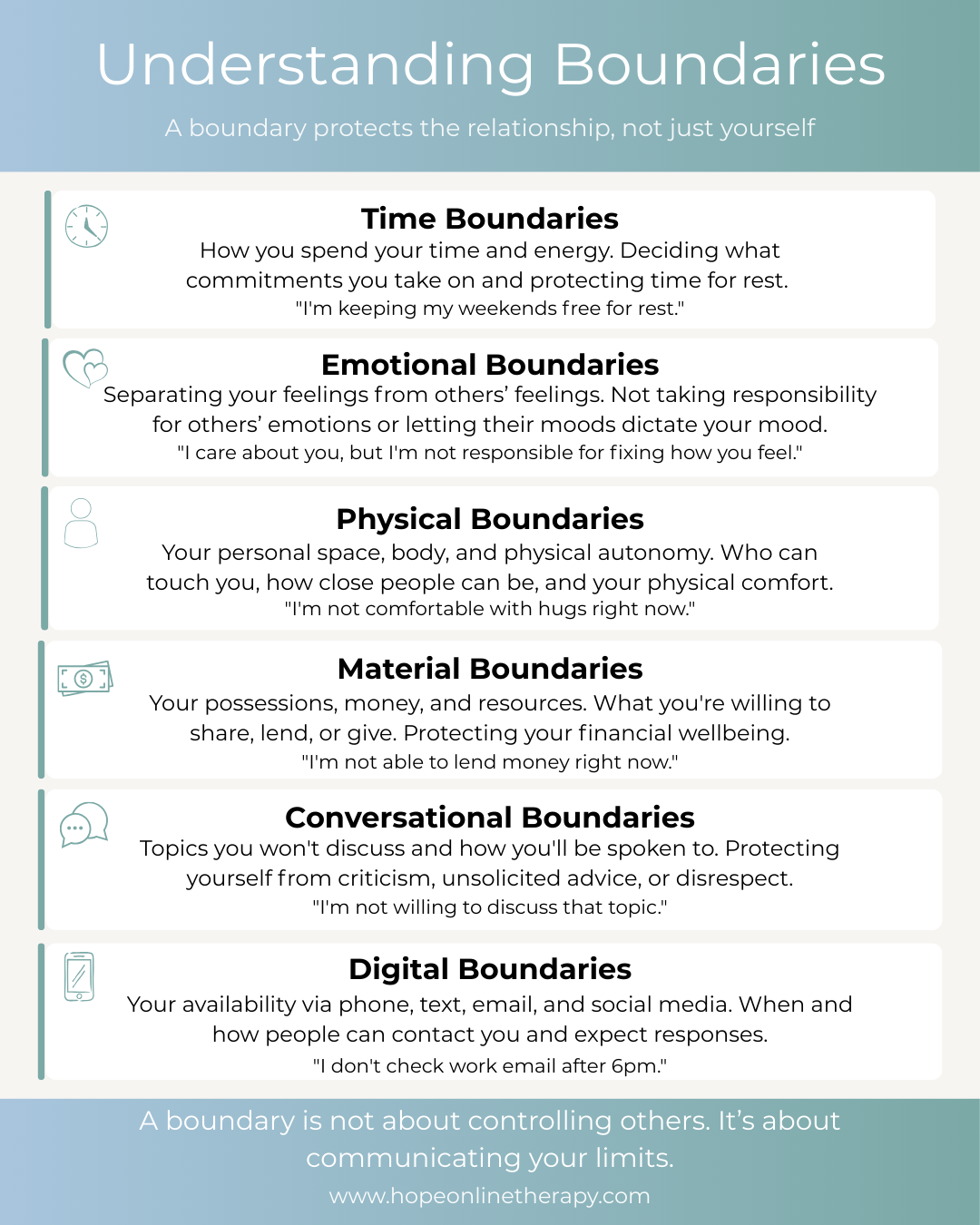
A boundary protects the relationship, not just yourself. When you set boundaries, you prevent resentment from building. You show up more genuinely. You give from desire rather than obligation. Paradoxically, boundaries often improve relationships rather than damage them.
Types of boundaries:
Time boundaries: How you spend your time and energy
Emotional boundaries: Separating your feelings from others' feelings; not taking responsibility for others' emotions
Physical boundaries: Your personal space and body
Material boundaries: Your possessions, money, resources
Conversational boundaries: Topics you won't discuss, ways you won't be spoken to
Digital boundaries: Availability via phone, text, email, social media
You already have boundaries, everyone does. The question is whether you're communicating them clearly and honoring them consistently.
Why Boundaries Feel So Hard (and Guilty)
If boundaries are healthy and reasonable, why does setting them feel so terrible?
Your nervous system interprets boundary setting as danger. If people-pleasing developed as a survival strategy, your brain learned that saying no = risk. Risk of rejection, conflict, abandonment. Even when you consciously know a boundary is reasonable, your body might respond with anxiety, panic, or dread.
Guilt is a learned response. Somewhere along the way, you learned that having needs is selfish and that prioritizing yourself is wrong. That guilt isn't evidence that you're doing something bad, it's evidence that you're doing something unfamiliar.
You're anticipating others' negative reactions. People-pleasers are often highly attuned to others' emotions. You can vividly imagine the disappointment, anger, or hurt your boundary might cause. That anticipated pain feels almost as real as actual pain.
Some people will react badly. Let's be honest: not everyone will respond well to your boundaries, especially if they've benefited from your lack of them. Some people will push back, guilt-trip, or get angry. This doesn't mean your boundary was wrong, it might mean the relationship was built on an unsustainable dynamic.
You've been taught that good people don't have limits. Cultural, religious, or family messages might have reinforced that selflessness is virtuous and that having needs makes you difficult. These messages are wrong, but they're deeply ingrained.
Here's the truth: guilt is not a reliable indicator of wrongdoing. If you've spent years suppressing your needs, you'll feel guilty when you start honoring them, not because honoring your needs is wrong, but because it's new.
How to Set Boundaries (Practical Scripts)
Knowing you need boundaries is one thing. Actually setting them is another. Here's how to do it, with words you can use today.
The Basic Formula
A boundary statement has three parts:
State the boundary clearly (what you need or won't accept)
Keep it brief (no over-explaining or justifying)
Hold it (follow through, even when uncomfortable)
You don't need to be harsh. You don't need to explain yourself. You can be warm and still be firm.
Boundary Scripts for Common Situations
Declining an invitation:
"Thanks for thinking of me, but I can't make it."
"I'm not available, but I hope you have a great time."
"That doesn't work for me, but thank you for the invite."
Saying no to a request:
"I'm not able to take that on right now."
"I don't have the capacity for that."
"I can't help with that, but I hope you find someone who can."
Limiting your time:
"I can chat for about 15 minutes."
"I can help until 3pm, then I have to go."
"I'm available for an hour, but I'll need to leave after that."
Ending a conversation:
"I need to wrap up now."
"I have to go, but let's talk soon."
"I'm going to head out. Take care."
Stopping unsolicited advice:
"I appreciate your concern, but I've got this handled."
"I'm not looking for advice right now—I just needed to vent."
"Thanks, but I'm going to figure this out my own way."
Addressing how you're spoken to:
"I'm not okay with being spoken to that way."
"I need you to lower your voice."
"If this continues, I'm going to step away."
Protecting your time and energy:
"I'm keeping my weekends free for rest."
"I'm not taking on any new commitments right now."
"I'm being more protective of my time these days."
Setting limits with family:
"I'm not willing to discuss that."
"I love you, and I'm not going to engage with this topic."
"Let's talk about something else."
At work:
"I can take this on, but I'll need to deprioritize [other task]. Which is more important?"
"My plate is full—I won't be able to add this right now."
"I'm happy to help, but not until next week."
Boundaries are especially hard during the holidays—read more about navigating holiday stress
What If They Push Back?
Sometimes people don't accept your boundary gracefully. They might guilt-trip, argue, or try to negotiate.
You don't have to defend your boundary. "No" is a complete sentence. You can repeat yourself calmly without adding more justification.
Broken record technique: Simply repeat your boundary in slightly different words.
Them: "But we really need you there!"
You: "I understand, and I'm not able to make it."
Them: "Can't you just come for a little while?"
You: "I'm not going to be able to come. I hope it's a great event."
Name the dynamic if needed:
"I've already given you my answer."
"I'm not going to change my mind on this."
"I can see you're disappointed, and my answer is still no."
You can acknowledge their feelings without abandoning your boundary:
"I know this isn't what you hoped to hear."
"I understand you're frustrated."
"This is hard, and I still need to hold this limit."
Working Through the Guilt
You've set a boundary. Now you feel terrible. Here's how to work through it.
Remind yourself: guilt ≠ wrongdoing. Feeling guilty doesn't mean you did something wrong. It means you did something unfamiliar. Your nervous system is responding to perceived danger, not actual harm.
Expect discomfort. Don't wait until boundary-setting feels comfortable to do it. It might never feel comfortable, at least not at first. Do it anyway. The discomfort lessens over time.
Check the evidence. Ask yourself: Did I do something harmful? Or did I simply prioritize my own legitimate need? Would I judge a friend for setting this same boundary?
Separate your feelings from their feelings. You are not responsible for managing others' disappointment. Adults are capable of handling being told no. If someone reacts badly to a reasonable boundary, that's information about them, not evidence that your boundary was wrong.
Practice self-compassion. Speak to yourself the way you'd speak to a friend. You're learning a new skill. You're going to feel awkward. That's okay.
Reframe the narrative. Instead of "I'm being selfish," try "I'm taking care of myself so I can show up better in my relationships." Instead of "They're going to be so upset," try "They're capable of handling disappointment."
Remember why you're doing this. You're setting boundaries so you can stop resenting people. So you can have authentic relationships. So you can be present instead of performing. So you can have energy left for the things and people that matter most.
The guilt will ease. Every boundary you set and survive teaches your nervous system that boundary-setting isn't dangerous. It gets easier, not immediately, but eventually.
What About the Relationships That Don't Survive Your Boundaries?
This is the hard truth: some relationships won't survive your boundaries. Some people are only in your life because you've had no limits. When you start having limits, those relationships may change or end.
This may feel like evidence that you shouldn't have set the boundary. It is not.
A relationship that only works when you abandon yourself isn't a healthy relationship. It's an arrangement where your self-sacrifice is the price of admission.
You deserve relationships where:
Your needs matter as much as theirs
You can be honest without fear
Love doesn't depend on your compliance
You're valued for who you are, not what you provide
Some people will adjust to your boundaries and the relationship will improve. Some people will resist at first and eventually accept the new dynamic. And some people will exit your life.
The ones who leave were taking more than they were giving. Their departure, while painful, creates space for relationships built on mutuality rather than self-abandonment.
People-Pleasing in Specific Relationships
At work: Professional people-pleasers often overwork, under-charge, accept tasks outside their role, and avoid advocating for themselves. Boundaries at work might include protecting your time outside work hours, pushing back on unreasonable requests, or asking for what you need (raises, resources, accommodations).
With family: Family relationships often have the deepest grooves of people-pleasing, these patterns were established first. Boundaries with family might include limiting visit duration, declining to discuss certain topics, or reducing contact with family members who consistently disrespect your limits.
In romantic relationships: People-pleasers often lose themselves in relationships, deferring to partners' preferences and suppressing their own needs to avoid conflict. Healthy romantic relationships require both partners to have, and respect, boundaries.
With friends: People-pleasing friendships can become one-sided, with you always giving and them always taking. Boundaries might include not being the constant emotional dumping ground, declining requests that don't work for you, or letting friendships fade that no longer serve you.
When People-Pleasing Is Trauma Related
For many people, chronic people-pleasing is a trauma response, specifically, the "fawn" response.
You've probably heard of fight, flight, and freeze. Fawn is the fourth trauma response: appeasing the source of threat to stay safe. Instead of fighting back, running away, or shutting down, fawning means becoming agreeable, helpful, and non-threatening.
If your people-pleasing feels compulsive, like you couldn't say no even if you wanted to, it may be worth exploring with a trauma-informed therapist. The goal isn't to just white-knuckle your way into better boundaries. It's to address the underlying nervous system patterns that make self-abandonment feel like the only safe option.
Healing from fawn trauma often involves:
Understanding where the pattern originated
Learning to recognize when you're fawning
Building tolerance for the discomfort of not appeasing
Developing a felt sense of safety in your body
Gradually practicing boundary-setting in safe relationships
This is deep work, and it takes time. But it's possible. You don't have to spend the rest of your life abandoning yourself to manage others' emotions.
Progress, Not Perfection
You're not going to become a boundary setting expert overnight. You're going to slip. You're going to say yes when you meant no. You're going to feel guilty even when you set a healthy boundary.
That's okay. This is a practice, not a destination.
Every time you…
Notice you're people-pleasing (even if you don't stop)
Pause before automatically saying yes
Set a small boundary in a low-stakes situation
Tolerate the discomfort of someone's disappointment
Choose your own need over someone else's preference
...you're rewiring patterns that took years to develop. Give yourself credit for trying. Give yourself grace when you falter.
You've spent a lifetime learning to put yourself last. Unlearning that takes time.
You're Not Selfish. You're Recovering.
If you've read this far, you already know something needs to change. You're tired of the resentment, the exhaustion, the feeling that everyone else's needs matter more than yours.
Setting boundaries isn't selfish. It's not mean. It's not abandoning the people you love.
It's recognizing that you are a person with needs, limits, and inherent worth, just like everyone else.
It's deciding that your wellbeing matters.
It's building relationships where you can be yourself, not just a performance of what you think others want.
You can be kind and have boundaries. You can love people and say no to them. You can care about others' feelings and not be responsible for managing them.
These things aren't contradictions. They're what healthy relationships actually look like.

When to Seek Support
If people-pleasing is significantly impacting your life, your mental health, your relationships, your sense of self, therapy can help.
A therapist can:
Help you understand where your people-pleasing patterns originated
Support you in processing the emotions that come up as you change
Provide a safe space to practice boundary-setting
Address underlying anxiety, trauma, or self-worth issues
Offer accountability as you make changes
Validate your experience without judgment
You don't have to do this alone. And asking for help isn't another form of people-pleasing, it's an investment in yourself.
You Deserve to Take Up Space
You've spent so long making yourself smaller, more convenient, less needy. You've bent and flexed and accommodated until you're not sure what shape you actually are.
You're allowed to take up space.
You're allowed to have needs.
You're allowed to disappoint people.
You're allowed to be imperfect and still be loved.
The people who are meant to be in your life will stay, even when you stop performing. Even when you say no. Even when you choose yourself.
And the ones who leave? They were benefiting from your self-abandonment. You don't need relationships that cost you yourself.
It gets easier. The guilt fades. The discomfort lessens. And on the other side of all those hard boundaries is something you deserve: a life where you matter too.
Need Support in Setting Boundaries?
If people-pleasing, guilt, and boundary struggles are affecting your mental health and relationships, therapy can help.
I work with adults in Texas and Idaho who are ready to stop abandoning themselves, learning to set boundaries, manage guilt, and build relationships where their needs matter too.
Virtual therapy means you can start this work from the comfort of home, on a schedule that works for you.
Schedule a Free Consultation – Let's talk about how therapy can support you in this journey.
You've spent enough time putting yourself last. It's okay to start choosing yourself.