
You’ve been thinking about therapy for a while. Maybe the anxiety has gotten louder, a life change has knocked you off balance, or you’re simply tired of carrying everything alone.
But the first appointment can feel like a big unknown, especially when it happens through a screen. What will they ask? Do I have to share everything right away? What if the technology doesn’t work? What if I don’t know what to say?
These are some of the most common questions people have before a first session, and none of them mean you’re doing anything wrong. Let’s walk through what actually happens, so the first step feels a little less uncertain.
Why Many Texans Choose Online Therapy
Texas is big. Between long commutes, packed schedules, and limited options in some areas, getting to an in-person office can be a real barrier to getting support.
Online therapy removes much of that friction. Whether you’re in Houston, Dallas, Austin, San Antonio, or a small town far from the nearest therapist, you can meet from home, from a private space you choose, without the drive.
Many people find that online therapy offers:
No commute or time spent in a waiting room
The comfort of being in your own space
Easier scheduling around work, kids, or caregiving
More choice in who you work with, rather than only who is nearby
Online therapy isn’t the right fit for every situation, but for many people working through anxiety, stress, life transitions, or relationship concerns, it’s a practical way to get consistent support.
Before Your First Session
A little preparation goes a long way toward making your first appointment feel smooth.
Complete your intake paperwork. The intake forms typically take about 10 to 30 minutes to complete. They cover basics like your contact information, health history, and what brings you to therapy. Having this done ahead of time means your session can focus on talking, not forms.
Have your insurance information handy. If you plan to use insurance, upload your card so we can verify your coverage. (More on insurance below.)
Find a private, comfortable space. Choose somewhere you can speak openly without being overheard. A bedroom, a parked car, or a quiet corner of the house all work. Headphones can add a layer of privacy.
Check your technology. Make sure your device is charged, your internet connection is stable, and you know how to access the secure telehealth platform (TherapyAppointment). Logging in a few minutes early leaves time to sort out any hiccups.
Be physically located in Texas. Because of licensing requirements, you need to be physically in Texas during your session. If you’re traveling outside the state, check with your therapist before scheduling.
What Happens in the First Session
Sessions run about 53 to 55 minutes. Here’s the general flow of a first appointment:
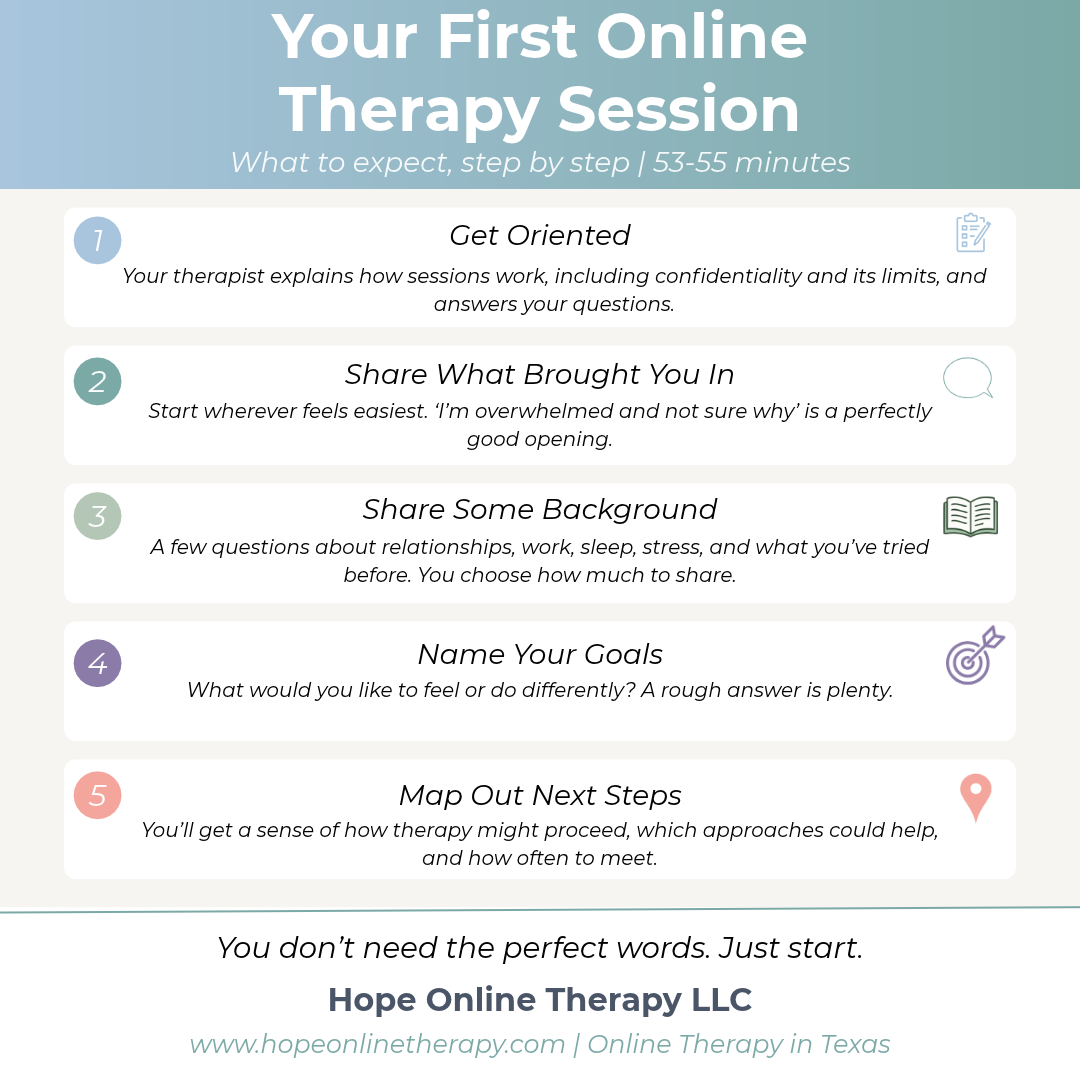
1. Getting oriented. Your therapist will explain how sessions work, including confidentiality and its limits, and answer any questions you have.
2. Talking about what brought you in. You’ll be invited to share what’s been going on, such as stress, anxiety, a transition, relationship difficulties, or something you can’t quite name yet. You don’t need a polished explanation. “I just feel overwhelmed” is a perfectly good starting point.
3. Some background. Your therapist may ask about your history, relationships, work, sleep, and what you’ve tried before. You choose how much to share and when.
4. Talking about goals. What would you like to feel or do differently? Even a rough answer helps shape the work.
5. Planning next steps. By the end, you’ll usually have a sense of how therapy might proceed, what approaches could help (such as CBT, which we cover in our post on cognitive distortions and how CBT helps), and how often to meet.
You are in control of the pace. You don’t have to share every painful detail in the first session, and you don’t have to talk about anything you’re not ready to. A good therapist will move at a speed that feels safe for you.
Common First-Session Worries (and Why They’re Okay)

“What if I cry?” That’s completely normal and nothing to apologize for. Therapy is a space where emotions are welcome.
“What if I don’t know what to say?” You don’t have to arrive with a plan. Your therapist will guide the conversation with questions.
“What if it’s awkward over video?” Many people feel a little self-conscious at first, and most find that it fades within the first few minutes as the conversation gets going.
“What if we’re not a good fit?” The first session is also your chance to see how it feels to work with this person. A good fit matters, and it’s perfectly fine to decide it isn’t right and look elsewhere.
“What if the technology glitches?” Tech hiccups happen and are usually quick to fix. Logging in a few minutes early helps.
A Quick Note About Insurance
I accept several major insurance plans such as Aetna, BCBS, United, and Curative. Benefits vary by plan, so please verify your mental health coverage before booking. It helps to ask your insurance company about your copay, your deductible, and whether telehealth sessions are covered.
What Online Therapy Is Not For
Online therapy is a good fit for many concerns, but it isn’t designed for emergencies. If you’re in crisis, thinking about harming yourself, or in immediate danger, please call or text 988 (the Suicide & Crisis Lifeline) or call 911.
Frequently Asked Questions
Do I need to be in Texas for online therapy? Yes. You need to be physically located in Texas during your session.
How long is a session? Sessions are about 53 to 55 minutes.
How long does the intake paperwork take? Typically 10 to 30 minutes.
Is online therapy confidential? Therapists are bound by confidentiality laws and ethics, with limited exceptions related to safety. Your therapist will explain how confidentiality works.
Can I use insurance? I accept Aetna, BCBS, United, and Curative. Benefits vary, so verify your coverage before booking.
Taking the First Step
Reaching out for therapy can feel like a big move, but you don’t have to have everything figured out. You don’t need the perfect words, a clear diagnosis, or a crisis to justify getting support.
You just need to be willing to start the conversation.
Ready to Get Started?
If you’re in Texas and thinking about online therapy, I’d love to talk. I work with adults in Texas and Idaho on anxiety, stress, life transitions, and the pressures of parenting and caregiving, in a warm, practical, and collaborative way.
Schedule a Free Consultation – Let’s talk about what you’re going through and whether we’re a good fit.
You don’t have to figure it out alone.