
You’ve been meaning to reach out to a therapist for a while now. Maybe stress has been piling up, a life change has thrown you off balance, or you’re a parent or caregiver who has spent so long taking care of everyone else that you’ve lost track of yourself.
And then there’s the practical side: finding someone, fitting an appointment into a packed week, maybe driving a long way to get there. For a lot of people in Idaho, those logistics are enough to keep “I should really call someone” on the back burner for months.
Online therapy changes that equation. It can also feel unfamiliar, so let’s walk through exactly what your first virtual session looks like, from paperwork to the final five minutes, so you know what you’re stepping into.
Why Online Therapy Works Well for Many Idahoans
Idaho is a spread-out state. Population centers like Boise, Meridian, Nampa, Idaho Falls, Coeur d’Alene, Twin Falls, and Pocatello have more options, but plenty of people live in smaller towns or rural areas where the nearest therapist may be a long drive away. Add winter road conditions and busy family schedules, and getting to an in-person appointment can be a real hurdle.
Online therapy can help by:
Cutting out travel time, especially in winter
Letting you attend from home or another private space you choose
Making it easier to fit sessions around work, kids, or caregiving responsibilities
Opening up your choice of therapist beyond whoever happens to be nearby
It isn’t the right fit for every situation, but for many people working through anxiety, stress, life transitions, or relationship concerns, it makes consistent support far more realistic.
Before Your First Session
A few simple steps make your first appointment smoother.
Finish the intake paperwork. The forms typically take about 10 to 30 minutes. They cover your contact details, health history, and what’s bringing you to therapy. Completing them ahead of time means your session time goes toward actually talking.
Test your connection, especially if you’re in a rural area. Idaho’s mountains and open country can mean uneven internet. Pick the spot in your home with the strongest signal, make sure your device is charged, and log in a few minutes early so there’s time to fix any hiccups. The sessions take place through a secure telehealth platform (TherapyAppointment).
Find a private space. Choose somewhere you can speak freely. If privacy at home is tricky, a parked car or a quiet room with headphones can work.
Double-check your time zone. Idaho spans two time zones. Most of the state is on Mountain time, but the northern panhandle is on Pacific time. When you schedule, confirm the time zone shown so you show up at the right hour.
Be physically in Idaho during your session. Because of licensing requirements, you need to be located in Idaho when we meet. If you’re traveling outside the state, check with me before scheduling.
Upload your insurance information if you plan to use it. (More on that below.)
What Happens in the First Session
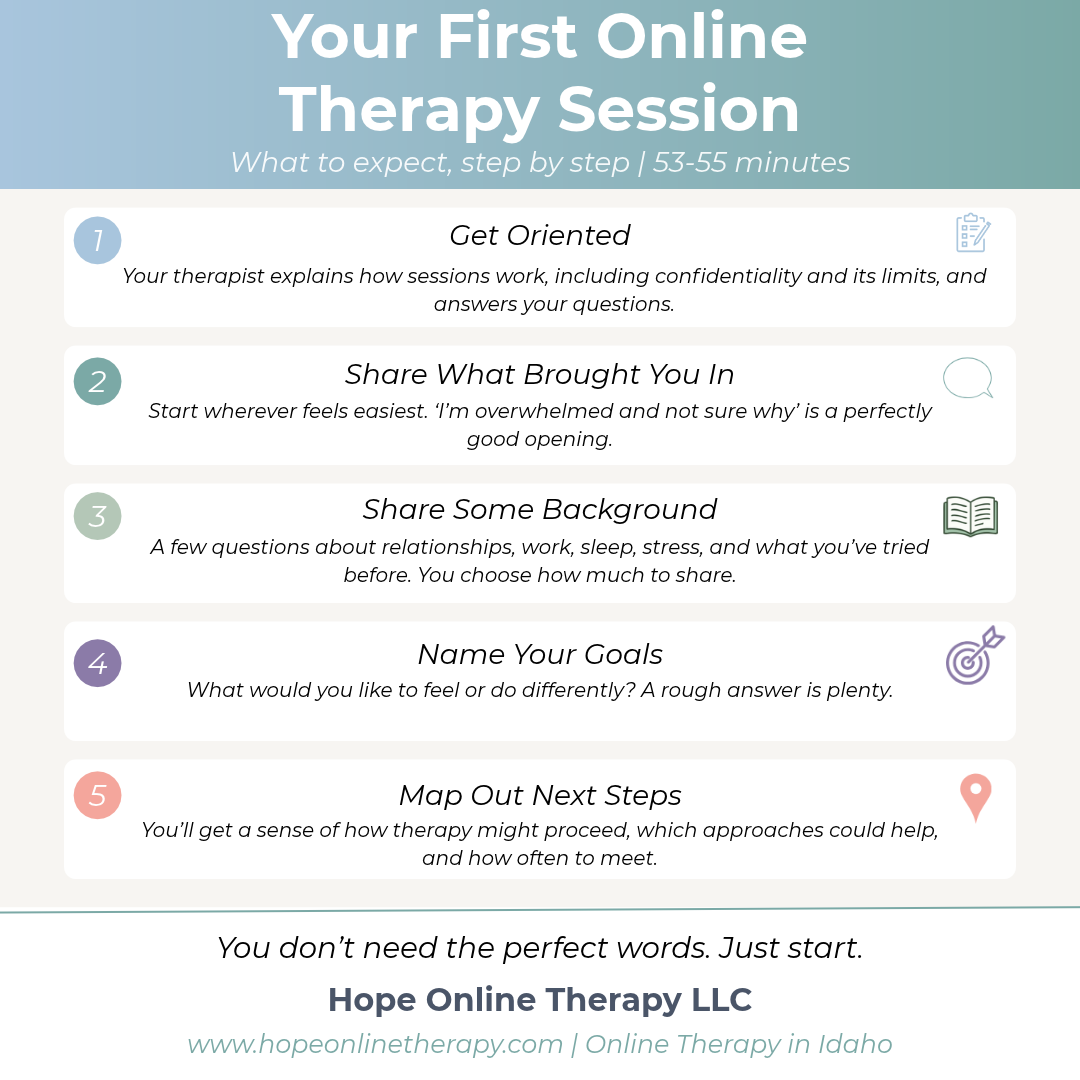
Sessions run about 53 to 55 minutes. A first session typically follows this rhythm:
Getting oriented. We’ll go over how sessions work, how confidentiality works (including its limits), and any questions you have.
Talking about what brought you in. You can start wherever feels easiest. “I’m exhausted and I don’t know why” is a perfectly good opening.
Sharing some background. I may ask about your relationships, work, sleep, stress, and what you’ve tried before. You decide how much to share and when.
Naming your goals. What would you like to feel or do differently? A rough answer is plenty.
Mapping out next steps. By the end, you’ll have a sense of how we might work together, which approaches could help (such as CBT, which we explain in our post on cognitive distortions and how CBT helps), and how often to meet.
You set the pace. Nobody expects you to unload your whole history in the first hour. You never have to go into anything you’re not ready to discuss.
First-Session Worries, Answered
“I don’t even know where to start.” That’s okay, and very common. Starting with “I’m not sure where to begin” works.
“What if I get emotional?” Tears, silence, and frustration are all welcome. Therapy is built for exactly that.
“Will it feel weird talking through a screen?” Many people feel a little self-conscious at the start, and for most it fades quickly once the conversation begins.
“What if we aren’t a good match?” The first session works both ways. You’re also getting a sense of whether this feels right. A good fit matters, and it’s fine to look elsewhere if it doesn’t.
“What if I’m a parent or caregiver and can’t find the time?” This is one of the biggest reasons people postpone therapy. Meeting from home can remove travel time, which may make it easier to protect an hour for yourself.
A Quick Note About Insurance
I accept BCBS, United, Regence, Aetna and Curative. Benefits and network participation can vary by plan and by state, so please verify your mental health coverage before booking. It helps to ask your insurer about your copay, your deductible, and whether telehealth sessions are covered.
What Online Therapy Isn’t For
Online therapy isn’t meant for emergencies. If you’re in crisis, thinking about harming yourself, or in immediate danger, please call or text 988 (the Suicide & Crisis Lifeline) or call 911.
Frequently Asked Questions
Do I need to be in Idaho for online therapy? Yes. You need to be physically located in Idaho during your session.
How long is a session? About 53 to 55 minutes.
How long does the intake paperwork take? Typically 10 to 30 minutes.
What if my internet is unreliable? Choose the spot in your home with the strongest signal, charge your device, and log in a few minutes early. If connection trouble is a recurring concern, mention it when you reach out. A really poor connection may make finding an in person therapist a better option.
Which time zone are appointments in? Idaho spans Mountain and Pacific time, so confirm the time zone shown when you schedule.
Can I use insurance? I accept several major plans. Benefits vary, so verify your coverage before booking.
You Don’t Need to Have It All Figured Out

You don’t need a crisis, a diagnosis, or the perfect words to start therapy. You just need to be willing to reach out.
Taking that first step is often the hardest part, and after it, the rest tends to feel a lot more manageable.
Ready to Get Started?
If you’re in Idaho and thinking about online therapy, I’d love to hear from you. I work with adults in Idaho and Texas on anxiety, stress, life transitions, trauma, and the demands of parenting and caregiving, in a warm, practical, and collaborative way.
Schedule a Free Consultation – Let’s talk about what you’re going through and whether we’re a good fit.
You don’t have to figure it out alone.